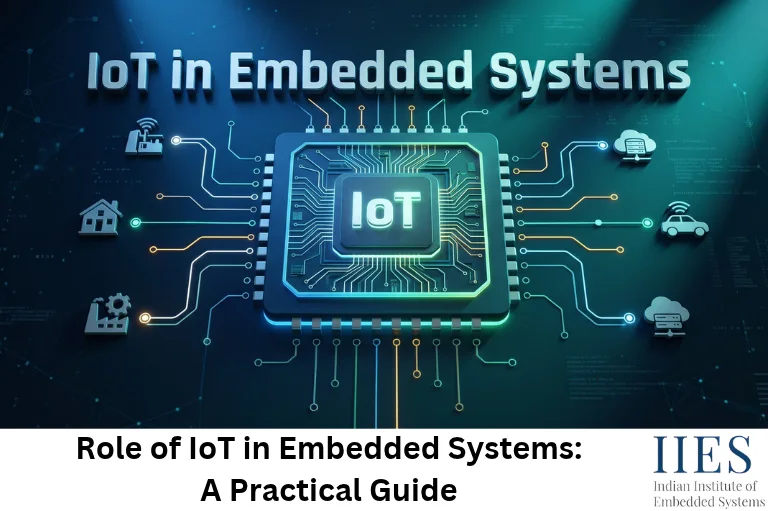
Why Is IoT Important in Embedded Systems?
Traditional embedded systems are designed to perform specific operations within electronic products. Their processing and control functions usually operate locally, without requiring continuous communication with external systems.
IoT extends these capabilities by introducing connectivity and access to information beyond the individual device.
The importance of IoT in embedded systems can be understood through the following engineering applications.
1. Remote Monitoring
Connected devices can transmit information about their operating conditions to remote dashboards. Engineers can monitor temperature, pressure, motor speed, battery status, and other parameters without physically accessing every device.
For example, an industrial monitoring controller can send vibration measurements to a central monitoring system. Maintenance teams can review the collected data and investigate abnormal operating patterns.
2. Intelligent Automation
An IoT-enabled embedded system can exchange information with other devices and use configured rules to perform automated operations.
In smart irrigation, a controller can read soil moisture measurements and activate a water pump when the moisture level falls below a configured threshold. A remote application can also display the system status and allow authorized users to adjust irrigation settings.
The local controller should remain responsible for essential control operations instead of depending entirely on an internet connection.
3. Data Collection and Analysis
IoT devices generate operational data over time. This information can be stored and analyzed to identify trends, equipment abnormalities, energy consumption patterns, and maintenance requirements.
For example, a manufacturing plant can compare motor vibration and temperature readings across multiple operating cycles to investigate possible mechanical problems.
4. Remote Configuration and Updates
Connected embedded products can receive authorized configuration changes and firmware updates through supported network interfaces.
This reduces the need for technicians to physically access every installed device. However, remote updates must include authentication, integrity verification, and recovery mechanisms.
5. Communication Between Devices
IoT allows multiple embedded devices to exchange information through suitable communication protocols and network infrastructure.
For example, environmental sensors can transmit measurements to a gateway, which forwards relevant information to a central monitoring platform.
This communication enables systems to operate as part of a larger connected environment rather than as isolated electronic products.

Core Concepts of Embedded IoT
Understanding the relationship between embedded systems and IoT requires knowledge of several hardware and software components.
1. Embedded Systems
An embedded system is a dedicated computing system designed to perform specific functions within a larger electronic or mechanical product.
It typically includes a microcontroller or microprocessor, memory, input and output interfaces, and application firmware.
Common examples include:
- Washing machine controllers
- Automotive electronic control units
- Digital meters
- Medical monitoring equipment
- Industrial motor controllers
- Smart home devices
2. Internet of Things
IoT refers to a network of physical devices that communicate and exchange information through suitable networking technologies.
An IoT system may contain sensors, embedded controllers, communication modules, gateways, cloud services, databases, and user applications.
IoT is not limited to internet access. Devices may also communicate through local networks or gateways before reaching an internet-connected platform.
3. Microcontrollers and Microprocessors
Microcontrollers such as STM32, ESP32, AVR, PIC, and NXP MCUs perform local processing in many IoT products.
A microcontroller can:
- Read sensor signals.
- Process digital and analog data.
- Execute control algorithms.
- Communicate through UART, SPI, I2C, CAN, or other interfaces.
- Manage network communication through integrated or external connectivity hardware.
Microprocessors running embedded Linux are commonly used when an application needs more processing capacity, memory, networking services, or complex software components.
4. Sensors and Actuators
Sensors collect information from the physical environment. Examples include temperature sensors, humidity sensors, accelerometers, pressure sensors, gas sensors, and proximity sensors.
Actuators convert electrical control signals into physical actions. Motors, relays, solenoid valves, and electronic switches are common examples.
The embedded controller processes sensor information and determines the appropriate actuator response.
5. Communication Protocols
Communication protocols define how devices exchange information.
Common technologies used in embedded IoT include:
- MQTT for lightweight publish/subscribe messaging.
- HTTP and HTTPS for communication with web services and APIs.
- Wi-Fi for network connectivity.
- Bluetooth Low Energy for short-range, low-power communication.
- LoRaWAN for low-power wide-area networking.
- Cellular IoT for communication through mobile networks.
- UART, SPI, I2C, and CAN for communication between embedded components and subsystems.
These technologies serve different purposes. For example, I2C may connect a sensor to a microcontroller, while MQTT carries processed sensor data between the device and an IoT platform.
6. Edge Computing
Edge computing means processing information close to where it is generated instead of transferring every operation to a remote cloud server.
An embedded controller can filter sensor readings, identify threshold violations, calculate averages, and perform immediate control decisions locally.
This reduces unnecessary communication and allows essential functions to continue during network interruptions.
7. Cloud Platforms and Gateways
A gateway connects local devices or networks to broader communication infrastructure. It may perform protocol conversion, data aggregation, authentication, and local processing.
Cloud platforms provide remote services such as device management, data storage, dashboards, analytics, and application integration.
Not every IoT device communicates directly with a cloud server. Some products communicate through gateways or local infrastructure.
How IoT Works in Embedded Systems
IoT-enabled embedded systems typically follow a sequence of sensing, processing, communication, and response.
The working process can be divided into eight stages.
Step 1: Data Collection
Sensors measure physical parameters such as temperature, humidity, pressure, vibration, or light intensity.
Step 2: Signal Acquisition
The microcontroller receives sensor data through ADC channels or digital interfaces such as I2C, SPI, and UART.
Step 3: Local Processing
Firmware validates the readings, removes unwanted noise where appropriate, applies calibration, and calculates useful values.
Step 4: Decision-Making
The embedded controller compares the processed information against configured thresholds or control algorithms.
Step 5: Network Communication
A communication module or integrated connectivity peripheral transmits selected information using a suitable protocol.
Step 6: Data Processing at the Platform
The IoT platform receives device messages and stores, analyzes, or routes the information to other services.
Step 7: Remote Monitoring or Control
Users and authorized applications can view device status, receive alerts, and send supported configuration commands.
Step 8: Local Action
The embedded controller processes authorized commands and controls the relevant hardware. Safety-critical control decisions should remain local whenever remote network latency or availability cannot be guaranteed.
For example, an industrial temperature controller should be capable of activating its local cooling response even when its internet connection is unavailable.
Architecture of an IoT-Enabled Embedded System
An IoT-enabled embedded architecture contains multiple layers that work together to connect physical devices with remote applications.
Main Architecture Layers
1. Physical Layer
This layer contains sensors, actuators, signal-conditioning circuits, power supplies, and electronic interfaces.
The accuracy and reliability of the complete system depend partly on correct sensor selection, electrical design, calibration, and protection against environmental interference.
2. Embedded Processing Layer
The microcontroller or microprocessor executes firmware and processes collected information.
It handles ADC conversion, peripheral communication, data filtering, threshold comparison, actuator control, and other application-specific operations.
3. Connectivity Layer
This layer transfers information through Wi-Fi, Bluetooth Low Energy, Ethernet, cellular communication, or low-power wide-area networks.
The connectivity method depends on application requirements such as communication range, energy consumption, data rate, network coverage, and cost.
4. Gateway and Network Layer
A gateway may aggregate data from multiple devices and provide protocol conversion or secure communication with remote systems.
This layer is particularly useful when embedded devices use local communication methods that are different from the network used by the cloud platform.
5. Cloud and Application Layer
The cloud platform receives device data, manages connections, processes information, and stores relevant records.
Web applications and mobile applications display the information and allow authorized users to interact with the connected devices.
Embedded IoT Architecture Flow
Sensor → Signal Conditioning → Microcontroller → Local Processing → Communication Module → Gateway / Internet → IoT Platform → Database / Analytics → Dashboard
The control path can operate in the opposite direction:
User Application → IoT Platform → Network → Embedded Controller → Actuator
The two paths should be designed separately. Sending telemetry and receiving a control command have different reliability, authentication, and safety requirements.
Key Features and Roles of IoT in Embedded Systems
IoT contributes several capabilities to embedded product development.
| Feature | Role in an embedded application |
| Remote monitoring | Sends device measurements and operating status to remote platforms. |
| Data acquisition | Collects sensor and equipment information for analysis. |
| Remote configuration | Allows authorized users to change supported operating parameters. |
| Device communication | Connects individual controllers to gateways and other systems. |
| Event notifications | Reports faults, threshold violations, and abnormal operating conditions. |
| Data analytics | Helps identify patterns and equipment performance trends. |
| Firmware updates | Supports authorized remote software maintenance. |
| Edge processing | Makes local decisions without requiring every operation to reach the cloud. |
An important design consideration is that these features should not interfere with the embedded system’s primary function. Network communication must not introduce unpredictable delays into time-critical operations.
Types of IoT Connectivity Used in Embedded Systems
Different IoT applications require different communication methods. Engineers should select a connectivity technology based on the actual operating environment rather than simply choosing the most familiar option.
| Connectivity technology | Typical application | Main engineering consideration |
| Wi-Fi | Smart appliances, monitoring equipment, connected controllers | Higher data capacity, but power consumption and network availability must be considered. |
| Bluetooth Low Energy | Wearables, sensors, mobile-device communication | Suitable for low-power, short-range device communication. |
| Ethernet | Industrial controllers, gateways, fixed monitoring equipment | Reliable wired connectivity with appropriate network design. |
| LoRaWAN | Smart agriculture, environmental monitoring, remote meters | Designed for low-power, wide-area communication with relatively small messages. |
| Cellular IoT | Remote monitoring, asset tracking, connected equipment | Provides mobile-network connectivity but requires coverage and subscription planning. |
| Zigbee or Thread | Smart home devices and local mesh networks | Requires compatible network infrastructure and appropriate device roles. |
The communication technology should be selected after considering the device’s operating environment, battery capacity, expected message size, required response time, security requirements, and overall lifecycle cost.
MQTT and Its Role in IoT
MQTT (Message Queuing Telemetry Transport) is a lightweight publish/subscribe messaging protocol designed for communication in constrained environments and IoT applications.
It uses a client-server model in which an MQTT broker manages message distribution.
For example, an embedded temperature monitor can publish data to:
factory/line1/motor01/temperature
A dashboard application subscribed to the same topic can receive the published readings without the embedded device needing to know how the dashboard is implemented.
Important MQTT concepts include:
- Publisher: The client that sends a message.
- Subscriber: The client that receives messages from subscribed topics.
- Broker: The server that manages message distribution.
- Topic: The message routing name used by publishers and subscribers.
- QoS: Quality of Service, which defines message delivery guarantees.
MQTT defines three QoS levels:
- QoS 0: At most once delivery.
- QoS 1: At least once delivery.
- QoS 2: Exactly once delivery under the protocol’s delivery rules.
Selecting a QoS level involves trade-offs in message delivery behavior, processing, and network overhead. MQTT does not automatically make an application safe or secure; authentication, authorization, TLS, and application-level validation are separate design responsibilities.
Advantages of IoT in Embedded Systems
1. Remote Accessibility
Engineers and operators can monitor supported device information without being physically present at the installation site.
2. Improved Operational Visibility
Continuous or periodic data collection makes it easier to identify equipment behavior, operating trends, and abnormal conditions.
3. Better Maintenance Planning
Historical sensor measurements can help maintenance teams investigate developing faults and plan inspections.
4. Intelligent Automation
Embedded controllers can combine local processing with information received from connected systems to support more flexible automation.
5. Scalable Device Management
A suitable IoT platform can manage configuration, status, software versions, and telemetry from multiple deployed devices.
6. Resource Optimization
Applications can use measured information to optimize energy consumption, water usage, machine operating schedules, and other resources.
Limitations and Engineering Challenges
IoT introduces additional design responsibilities that do not necessarily exist in standalone embedded products.
1. Cybersecurity Risks
Network-connected products face risks involving unauthorized access, exposed credentials, insecure communication, and vulnerable firmware.
Engineering approach: Use device identity, authentication, encrypted communication, access restrictions, secure update mechanisms, and a defined vulnerability-management process.
2. Network Dependency
Remote monitoring and cloud-based services may become unavailable when the network connection fails.
Engineering approach: Keep essential control functions local. Use timeouts, reconnection logic, buffering, and clearly defined offline operating modes.
3. Power Consumption
Wireless transmission, network scanning, and maintaining connections can consume significant energy in battery-operated devices.
Engineering approach: Use appropriate sleep modes, scheduled wake-up intervals, data batching, and low-power communication technologies.
4. Memory and Processing Constraints
Encryption, network stacks, protocol libraries, and application buffers consume RAM and Flash.
Engineering approach: Measure stack usage, heap consumption, packet sizes, and processing time on the actual target hardware.
5. Data Management
Large deployments can produce substantial amounts of telemetry. Poor sampling and unnecessary transmission can increase storage and communication costs.
Engineering approach: Apply filtering, aggregation, event-based reporting, suitable retention policies, and data validation.
6. System Complexity
IoT products combine electronics, firmware, networking, cloud infrastructure, and application software.
Engineering approach: Separate the sensing, control, communication, and application layers. Test each subsystem individually before integrating the complete product.

Real-World Applications of IoT in Embedded Systems
1. Industrial Automation
Industrial IoT combines embedded controllers, sensors, communication networks, and monitoring platforms to improve the visibility of manufacturing operations.
A vibration monitoring unit can collect motor data and transmit measurements to an industrial gateway. Monitoring software can compare operating trends and help engineers investigate possible equipment faults.
Embedded technologies: STM32, ARM Cortex-M, industrial sensors, CAN, RS-485, Ethernet, MQTT, and embedded Linux gateways.
2. Smart Agriculture
IoT-enabled irrigation systems use soil moisture, temperature, humidity, and other sensor readings to support agricultural decisions.
A microcontroller processes the measurements and controls a pump or valve according to predefined conditions. Farmers can access system status and measurements remotely.
Embedded technologies: ESP32, STM32, ADC, GPIO, Wi-Fi, LoRaWAN, and low-power sensor nodes.
3. Healthcare Equipment
Connected healthcare equipment can transmit selected measurements to authorized monitoring systems.
A wearable device may collect movement or physiological sensor data and transfer the information to a mobile application. Medical devices require additional validation, appropriate privacy safeguards, and careful management of safety-related functions.
Embedded technologies: Low-power MCUs, sensors, Bluetooth Low Energy, secure communication, and power-management firmware.
4. Automotive Electronics
Modern vehicles contain embedded controllers responsible for engine management, braking-related functions, battery monitoring, body electronics, and other operations.
Connected vehicle systems can provide remote diagnostics, vehicle status information, and telematics services.
Embedded technologies: ARM-based controllers, automotive MCUs, CAN, automotive Ethernet, cellular connectivity, and embedded software.
Safety-critical vehicle control must remain within appropriately designed and validated onboard systems. A remote cloud service must not be assumed to provide deterministic control timing.
5. Smart Homes
Smart lights, thermostats, security systems, appliances, and energy-monitoring devices use embedded controllers with networking capabilities.
Users can access device status and control supported features through local or remote applications.
Embedded technologies: ESP32, wireless sensor modules, Bluetooth Low Energy, Wi-Fi, and smart-home communication protocols.
6. Energy and Smart Metering
Connected metering systems collect electricity, water, or other utility measurements and transmit readings to authorized monitoring infrastructure.
This can reduce dependence on manual meter collection and support better usage analysis.
Embedded technologies: Low-power microcontrollers, metering ICs, communication modules, secure device identity, and remote data management.
7. Robotics and Asset Monitoring
Robotic systems use embedded controllers to process sensor inputs, coordinate motors, and communicate with supervisory systems.
IoT connectivity can support fleet monitoring, operational logging, and remote diagnostics. Time-critical motion control should remain on the appropriate local controller.
Embedded IoT Development Workflow
Developing a reliable IoT-enabled embedded product requires a structured engineering process.
Step 1: Define the Application Requirements
Identify what the device must measure, control, communicate, and report.
Specify sensor accuracy, response time, operating environment, network availability, power requirements, and security expectations.
Step 2: Select the Hardware
Choose a microcontroller or microprocessor based on:
- Processing performance.
- RAM and Flash capacity.
- Available communication interfaces.
- Integrated wireless connectivity.
- Operating voltage and power consumption.
- Peripheral and security features.
An ESP32 may suit a Wi-Fi-based prototype, while an STM32 or NXP microcontroller may be better suited to a particular industrial or real-time control design.
Step 3: Develop the Sensor Interface
Configure ADC, GPIO, I2C, SPI, UART, or other required interfaces.
Validate electrical connections, signal conditioning, sampling frequency, and sensor calibration.
Step 4: Develop the Firmware
Implement sensor acquisition, data validation, local control, error handling, and communication management.
A modular architecture helps isolate hardware-specific drivers from application logic.
Step 5: Configure Network Communication
Select the appropriate network and application protocol.
Configure device identification, broker or server details, authentication, and secure communication.
Step 6: Integrate the IoT Platform
Connect the device to a suitable IoT platform or gateway. Verify that telemetry is correctly received, stored, and displayed.
Step 7: Test Failure Conditions
Test the device during Wi-Fi disconnection, broker unavailability, invalid sensor readings, low battery conditions, and unexpected resets.
Step 8: Validate Deployment and Maintenance
Verify firmware update mechanisms, device identity, operating logs, recovery procedures, and long-term maintenance requirements.
Traditional Embedded Systems vs IoT-Enabled Embedded Systems
Both systems use embedded hardware and firmware. The primary difference is the integration of network communication and connected services.
| Parameter | Traditional Embedded System | IoT-Enabled Embedded System |
| Main function | Performs dedicated local tasks | Performs local tasks and supports connected services |
| Connectivity | May operate without networking | Includes suitable network connectivity |
| Data handling | Mainly local processing | Local processing and network-based data exchange |
| Monitoring | Usually through local interfaces | Supports remote monitoring |
| Control | Primarily local | Local control with authorized remote commands |
| Updates | Often require physical access | May support secure remote firmware updates |
| Architecture | Can be relatively self-contained | May include gateways, brokers, cloud platforms, and applications |
| Security | Protects device hardware and local interfaces | Must also address network and remote-service security |
| Example | Conventional digital temperature controller | Connected temperature monitoring and control unit |
An IoT-enabled system is not automatically better for every application. A standalone embedded controller may be the correct choice when connectivity adds unnecessary cost, energy consumption, or security risk.
Best Practices for Embedded IoT Development
Reliable IoT products require disciplined hardware and firmware design.
1. Separate Application and Communication Logic
Keep sensor drivers, data processing, control algorithms, and network communication in separate software modules.
This makes debugging easier and prevents network failures from unnecessarily affecting local functions.
2. Use Secure Communication
Use TLS for appropriate network connections and verify server certificates. Avoid sending credentials or sensitive information over unencrypted communication channels.
3. Validate Sensor Readings
Check sensor values for invalid ranges, disconnected sensors, communication errors, and sudden unexpected changes.
Do not allow a corrupt sensor reading to trigger an unsafe actuator command.
4. Use Efficient Data Transmission
Transmit measurements according to the application’s actual monitoring needs. Use event-driven reporting, filtering, and batching where appropriate.
5. Design for Network Failure
The device should continue essential local functions when a remote service becomes unavailable.
Use appropriate timeouts, bounded reconnection attempts, watchdog supervision, and local storage where required.
6. Manage Memory Carefully
Embedded devices have finite RAM and Flash capacity. Size communication buffers according to expected payloads and avoid uncontrolled dynamic memory allocation in long-running firmware.
7. Plan Secure Firmware Updates
Use authenticated updates, integrity checks, version tracking, recovery procedures, and rollback support where the hardware architecture permits.
8. Follow Appropriate Coding Standards
Use the applicable C language standard, compiler warnings, static analysis, and coding guidelines such as MISRA C when required by the project. Verify that third-party communication libraries are maintained and reviewed.
Common Mistakes in Embedded IoT Development
| Mistake | Why it happens and its impact | Professional approach |
| Using Wi-Fi without considering power | Wireless communication can drain battery-operated devices. | Measure current consumption and select suitable sleep and transmission strategies. |
| Depending completely on cloud connectivity | Network failures can interrupt essential product functions. | Keep critical control functions local and define offline behavior. |
| Ignoring certificate validation | Developers sometimes use insecure test configurations for convenience. | Validate server certificates and use suitable device authentication. |
| Sending excessive sensor data | Developers may publish every measurement without considering network or storage costs. | Filter, aggregate, and transmit only useful information. |
| Ignoring memory consumption | Protocol stacks and large buffers consume limited embedded RAM. | Measure memory usage and test under realistic network conditions. |
| Blocking time-critical firmware tasks | Network operations may take longer than expected. | Separate communication tasks from control tasks and use suitable scheduling. |
| Skipping firmware recovery design | Developers may focus only on successful updates. | Implement update verification, recovery, and rollback procedures. |
| Confusing local interfaces with IoT protocols | UART, SPI, and I2C are sometimes treated as complete internet communication solutions. | Distinguish peripheral communication from network and application-layer protocols. |
Future Trends in Embedded IoT
The development of IoT-enabled embedded systems is increasingly influenced by improvements in processing hardware, wireless communication, device security, and edge intelligence.
1. Edge AI and TinyML
TinyML enables selected machine-learning models to run on resource-constrained embedded devices.
For example, an embedded vibration-monitoring unit may classify selected machine operating patterns locally instead of transmitting every raw measurement for remote processing.
2. More Secure Connected Devices
Security is becoming a core design requirement throughout the device lifecycle. Secure boot, protected device identity, signed firmware updates, hardware security features, and vulnerability management are important considerations.
3. Low-Power Wireless Communication
Low-power wireless technologies continue to support battery-operated monitoring systems, remote sensors, and smart infrastructure.
The appropriate technology depends on coverage, network capacity, data rate, energy requirements, and deployment conditions.
4. Edge and Cloud Collaboration
Future IoT architectures will continue using both local processing and cloud-based services.
Embedded devices will handle time-sensitive operations, while remote platforms can support device management, historical analysis, and system-wide coordination.
5. Connected Industrial Systems
Industrial IoT combines embedded controllers, industrial networks, sensing systems, and analytics platforms to improve equipment monitoring and manufacturing visibility.
Engineers will need to understand both traditional control systems and modern connected architectures.

Conclusion
The role of IoT in embedded systems is to extend dedicated electronic devices with network communication, remote monitoring, data exchange, and connected services. By combining microcontrollers, sensors, actuators, firmware, communication protocols, gateways, and cloud platforms, engineers can develop products that interact with larger digital systems.
However, successful embedded IoT development requires more than establishing a network connection. Engineers must design reliable local control, manage memory and power consumption, validate sensor data, handle network failures, and protect communication and firmware against security threats.
For students and aspiring embedded developers, a strong foundation in Embedded C, microcontroller architecture, STM32, ESP32, communication protocols, RTOS, and practical debugging provides a useful starting point for developing connected embedded applications.