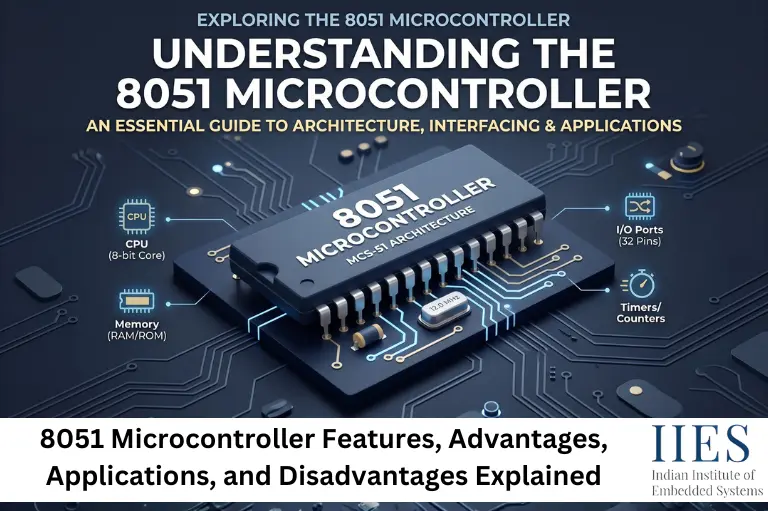
What Is the 8051 Microcontroller?
The 8051 is an 8-bit microcontroller originally designed by Intel and later manufactured by dozens of vendors including Atmel, Philips, and Silicon Labs. It belongs to the MCS-51 family and was specifically engineered for embedded control tasks, situations where a small, dedicated processor handles a specific job without the overhead of a full operating system.
At its core, the 8051 integrates a CPU, RAM, ROM, timers, serial communication, and I/O ports into a single chip. This level of integration was groundbreaking in the 1980s and made it one of the most widely adopted microcontroller architectures in history.
Today, the 8051 architecture continues to influence chip design, and modified versions with enhanced peripherals are still actively manufactured. For educational purposes and cost-sensitive legacy systems, it remains a go-to platform.

Key Features of the 8051 Microcontroller
Understanding 8051 microcontroller features helps clarify both why it became so popular and where its limitations lie.
8-Bit CPU Architecture The 8051 uses an 8-bit data bus, meaning it processes 8 bits of data at a time. While this limits raw throughput, it was perfectly suited to the control-oriented tasks it was designed for.
On-Chip Memory The standard 8051 includes 4KB of ROM for program storage and 128 bytes of internal RAM for data. External memory can be added to extend this capacity up to 64KB each for program and data memory.
Four 8-Bit I/O Ports It has four bidirectional ports (P0, P1, P2, P3), providing 32 programmable I/O pins in total. Each port can be individually configured for input or output.
Two 16-Bit Timers/Counters The built-in Timer 0 and Timer 1 support multiple operating modes and are used for timing control, event counting, baud rate generation, and PWM-like applications.
Full-Duplex UART The 8051 includes a built-in serial communication port (UART) that supports full-duplex asynchronous data transfer, making it suitable for RS-232 communication with PCs and other serial devices.
Interrupt System It supports five interrupt sources, two external interrupts, two timer interrupts, and one serial port interrupt, with two priority levels. This allows the MCU to respond to real-time events efficiently.
Boolean Processor One often-overlooked feature is the 8051’s built-in bit manipulation capability. It can operate on individual bits of RAM and SFRs (Special Function Registers), making it highly efficient for control logic.
Single Power Supply (5V) The device operates from a standard 5V supply, simplifying circuit design significantly for the era it was created in.
Why Is the 8051 Microcontroller Mostly Used?
Despite the availability of more powerful alternatives, the 8051 is still used for several practical reasons.
First, it is cost-effective. Compatible 8051 chips are inexpensive and widely available from multiple vendors. For simple control tasks, there is no economic case for using a more powerful processor.
Second, its architecture is extremely well-documented. Decades of textbooks, application notes, and tutorials mean that engineers can find answers to almost any 8051-related question quickly. For students learning microcontroller programming for the first time, this makes the 8051 an ideal starting point.
Third, legacy system maintenance is a major factor. A significant number of industrial machines, medical devices, and consumer electronics built between the 1980s and 2000s were designed around the 8051. Maintaining or upgrading these systems still requires working knowledge of the architecture.
Fourth, several modern derivatives of the 8051 – like those from Silicon Labs and Dallas Semiconductor, have been updated with higher clock speeds, additional flash memory, and expanded peripherals while retaining the original instruction set. This means engineers can get improved performance without abandoning familiar tools and code.
Advantages of the 8051 Microcontroller
The 8051 earned its dominant position in embedded systems for good reasons. Here are the core advantages:
- Simple and well-understood architecture – Ideal for beginners and educational use
- Boolean processing capability – Bit-level manipulation is built into the hardware, reducing the need for software workarounds
- Low cost – One of the most affordable microcontroller families available
- Wide vendor support – Dozens of manufacturers produce compatible variants
- Extensive documentation and community knowledge – Decades of published resources
- Deterministic timing – Instruction execution is predictable, which is critical in real-time control applications
- Versatile interrupt handling – Efficient response to external events without continuous polling
- Mature toolchain – Compilers, simulators, and debuggers have been available for years
For small-scale automation tasks, educational labs, and legacy maintenance, these advantages remain compelling even today.

Disadvantages of the 8051 Microcontroller
Limited Processing Power
The 8051 has low processing speed, making it unsuitable for complex and high-performance applications.
Limited Memory Capacity
It offers very small RAM and ROM, which limits large and advanced program development.
Outdated Instruction Set
The instruction set is older and less efficient compared to modern microcontrollers.
Lack of Integrated Peripherals
The 8051 lacks built-in features like USB, Wi-Fi, Ethernet, and advanced ADC modules.
Limited Availability of Modern Development Tools
Modern debugging, profiling, and RTOS support are limited for the 8051 platform.
Higher Power Consumption
The 8051 consumes more power than many modern low-power microcontrollers.
Active community support and updated learning resources are decreasing over time.
Limited Connectivity Options
Wireless and modern communication features require additional external modules.
Reduced I/O Pin Count
The available I/O pins may not be enough for large interfacing projects.
Inefficient Code Density
Programs often require more memory space compared to modern architectures.
Applications of the 8051 Microcontroller
The applications of the 8051 microcontroller span a surprisingly wide range of industries, given its simplicity:
Industrial Automation – The 8051 is used in programmable logic controllers (PLCs), motor controllers, and sensor interfacing systems where precise timing and reliable I/O control are essential.
Consumer Electronics – Older televisions, washing machines, microwave ovens, and air conditioning units have relied on 8051-based controllers to manage their core functions.
Automotive Systems – Early automotive embedded systems used the 8051 for functions like dashboard displays, window control, and basic engine management.
Medical Devices – Simple diagnostic devices, patient monitors, and infusion pumps have been built around 8051 architecture due to its deterministic behavior.
Communication Devices – Serial communication applications including modems, UART bridges, and protocol converters often used the 8051’s built-in serial port.
Educational Projects – The 8051 remains the most common microcontroller used in university and polytechnic electronics curricula worldwide, with applications ranging from LED displays to temperature controllers.
Security Systems – Access control panels, keypad-based locks, and basic alarm systems have used the 8051 for their control logic.
8051 vs Modern Microcontrollers: A Quick Comparison
Feature | 8051 | ARM Cortex-M (e.g., STM32) |
Architecture | 8-bit | 32-bit |
Clock Speed | 1–33 MHz | Up to 480 MHz |
Internal RAM | 128 bytes | 16KB–1MB+ |
Flash Memory | 4KB | 16KB–2MB+ |
Peripherals | Basic UART, Timers | USB, Ethernet, ADC, I2C, SPI |
Power Consumption | Moderate to high | Low (multiple sleep modes) |
Development Tools | Limited | Extensive (Keil, STM32CubeIDE) |
Cost | Very low | Low to moderate |
Learning Curve | Low | Moderate |
Future Outlook: Is the 8051 Still Relevant in 2026?
The honest answer is: for learning and legacy maintenance, yes. For new product development, rarely.
In 2026, the embedded systems landscape is dominated by 32-bit ARM Cortex-M microcontrollers, RISC-V-based chips, and purpose-built IoT processors. These devices offer orders of magnitude more performance, built-in wireless connectivity, and power management features that the 8051 simply cannot match.
However, educational institutions continue to use the 8051 because its simplicity makes it an effective teaching tool. Understanding the 8051 gives students a solid conceptual foundation before moving to more complex architectures. Many universities and engineering colleges in India, Southeast Asia, and Africa still structure their embedded systems curriculum around the 8051.
For new designs, developers are better served by platforms like the STM32 series, ESP32 for IoT applications, or PIC32 microcontrollers. These offer richer feature sets, better tooling, and longer manufacturer support commitments.

Conclusion
The 8051 microcontroller holds a unique place in the history of electronics. Its features, from the built-in UART and dual timers to the bit-manipulation capabilities, were genuinely innovative for their time, and they shaped how engineers approached embedded design for decades. Understanding what the 8051 is, why it became so widely used, and where its applications still make sense is valuable knowledge for any embedded systems practitioner.
That said, its disadvantages are real and increasingly relevant. Limited memory, outdated instruction set, lack of modern peripherals, and higher power consumption make it a poor fit for the demands of modern embedded development. For anyone starting a new design in 2026, modern 32-bit microcontrollers offer far better performance per dollar.
The right approach is to learn from the 8051’s architecture, understand its role in the embedded ecosystem, and then carry those fundamentals into the more capable platforms that define the field today.