What Do You Mean by Embedded Systems?
An embedded system is a dedicated computing unit designed to perform a specific function inside a larger device. Unlike general-purpose computers, embedded systems are built for speed, stability, low power, and real-time control.
Common examples include:
- automotive ECUs
- wearable fitness trackers
- washing machine controllers
- drone flight controllers
- smart meters
- medical infusion pumps
The purpose of embedded systems is to execute tasks with high reliability while working under strict limitations such as:
- limited RAM
- fixed CPU frequency
- low storage
- battery constraints
- hard real-time deadlines
This is exactly why embedded optimization becomes essential.

What Is Performance Optimization in Embedded Systems?
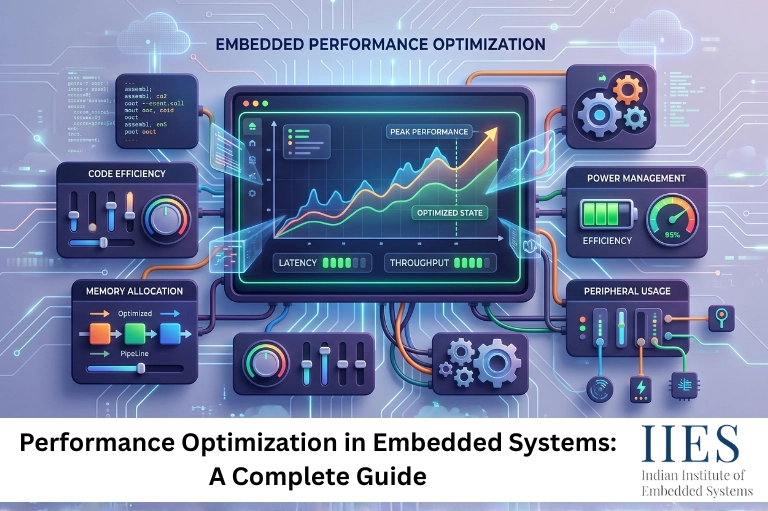
Performance optimization in embedded systems means improving how efficiently hardware and firmware work together.
This includes optimizing:
- execution speed
- CPU cycles
- memory usage
- interrupt latency
- task scheduling
- code size
- power consumption
- peripheral throughput
In simple terms, the goal is:
maximum output using minimum CPU time, memory, and power
A well-optimized embedded device should respond faster, consume less energy, and remain stable under peak workload.
Why Performance Optimization Matters
Modern embedded applications are evolving rapidly. Devices now run:
- TinyML workloads
- sensor fusion
- edge AI inference
- predictive maintenance
- OTA updates
- multi-protocol communication stacks
This growing complexity creates challenges:
Challenge | Optimization Need |
Limited MCU resources | Memory optimization in embedded system |
Battery-powered devices | Power optimization techniques in embedded systems |
Real-time deadlines | RTOS and interrupt tuning |
Faster data processing | Software performance optimization in embedded system |
Cost-sensitive hardware | Code optimization in embedded system |
For example, in EV BMS controllers, a 2–5 ms reduction in ADC processing latency can improve balancing precision and safety response.
1) Code Optimization in Embedded System
The first layer of optimization starts with firmware.
Best techniques
- remove redundant loops
- use fixed-point math instead of floating point where possible
- inline small frequently called functions
- reduce recursive logic
- optimize ISR routines
- avoid unnecessary polling
Practical example
Instead of scanning all sensors every 1 ms, event-driven interrupts can reduce CPU load significantly.
Expert tip
Use compiler optimization levels carefully:
- -O2 → best balance
- -Os → reduce code size
- -Ofast → maximum speed, but validate timing safety
This is the foundation of software performance optimization in embedded system workflows.
2) Memory Optimization in Embedded System
Memory is one of the biggest bottlenecks in microcontroller-based products.
Key strategies
- prefer static allocation over dynamic memory
- use memory pools
- optimize struct alignment
- reduce stack depth
- store constants in Flash
- compress lookup tables
Mini case study
A Cortex-M4 industrial sensor node reduced RAM usage by 28% after:
- replacing dynamic buffers
- using DMA ring buffers
- packing telemetry structs
This improved system stability and eliminated random crashes.
3) Power Optimization in Embedded Systems
Battery life is a major KPI for wearables, IoT devices, and portable medical electronics.
Proven power optimization techniques in embedded systems
- sleep mode transitions
- clock gating
- DVFS (dynamic voltage and frequency scaling)
- peripheral shutdown during idle
- sensor duty cycling
- event-based wake-up
- low-power RTOS tickless mode
Real-world example
A BLE health monitor improved battery backup from 5 days to 11 days after moving from polling architecture to interrupt-driven wake cycles.
This is one of the most impactful forms of embedded optimization.
4) RTOS and Task Scheduling Optimization
For real-time applications, scheduling determines responsiveness.
Best practices
- assign task priorities by criticality
- keep ISRs short
- defer heavy work to tasks
- reduce context switching
- use queues instead of busy waits
- optimize mutex usage
Common mistake
Many developers overuse high-priority tasks, causing starvation of communication and logging threads.
The result:
- packet loss
- watchdog resets
- latency spikes
5) Peripheral and Hardware-Level Optimization
Firmware alone cannot solve all performance issues.
Hardware-level tuning often includes:
- DMA-based UART/SPI transfers
- ADC oversampling tuning
- timer prescaler optimization
- FPGA/DSP offloading
- cache-friendly bus access
- selecting faster external Flash
Example workflow
In motor control systems:
- ADC sampling via DMA
- PWM update using timer interrupts
- control loop in high-priority task
- telemetry in low-priority thread
This architecture improves deterministic behavior.
Comparison Table: Optimization Areas vs Impact
Optimization Area | Main Benefit | Best Use Case |
Code optimization | Faster execution | Control loops |
Memory optimization | Lower RAM usage | IoT nodes |
Power optimization | Longer battery life | Wearables |
RTOS optimization | Better latency | Robotics |
Hardware acceleration | Higher throughput | DSP/image systems |
How Engineers Optimize Embedded Systems
A proven step-by-step workflow:
Step 1: Profile first
Use tools like:
Step 2: Identify bottleneck
Check:
- ISR overload
- memory leaks
- CPU utilization
- task jitter
- stack overflow
- bus latency
Step 3: Optimize the biggest bottleneck
Never optimize blindly.
Example:
If UART logging takes 30% CPU, switch to DMA + circular buffer before touching algorithms.
Step 4: Re-test with benchmarks
Track:
- response time
- current draw
- throughput
- worst-case latency
- thermal performance
Embedded System Design Metrics: How to Measure Optimization Results
In real-world engineering, optimization only matters when the improvement is measurable. That is why embedded system design metrics are essential for validating whether firmware, memory, RTOS, and power optimization in embedded systems are actually improving performance.
The best practice is to benchmark the device before and after each optimization change.
Key Metrics to Track
- CPU utilization: measures processor load and available headroom
- ISR latency: checks interrupt response speed
- Task response time: verifies RTOS deadline performance
- Memory footprint: tracks RAM and Flash usage
- Stack usage: helps prevent overflow and random resets
- Battery current draw: validates low-power firmware improvements
- Wake-up latency: measures sleep-to-active transition speed
- Throughput: sensor samples, packets, or tasks completed per second
- WCET: confirms worst-case task timing for real-time safety
For example, reducing CPU load from 70% to 35% after switching UART logging to DMA clearly proves the optimization worked.
These embedded system design metrics help engineers make data-driven decisions instead of relying on assumptions.

Quick Metrics Table
Metric | Why It Matters |
CPU utilization | Detects overload |
ISR latency | Faster interrupts |
Task response time | RTOS deadlines |
Memory footprint | RAM efficiency |
Stack usage | Prevents resets |
Battery current draw | Longer battery life |
Wake-up latency | Better sleep efficiency |
Throughput | Higher workload speed |
WCET | Real-time safety |
Debugging Techniques in Embedded Systems: Tools to Find Performance Bottlenecks
After measuring embedded system design metrics, the next step is identifying why performance issues happen. This is where debugging techniques in embedded systems become essential.
Whether the issue is high CPU load, memory overflow, missed RTOS deadlines, or poor battery life, the right embedded system debugging tools help engineers quickly trace the root cause.
A strong debugging workflow usually combines software tracing, real-time logging, and hardware signal analysis.
1) Firmware and RTOS Debugging
For debugging embedded systems, software-level tools help trace task execution, ISR latency, and scheduler delays.
The most effective tools include:
- STM32CubeIDE Profiler for code hotspots and function timing
- Segger SystemView for RTOS task switching and CPU load
- FreeRTOS Tracealyzer for queue delays and blocked tasks
- J-Link RTT for low-overhead real-time debug logs
- ARM Keil Event Recorder for ISR and middleware timing
These tools are ideal for finding:
- high CPU usage
- task starvation
- priority inversion
- memory leaks
- blocking drivers
- excessive logging overhead
This makes them highly effective embedded system debugging tools for firmware optimization.
2) Hardware Debugging Tools in Embedded System Design
Many performance problems come from peripherals, timing mismatches, or electrical signal issues. In these cases, hardware debugging tools in embedded system workflows are critical.
The most practical hardware tools are:
- Oscilloscope → interrupt timing, PWM, wake-up latency
- Logic analyzer → UART, SPI, I2C, CAN debugging
- Power profiler → sleep current and active current spikes
- JTAG/SWD debugger → breakpoints, register inspection
- Protocol analyzer → advanced bus-level diagnostics
These tools help identify:
- ADC timing drift
- UART packet loss
- SPI clock mismatch
- GPIO interrupt glitches
- sensor communication lag
3) Best Debugging Workflow for Engineers
A proven workflow for debugging embedded systems:
- measure CPU, memory, and power metrics
- trace RTOS tasks and interrupts
- inspect communication timing
- verify hardware signals with logic analyzer
- compare before vs after optimization
- validate WCET and battery current
This workflow helps engineers solve performance issues faster and supports power optimization in embedded systems as well.
Quick Debugging Tool Table
Tool | Best Use |
STM32CubeIDE | firmware profiling |
Segger SystemView | RTOS debugging |
Tracealyzer | task bottlenecks |
J-Link RTT | fast debug logs |
Oscilloscope | timing validation |
Logic Analyzer | protocol debugging |
Power Profiler | current measurement |
JTAG/SWD | register debugging |
Common Embedded System Bottlenecks and Fixes
Even after applying strong optimization methods, many projects still face recurring bottlenecks that affect speed, power efficiency, and system stability.
The table below helps engineers quickly map common issues to their root causes and best fixes using practical debugging techniques in embedded systems.
Problem | Likely Cause | Best Fix |
High CPU usage | continuous polling loops | switch to interrupts + DMA |
Low battery life | busy-wait tasks and active peripherals | sleep mode + tickless RTOS |
Random resets | stack overflow or heap fragmentation | increase stack + static memory |
UART packet loss | blocking logs or small buffers | DMA circular buffer |
Sensor lag | slow ADC polling | timer-triggered ADC DMA |
RTOS task delay | poor priority mapping | optimize task priorities |
SPI/I2C communication errors | timing mismatch | validate with logic analyzer |
Wake-up latency | slow sleep-to-active transition | optimize clock restore path |
Future Trends: Embedded Performance Optimization Beyond 2026
The future of optimization is shifting toward AI-assisted firmware tuning.
Emerging trends include:
- TinyML compiler-assisted optimization
- automatic task scheduling analysis
- predictive power scaling
- ML-driven DVFS
- RISC-V vector acceleration
- AI code profilers
- edge inference hardware offload
As embedded AI expands, optimization will increasingly focus on:
- neural inference latency
- SRAM reuse
- NPU scheduling
- thermal-aware power scaling
This opens major opportunities for engineers working in automotive, medical, and industrial edge systems.
Common Mistakes to Avoid
Avoid these frequent optimization errors:
- optimizing before profiling
- overusing floating-point operations
- dynamic memory fragmentation
- large ISR execution time
- excessive debug logging
- ignoring cache alignment
- poor task priority mapping
- polling instead of interrupts
These mistakes reduce both speed and battery life.
Best Practices from Industry Experts
The best embedded teams follow these principles:
- optimize architecture before micro-optimizations
- benchmark every firmware release
- document timing assumptions
- validate worst-case latency
- power profile in real hardware
- optimize for maintainability, not only speed
- use CI regression benchmarks
This ensures sustainable optimization across product updates.

Conclusion
As devices become smarter and more connected, performance optimization in embedded systems is no longer optional, it is a core engineering discipline.
From code optimization in embedded system firmware to power optimization techniques in embedded systems, every improvement directly impacts speed, reliability, and battery life.
The best results come from a profile → optimize → validate workflow, supported by strong RTOS design, efficient memory usage, and hardware-aware coding.
If your goal is to build faster IoT devices, stable automotive controllers, or low-power wearable products, mastering embedded optimization will give your systems a clear competitive edge.