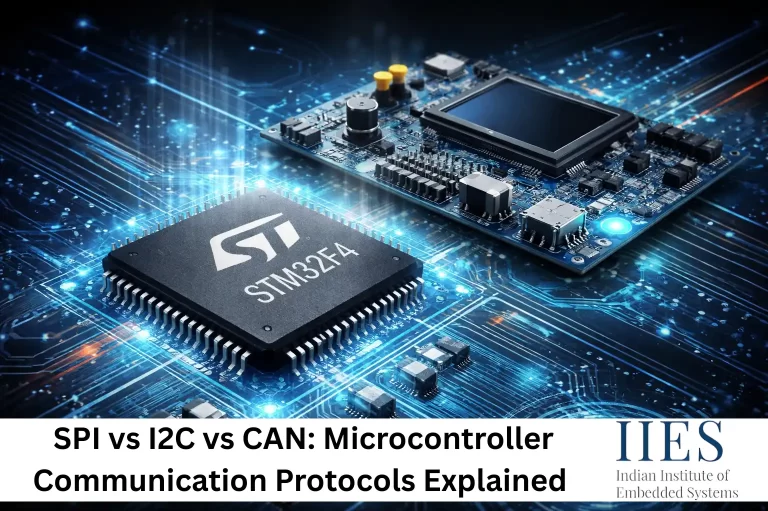
STM32F4 Series Microcontrollers
STM32F4 microcontrollers deliver a balanced combination of speed, power efficiency, and peripheral integration suitable for modern embedded products.
STM32F4 Specifications
| Property | Description |
|---|
| Core | ARM Cortex-M4 |
| Clock Speed | Up to 180 MHz |
| Memory | Flash 256 KB – 2 MB, SRAM 64 KB – 384 KB |
| Peripherals | GPIO, UART, SPI, I2C, ADC, CAN, USB, Ethernet |
| Strength | DSP instructions, Floating Point Unit, Graphics support |
This table highlights why the STM32F4 microcontroller delivers higher capability compared to many entry-level controllers.

Key Features of STM32F4 Microcontroller
1. ARM Cortex-M4 Core
At the heart of the STM32F4 series lies the ARM Cortex-M4 processor, known for its advanced features such as single-cycle digital signal processing (DSP) instructions and floating-point unit (FPU). This enables the microcontroller to handle complex mathematical operations with ease, making it suitable for applications like audio processing, motor control, and more.
2. Memory Configuration
The STM32F4 series provides ample memory resources, crucial for storing program code, data, and configuration settings. With Flash memory capacity ranging from 256 KB to 2 MB and SRAM ranging from 64 KB to 384 KB, developers have the flexibility to design applications of varying complexities.
3. Peripheral Integration
A standout feature of the STM32F4 series is its extensive set of peripherals. These include GPIO, UART, SPI, I2C, and more. This rich peripheral integration simplifies the interfacing of the microcontroller with a wide array of sensors, displays, communication modules, and other external devices.
4. Advanced Connectivity
The STM32F4 microcontrollers offer advanced connectivity options, including USB interfaces, Ethernet controllers, and CAN interfaces. These features make the series suitable for applications requiring high-speed data transfer, networking capabilities, and communication with other devices in industrial or automotive settings.
5. Analog Features
For applications demanding precise analog measurements, the STM32F4 series includes ADC modules with varying resolutions up to 12 bits. This makes the microcontrollers well-suited for sensor interfacing, medical devices, and industrial automation.
6. Rich Graphics Support
STM32F4 microcontrollers come equipped with hardware accelerators for graphics rendering. This is particularly beneficial for applications such as human-machine interfaces (HMIs) and touchscreen displays.
Applications of STM32F4 Microcontroller
- Industrial Automation: High processing power and peripheral support make it ideal for motor control, factory automation, and data acquisition.
- Audio Processing: DSP and FPU capabilities enable real-time audio filtering and digital audio effects.
- Medical Devices: Accurate analog processing and integrated peripherals support patient monitoring and diagnostic equipment.
- Communications: USB, Ethernet, and CAN interfaces make it suitable for IoT gateways and embedded network nodes.
- Consumer Electronics: Smart home devices, portable gadgets, and microcontroller-based kits benefit from its performance and efficiency.
Development Ecosystem Around STM32F4
STMicroelectronics provides a robust ecosystem for STM32F4 developers, including:
- STM32CubeIDE: Simplifies configuration, programming, and debugging.
- STM32CubeMX: Tool for peripheral configuration and initialization code generation.
- Extensive documentation, libraries, and online community support to help engineers unleash the full potential of
- STM32F4.

How STM32F4 Microcontroller Works in Practice
Engineers typically define:
- Controller initialization
- Interaction of I/O ports with hardware
- Memory and register configuration
- Task sequencing
- Error handling
Once programmed, the device operates independently, delivering reliable long-term performance.
Methods of Building Applications with STM32F4
High-Level Programming (Embedded C/C++)
Developers use IDEs with editor, compiler, linker, debugger, and simulator. Ideal for structured development and large systems.
Assembly Language Programming
Used for performance-critical applications, direct hardware control, and highly optimized routines.
Super Loop Architecture Example
void main()
{
    Configurations();
    Initializations();

    while(1)
    {
        Task1();
        Task2();
        // Additional tasks
        TaskN();
    }
}
Learning Path and Practical Advantages
Learning Path for Beginners
Beginners first encounter STM32F4 through simple GPIO experiments, gradually progressing to complex peripheral-driven applications. This structured learning mirrors industry practice and prepares students for professional embedded development.
Flexibility Across Domains
A single STM32F4 device can handle control algorithms, communication stacks, and graphical interfaces without redesign, reducing development time and facilitating cross-project learning.
Real-World Reliability
STM32F4 devices demonstrate stable behavior under long operating hours in industrial, medical, and consumer applications. Engineers can confidently use them to design dependable embedded systems.