What is Cortex-A53?
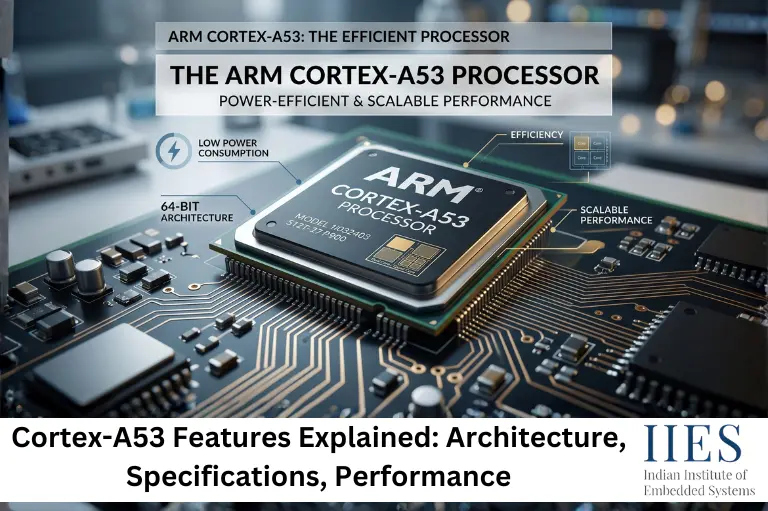
The Cortex-A53 is a 64-bit ARM processor core based on the ARMv8-A architecture, designed to provide high energy efficiency while delivering sufficient performance for general-purpose computing and embedded applications.
Introduced by ARM as part of the ARMv8 family, the Cortex-A53 became one of the most successful ARM cores ever designed.
Key characteristics include:
- 64-bit ARMv8-A instruction set
- Low-power design
- In-order execution pipeline
- Multi-core support
- Hardware virtualization
- ARM TrustZone security
- NEON SIMD acceleration
- Linux and Android compatibility
Unlike high-performance cores that prioritize maximum speed, the Cortex-A53 focuses on achieving the best performance-per-watt ratio.

Cortex-A53 Specifications
Feature | Specification |
Architecture | ARMv8-A |
Instruction Set | 64-bit ARM |
Execution Type | In-order |
Pipeline | Dual-issue |
Core Configuration | Single, Dual, Quad, Octa Core |
L1 Cache | 8KB–64KB |
L2 Cache | Up to 2MB Shared |
Virtualization | Supported |
TrustZone Security | Supported |
NEON Engine | Supported |
Floating Point Unit | Integrated |
Process Technology | Depends on SoC Vendor |
Operating Systems | Linux, Android, RTOS |
These Cortex-A53 specifications make the processor suitable for applications ranging from consumer electronics to industrial automation systems.
What Makes the ARM Cortex-A53 Architecture Efficient?
ARM Cortex-A53 architecture is built around a carefully optimized in-order execution pipeline.
Many beginners assume that out-of-order execution always provides better processor design. In practice, embedded applications often benefit more from lower power consumption than from maximum computational throughput.
The Cortex-A53 achieves efficiency through:
1. In-Order Execution
Instructions are executed sequentially.
Benefits:
- Lower power consumption
- Reduced silicon complexity
- Smaller chip area
- Lower manufacturing cost
2. Dual-Issue Pipeline
The processor can issue two instructions simultaneously under suitable conditions.
Advantages include:
- Better throughput
- Improved instruction efficiency
- Increased performance without excessive power draw
3. Advanced Branch Prediction
Branch prediction minimizes pipeline stalls and improves execution efficiency.
4. Integrated NEON SIMD Engine
NEON accelerates:
- Multimedia processing
- Audio algorithms
- Signal processing
- Computer vision
- AI inference workloads
Key Cortex-A53 Features Every Embedded Engineer Should Know
1. 64-Bit Processing Support
One of the most significant Cortex-A53 features is native 64-bit processing.
Benefits include:
- Larger address space
- Improved operating system support
- Better memory management
- Future-proof software development
2. ARM TrustZone Security
TrustZone creates isolated execution environments.
Applications include:
- Secure boot
- Cryptographic processing
- Secure payment systems
- Device authentication
3. Hardware Virtualization
Virtualization enables multiple operating systems to run efficiently on a single processor.
Common uses:
- Automotive platforms
- Industrial controllers
- Edge computing systems
4. Dynamic Voltage and Frequency Scaling (DVFS)
DVFS adjusts processor speed according to workload requirements.
This reduces:
- Heat generation
- Battery consumption
- Overall power usage
5. Multi-Core Scalability
Manufacturers can deploy Cortex-A53 cores in:
- Single-core systems
- Dual-core systems
- Quad-core systems
- Octa-core systems
This flexibility allows SoC vendors to target multiple market segments.
Is Cortex-A53 Processor Good for Gaming?
The answer depends on the type of gaming.
For lightweight and casual gaming, the Cortex-A53 performs well.
Examples include:
- Puzzle games
- Strategy games
- Educational applications
- Casual mobile games
However, modern AAA mobile games place heavy demands on:
- CPU resources
- GPU performance
- Memory bandwidth
In such scenarios, newer ARM cores such as Cortex-A76, Cortex-A78, and Cortex-X series deliver significantly better results.
Gaming Performance Summary
Gaming Type | Cortex-A53 Suitability |
Casual Games | Excellent |
Puzzle Games | Excellent |
Retro Emulation | Good |
2D Games | Very Good |
Mid-Level Android Games | Acceptable |
High-End AAA Games | Limited |
For embedded gaming devices and retro gaming consoles, Cortex-A53 remains a practical choice due to its low power requirements.

Cortex-A53 Benchmark Performance
How Does the Cortex-A53 Perform in Benchmarks?
Cortex-A53 benchmark results vary depending on:
- Clock frequency
- Number of cores
- Memory subsystem
- SoC implementation
Typical performance characteristics:
Metric | Relative Performance |
Single-Core Performance | Moderate |
Multi-Core Performance | Good |
Power Efficiency | Excellent |
Thermal Efficiency | Excellent |
Embedded Linux Performance | Very Good |
Real-Time Responsiveness | Good |
A well-designed quad-core Cortex-A53 system often outperforms older ARM Cortex-A9 and Cortex-A7 platforms while consuming less power.
Real-World Applications of Cortex-A53 Processors
The Cortex-A53 is used extensively across industries.
Consumer Electronics
Examples include:
- Smart TVs
- Streaming devices
- Android TV boxes
- Tablets
Industrial Automation
Applications include:
- PLC systems
- HMI panels
- Industrial gateways
- Factory monitoring systems
Networking Equipment
Common deployments:
- Routers
- Firewalls
- Wireless access points
- Network storage devices
IoT and Edge Computing
The Cortex-A53 powers:
- Smart city infrastructure
- AI edge devices
- IoT gateways
- Remote monitoring systems
As of 2025–2026, Cortex-A53-based SoCs remain widely used in industrial Linux platforms because they provide long product life cycles and proven software stability.
Cortex-A53 Development Board Options
Engineers frequently use the following boards for development and prototyping.
Development Board | Processor |
Raspberry Pi 3 Model B | Quad Cortex-A53 |
Raspberry Pi Zero 2 W | Quad Cortex-A53 |
NXP i.MX8M Mini EVK | Cortex-A53 Based |
BeagleBone AI-64 | Cortex-A53 Based |
Rock64 | Cortex-A53 Based |
When selecting a Cortex-A53 development board, consider:
- Linux support
- Community ecosystem
- Peripheral interfaces
- Industrial availability
- Long-term supply
Cortex-A53 vs Cortex-A57: Which One Should You Choose?
A common question among embedded engineers is whether to choose Cortex-A53 or Cortex-A57.
Feature | Cortex-A53 | Cortex-A57 |
Execution | In-order | Out-of-order |
Power Consumption | Lower | Higher |
Performance | Moderate | High |
Silicon Area | Smaller | Larger |
Thermal Output | Lower | Higher |
Cost | Lower | Higher |
Battery Efficiency | Excellent | Moderate |
When to Choose Cortex-A53
Choose Cortex-A53 when:
- Battery life is important
- Thermal constraints exist
- Cost matters
- Embedded Linux workloads dominate
When to Choose Cortex-A57
Choose Cortex-A57 when:
- Maximum CPU performance is required
- Heavy computation is expected
- Server-class workloads are involved
Common Mistakes When Working with Cortex-A53
Mistake 1: Assuming More Clock Speed Solves Everything
Performance bottlenecks often originate from:
- Memory latency
- Cache misses
- Storage speed
Not merely processor frequency.
Mistake 2: Ignoring Thermal Design
Many engineers focus only on CPU specifications.
In real products, thermal limitations frequently determine sustained performance.
Mistake 3: Underestimating Linux Optimization
Proper optimization of:
- Kernel configuration
- Device drivers
- Scheduling
- Memory management
can significantly improve Cortex-A53 performance.
Mistake 4: Choosing an Overpowered Processor
Many embedded products run efficiently on Cortex-A53 while consuming less power and reducing BOM costs.
The Cortex-A53 continues to remain relevant because many embedded applications prioritize:
- Reliability
- Long-term availability
- Energy efficiency
- Cost optimization
While newer ARM cores provide greater computational performance, many industrial and IoT applications do not require that extra processing power.
As a result, Cortex-A53-based systems continue to appear in new product designs even in 2026.

Conclusion
The Cortex-A53 features that made it successful a decade ago remain valuable today. Its combination of 64-bit processing, low power consumption, TrustZone security, virtualization support, NEON acceleration, and flexible multi-core configurations makes it one of ARM’s most practical processor cores.
Whether you are evaluating a Cortex-A53 development board, comparing Cortex-A53 vs Cortex-A57, studying ARM Cortex-A53 architecture, or analyzing Cortex-A53 benchmark results, the processor continues to demonstrate why efficient design often matters more than raw performance.
For embedded Linux systems, IoT devices, networking equipment, and industrial applications, the Cortex-A53 remains a proven and reliable choice.