What Is 8051 Microcontroller?
To understand what is 8051 microcontroller, think of it as the starting point of embedded systems learning.
The 8051 is a classic 8-bit microcontroller architecture developed for control-based applications. It is simple, predictable, and ideal for learning how software interacts directly with hardware registers.
Its architecture typically includes:
- CPU core
- RAM and ROM
- GPIO ports
- timers/counters
- serial UART
- interrupt controller
The reason what is 8051 architecture is still widely taught is because it clearly explains how embedded hardware works internally.
Where 8051 Is Still Used
Even today, the 8051 remains useful in:
- lab experiments
- digital counters
- keypad systems
- traffic light controllers
- industrial legacy machines
- simple appliance control boards
A student learning timers, ports, and interrupts can understand embedded concepts much faster with 8051.

What Is ARM Microcontroller?
Now let’s understand what is ARM microcontroller.
ARM is a family of processor architectures based on RISC principles, designed for fast execution and low power consumption. In embedded systems, the most popular ARM family is Cortex-M, which powers boards like STM32, LPC, Tiva C, and Nordic chips.
When learners search what is ARM architecture, they are usually trying to understand why ARM is used in almost every modern embedded product.
The answer is simple: ARM combines high performance, rich peripherals, and low power.
A modern ARM microcontroller may include:
- 32-bit CPU
- Flash and SRAM
- ADC / DAC
- SPI / I2C / UART
- PWM timers
- DMA
- CAN / USB
- BLE / Wi-Fi support
- RTOS compatibility
This makes ARM ideal for:
- IoT devices
- robotics
- automotive electronics
- smart home systems
- medical electronics
- industrial automation
Core Difference Between 8051 and ARM
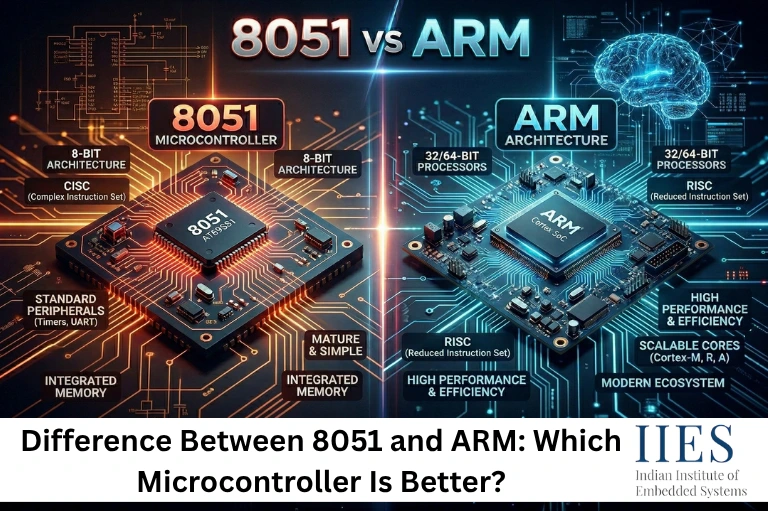
The real difference between 8051 and ARM processor architecture starts from design philosophy.
The 8051 is built for simple control logic, while ARM is built for scalable modern computing in embedded devices.
Quick Comparison Table
Parameter | 8051 | ARM |
Bit Width | 8-bit | 32-bit |
Architecture | Simple control-oriented | RISC high performance |
Speed | Low | High |
Memory | Limited | Large |
Power Modes | Basic | Advanced |
RTOS | Rare | Excellent |
IoT Support | Minimal | Strong |
Learning Use | Fundamentals | Product development |
Industry Demand | Legacy + academic | Very high |
This table helps users quickly understand the 8051 vs ARM decision.
Performance and Memory: Practical Difference
One of the most important parts of microcontroller architecture is how much processing and memory the device can handle.
The 8051 is enough for smaller tasks such as:
- LED sequences
- timer-based delays
- keypad password systems
- LCD status display
- simple UART communication
But once your project needs:
- multiple sensors
- wireless communication
- mobile app control
- cloud logging
- multitasking
- OTA firmware updates
ARM becomes necessary.
For example, a temperature monitoring system on 8051 may simply display temperature on LCD.
The same project on ARM can:
- send data to cloud
- show live graph in mobile app
- generate alerts
- log data to flash
- sleep to save battery
- update firmware remotely
That is the practical arm vs 8051 difference.
Learning Path for 8051 Microcontroller
This roadmap is designed for learners asking how to learn 8051 microcontroller.
Stage 1: Core Fundamentals
Start with low-level basics:
- architecture overview
- registers
- memory map
- GPIO ports
- delay programming
- LED blinking
This stage helps you understand direct hardware control.
Stage 2: Peripherals
Move into important modules:
- timer programming
- counter applications
- UART communication
- interrupts
- LCD interfacing
- keypad scanning
This stage builds strong confidence in embedded fundamentals.

Stage 3: Project Building
Now convert theory into projects:
- digital clock
- traffic signal system
- password door lock
- visitor counter
- serial communication terminal
- home appliance control
At this point, what is 8051 microcontroller becomes easy to explain in interviews.
Learning Path for ARM Microcontroller
Now let’s build a roadmap for how to learn ARM microcontroller.
Stage 1: ARM Basics
Begin with:
- GPIO
- LED blinking
- button interrupt
- UART debugging
- timers and PWM
STM32 boards are excellent for this stage.
Stage 2: Intermediate Peripheral Mastery
Move deeper into:
- ADC
- DAC
- SPI sensors
- I2C modules
- RTC
- DMA
- CAN
- USB
This is where ARM architecture becomes much more practical.
Stage 3: Advanced Firmware Development
This stage is highly valuable for jobs:
- FreeRTOS
- BLE modules
- Wi-Fi stacks
- bootloader
- OTA update
- motor control
- IoT dashboard
- TinyML edge AI
This roadmap makes you ready for modern microcontrollers used in industry.
Real-World Project Comparison
A better way to understand difference between 8051 and ARM is through projects.
8051 Best Projects
The 8051 works best for:
- electronic voting machine
- digital stopwatch
- elevator control logic
- temperature display
- serial communication demos
ARM Best Projects
ARM shines in:
- smart energy meter
- home automation
- BLE health tracker
- drone controller
- industrial motor control
- AI object detection edge node
This practical section improves engagement and SEO depth.
Which Is Better: 8051 or ARM?
The answer depends on your end goal.
If your goal is:
- concept learning
- register-level understanding
- college labs
- viva preparation
- mini projects
then 8051 is the better start.
If your goal is:
- embedded jobs
- IoT
- RTOS
- automotive
- STM32
- firmware engineering
- robotics
- modern product design
then ARM is clearly better.
The ideal roadmap is:
Learn 8051 → understand fundamentals → transition to ARM → build industry projects
This is the strongest long-term embedded path.
Career and Future Scope
From a career perspective, ARM has significantly stronger demand.
Today, most embedded job roles mention:
- ARM Cortex-M
- STM32
- RTOS
- SPI / I2C
- CAN
- low-power firmware
- IoT connectivity
However, companies still value candidates who know 8051 because it shows strong understanding of microcontroller architecture.
So both are useful, but in different stages:
- 8051 = learning depth
- ARM = career growth

Conclusion
The difference between 8051 and ARM is best understood as a journey from fundamental embedded learning to real-world modern firmware development.
The 8051 remains one of the best platforms to understand ports, timers, memory, and interrupt logic.
ARM, however, is the backbone of today’s modern microcontrollers, making it the best choice for advanced projects, IoT systems, automation, and embedded careers.
The smartest approach is simple:
Start with 8051 for strong basics, then master ARM for product-level engineering.
That combination gives you the best possible embedded systems foundation.