What Is the STM32 Blackpill?
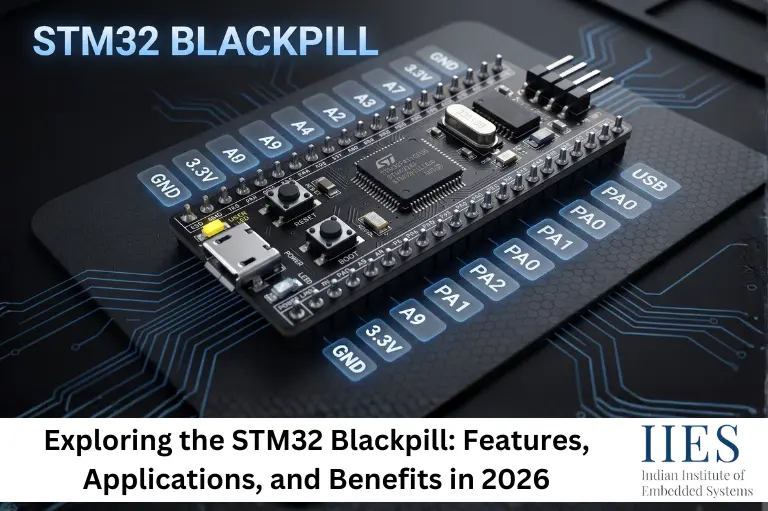
The STM32 Blackpill is a compact development board based on STMicroelectronics’ STM32 series microcontrollers. Most Blackpill variants use the STM32F103 or STM32F411 microcontroller families, built around ARM Cortex-M cores.
The board gained popularity because it offers:
- High processing performance
- Small footprint
- Low power consumption
- Rich GPIO availability
- USB support
- Excellent development ecosystem
- Affordable cost compared to many alternatives
The most commonly used version today is the STM32F411CEU6 Blackpill, which combines strong computational capability with compact hardware design.

Why the STM32 Blackpill Is Important for Modern Embedded Development
Many traditional microcontroller boards struggle when applications demand:
- Faster processing
- Better real-time response
- Multiple communication protocols
- Compact PCB integration
- Low power consumption
- Advanced peripheral handling
The STM32 Blackpill solves these limitations effectively.
Its ARM Cortex architecture makes it suitable for modern embedded systems where performance and efficiency matter. Developers working on robotics, drones, IoT systems, industrial monitoring, and smart devices often prefer the STM32 ecosystem because it provides professional-grade capabilities at a beginner-friendly cost.
Key Features of the STM32 Blackpill
ARM Cortex-M Core Architecture
At the center of the STM32 Blackpill is an ARM Cortex-M microcontroller.
Depending on the board variant, you may get:
Variant | Core Type | Clock Speed |
STM32F103 | Cortex-M3 | Up to 72 MHz |
STM32F411 | Cortex-M4 | Up to 100 MHz |
The Cortex-M4 version also includes DSP instructions and floating-point processing, making it highly efficient for signal processing and advanced calculations.
Compact Form Factor
One of the biggest reasons behind the popularity of the STM32 Blackpill board is its small size.
Typical dimensions are approximately:
Despite its compact footprint, the board still offers a large number of GPIO pins and peripheral interfaces.
This makes it ideal for:
- Portable electronics
- Mini robotics projects
- Compact IoT devices
- Wearable systems
- Space-constrained PCB designs
Memory and Storage Capabilities
The STM32 Blackpill provides sufficient onboard memory for most embedded applications.
Typical specifications include:
- 512 KB Flash memory
- 128 KB SRAM
This memory allocation allows developers to run complex firmware, communication stacks, sensor libraries, and real-time operating systems efficiently.
Some advanced projects even integrate external flash memory or SD card modules for additional storage.
Rich Peripheral Support
The board includes multiple communication interfaces that simplify hardware integration.
Supported interfaces include:
- UART
- SPI
- I2C
- USB OTG
- PWM
- ADC
- DAC
- CAN (on some variants)
This flexibility allows seamless communication with:
- Sensors
- Displays
- Motors
- Wireless modules
- GPS devices
- Bluetooth modules
- Wi-Fi modules
Flexible Power Options
The STM32 Blackpill supports several power methods:
- USB power
- External power supply
- Battery-powered operation
Its efficient power management makes it suitable for low-power applications such as remote monitoring systems and portable IoT devices.
Excellent Development Ecosystem
One of the strongest advantages of STM32 hardware is the mature software ecosystem.
Developers can use:
- STM32CubeIDE
- PlatformIO
- Arduino IDE
- Keil uVision
- IAR Embedded Workbench
The official STM32CubeMX configuration tool also simplifies peripheral initialization and project generation.
This significantly reduces development complexity for beginners learning STM32 Black Pill programming.
STM32 Black Pill Programming Explained
Programming the STM32 Blackpill is easier today than ever before.
Developers typically use:
STM32CubeIDE
This is the official IDE from STMicroelectronics.
Features include:
- Code editor
- Debugger
- Peripheral configuration
- Compiler integration
- Project generation
It is ideal for professional embedded development.
Arduino IDE Support
Many beginners start with Arduino-compatible STM32 support.
Advantages include:
- Faster learning curve
- Huge community support
- Easy library integration
- Rapid prototyping
This method is excellent for educational and hobby projects.
PlatformIO for Advanced Workflows
Professional developers often use PlatformIO because it supports:
- Multi-board development
- Automated builds
- Dependency management
- VS Code integration
This approach is highly scalable for larger firmware projects.

Real-World Applications of the STM32 Blackpill
IoT Devices
The STM32 Blackpill is widely used in IoT systems because of its low power consumption and processing capability.
Common IoT applications include:
- Smart home controllers
- Environmental monitoring systems
- Wireless sensor nodes
- Smart agriculture systems
- Energy monitoring devices
When paired with ESP8266 or ESP32 modules, the board can easily connect to cloud platforms.
Robotics Projects
The high-speed GPIO handling and timer peripherals make the board excellent for robotics.
Examples include:
- Line-following robots
- Robotic arms
- Autonomous navigation systems
- Motor control systems
- Drone flight controllers
The STM32F411 version is particularly effective for real-time robotics applications.
Industrial Automation
Industrial engineers often use STM32 boards in:
- PLC-like systems
- Data acquisition units
- Industrial sensor interfaces
- Motor drivers
- Control panels
Its reliability and real-time response make it suitable for automation environments.
DIY Electronics and Prototyping
For hobbyists, the Blackpill provides a cost-effective platform for experimentation.
Popular DIY projects include:
- LED matrix displays
- Home automation systems
- MIDI controllers
- Audio processing systems
- Digital clocks
- Oscilloscopes
STM32 Blackpill vs Bluepill
Many developers compare the STM32 Blackpill with the STM32 Bluepill.
Feature | STM32 Blackpill | STM32 Bluepill |
Processor | Cortex-M4/M3 | Cortex-M3 |
Clock Speed | Up to 100 MHz | Up to 72 MHz |
USB Support | Better USB OTG support | Basic USB |
Performance | Higher | Moderate |
Price | Slightly higher | Lower |
Advanced DSP | Yes (F4 variants) | No |
The Bluepill remains excellent for simple projects, but the Blackpill offers significantly better performance for modern embedded applications.
STM32 Blackpill Price and Affordability
One major reason behind the popularity of the board is the affordable STM32 Blackpill price.
In 2026, most STM32 Blackpill boards are available in the range of:
- $4 to $10 depending on variant and supplier
Considering the processing power and features offered, the board provides exceptional value for money.
This affordability makes it attractive for:
- Students
- DIY makers
- Startups
- Prototype developers
- Educational institutions
Common Mistakes Beginners Make
Ignoring Voltage Levels
STM32 boards operate at 3.3V logic.
Using 5V sensors directly may damage the microcontroller.
Poor Power Management
Unstable power supplies often cause random resets and debugging issues.
Always use regulated power sources.
Incorrect Boot Configuration
Many beginners struggle with flashing firmware because of incorrect BOOT0 pin settings.
Understanding the bootloader process is essential.
Using Blocking Code
Efficient embedded programming requires non-blocking logic and proper interrupt handling.
Avoid excessive delay functions in production projects.
Best Practices for STM32 Black Pill Programming
To build reliable embedded systems:
- Use hardware timers instead of software delays
- Organize code into modular libraries
- Enable watchdog timers
- Optimize memory usage
- Use DMA where possible
- Implement low-power modes for battery systems
- Follow proper PCB grounding practices
These techniques improve firmware stability and performance.
Future Trends for STM32 Blackpill in 2026 and Beyond
The embedded systems industry continues growing rapidly.
Key trends influencing STM32 Blackpill adoption include:
Edge AI Integration
STM32 microcontrollers are increasingly being used for lightweight AI inference at the edge.
Applications include:
- Voice detection
- Gesture recognition
- Predictive maintenance
- Smart monitoring systems
Advanced IoT Connectivity
Future projects increasingly combine STM32 with:
- LoRaWAN
- NB-IoT
- Wi-Fi 6 modules
- Bluetooth Low Energy
This expands possibilities for smart connected systems.
Growth in Robotics and Automation
Affordable high-performance boards like the STM32 Blackpill are becoming central to educational robotics and industrial automation.

Conclusion
The STM32 Blackpill continues to be one of the most versatile and cost-effective embedded development boards available in 2026. Its powerful ARM Cortex architecture, compact size, extensive peripheral support, and excellent software ecosystem make it suitable for a wide range of applications – from beginner electronics projects to advanced industrial systems.
Whether you are experimenting with embedded programming, building an IoT prototype, developing robotics systems, or exploring real-time control applications, the STM32 Blackpill provides an outstanding balance of performance, flexibility, and affordability.
As the demand for smarter connected devices grows, mastering STM32 Black Pill programming can become a valuable skill for developers, students, engineers, and technology enthusiasts alike.