Why STM32 Timer Interrupts Matter in Real Projects
In many beginner projects, developers use software delays to control timing. While this works for simple LED blinking, it becomes a serious problem in real applications.
For example:
- A motor controller needs precise PWM timing
- A sensor must be sampled every 10 ms
- A communication timeout must be detected accurately
- A button press should be captured instantly
- Multiple tasks must run without blocking the CPU
This is where STM32 timer interrupts become essential.
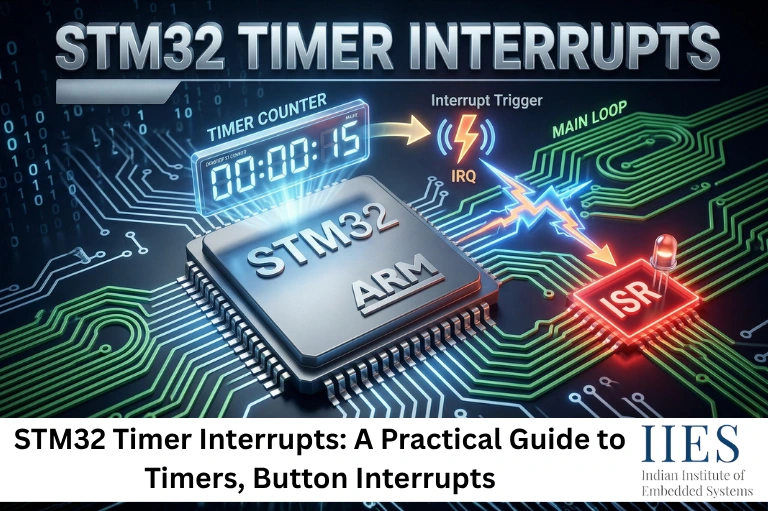
Instead of wasting CPU cycles in a loop, the timer peripheral counts in the background. Once the counter reaches a preset value, it triggers an interrupt and the CPU runs the corresponding Interrupt Service Routine (ISR).
This method improves:
- CPU efficiency
- responsiveness
- power optimization
- multitasking behavior
- timing precision

Understanding STM32 Timers Explained Simply
Before jumping into interrupts, it helps to understand how STM32 timers explained at the hardware level.
A timer mainly consists of:
Timer Component | Function |
Prescaler | Divides input clock frequency |
Counter | Counts timer ticks |
Auto Reload Register (ARR) | Sets overflow value |
Compare Register | Triggers compare events |
Capture Unit | Measures input signal timing |
How Timer Overflow Works
A stm32 timer overflow interrupt occurs when the counter reaches the ARR value and resets to zero.
For example:
- MCU clock = 72 MHz
- Prescaler = 7200 – 1
- ARR = 10000 – 1
This creates a 1-second interrupt event.
That is the foundation of almost every stm32 timer interrupt example.
Types of STM32 Timers
STM32 microcontrollers provide different types of timers for various applications:
1. Basic Timers (TIM6, TIM7)
- Used for simple time base generation
- No input/output features
2. General Purpose Timers (TIM2–TIM5)
- Support input capture and output compare
- Used in most applications
3. Advanced Timers (TIM1, TIM8)
- Used for motor control and PWM
- Support dead-time insertion and complementary outputs
Key Insight:
Choosing the right timer type is important for performance and scalability in embedded systems.
STM32 Timer Configuration Step by Step
A correct stm32 timer configuration follows a clear workflow.
1) Enable Timer Clock
First enable the peripheral clock for TIM2.
__HAL_RCC_TIM2_CLK_ENABLE();
2) Configure Prescaler and Period
This decides interrupt frequency.
htim2.Instance = TIM2;

htim2.Init.Prescaler = 7199;

htim2.Init.Period = 9999;

htim2.Init.CounterMode = TIM_COUNTERMODE_UP;

HAL_TIM_Base_Init(&htim2);
3) Start Interrupt Mode
HAL_TIM_Base_Start_IT(&htim2);
4) Handle Timer Callback
void HAL_TIM_PeriodElapsedCallback(TIM_HandleTypeDef *htim)

{

   if(htim->Instance == TIM2)

   {

       HAL_GPIO_TogglePin(GPIOA, GPIO_PIN_5);

   }

}
This is the most common stm32 timer interrupt example code used for LED blink projects.
Practical STM32 Timer Example: LED Blink Without Delay
Let’s convert the theory into a practical stm32 timer example.
Problem
Blink LED every 1 second without blocking delay.
Why This Matters
Using interrupt-driven timing allows the CPU to simultaneously:
- read sensors
- process UART data
- handle communication
- monitor button events
Workflow
- Timer counts in hardware
- Overflow occurs every 1 second
- Interrupt triggers callback
- LED toggles instantly
This is much more scalable than HAL_Delay().
Real Industry Use Case
This same structure is used in:
- RTOS task scheduling
- industrial PLC timing
- battery monitoring systems
- automotive diagnostics
- IoT heartbeat signals
STM32 Button Interrupt and External Interrupt Setup
Now let’s combine timers with stm32 button interrupt logic.
A button press is typically handled using stm32 external interrupt through EXTI lines.
Example Use Case
- PA0 → button input
- PA5 → LED output
When the button is pressed, the LED toggles immediately.
GPIO External Interrupt Configuration
GPIO_InitTypeDef GPIO_InitStruct = {0};

GPIO_InitStruct.Pin = GPIO_PIN_0;

GPIO_InitStruct.Mode = GPIO_MODE_IT_FALLING;

GPIO_InitStruct.Pull = GPIO_PULLUP;

HAL_GPIO_Init(GPIOA, &GPIO_InitStruct);
Callback Function
void HAL_GPIO_EXTI_Callback(uint16_t GPIO_Pin)

{

   if(GPIO_Pin == GPIO_PIN_0)

   {

       HAL_GPIO_TogglePin(GPIOA, GPIO_PIN_5);

   }

}
This is one of the most searched beginner-friendly stm32 external interrupt examples.
Button Debouncing in STM32 Interrupts
Mechanical buttons do not generate a clean signal. When pressed, they produce multiple rapid transitions due to physical bouncing.
This can cause multiple unwanted interrupts.
Software Debouncing Example:
static uint32_t last_interrupt_time = 0;

void HAL_GPIO_EXTI_Callback(uint16_t GPIO_Pin)

{

  if(GPIO_Pin == GPIO_PIN_0)

  {

     if(HAL_GetTick() - last_interrupt_time > 200)

     {

        HAL_GPIO_TogglePin(GPIOA, GPIO_PIN_5);

        last_interrupt_time = HAL_GetTick();

     }

  }

}
Why It Matters:
- Prevents false triggering
- Improves system reliability
- Essential for real-world products

STM32 Timer Interrupt vs External Interrupt
A common beginner confusion is choosing between timer and GPIO interrupts.
Feature | Timer Interrupt | External Interrupt |
Trigger Source | Internal timer event | GPIO pin event |
Best For | periodic tasks | button/sensor trigger |
Precision | extremely high | depends on external signal |
CPU Usage | low | low |
Example | LED blink | push button |
Expert Tip
In real products, both are often combined.
For example:
- timer interrupt → periodic sensor read
- button interrupt → manual trigger
- timer overflow → timeout recovery
This hybrid design is common in smart devices.
Understanding STM32 Interrupt Priority
When multiple interrupts occur together, stm32 interrupt priority decides which ISR runs first.
For example:
- UART receive interrupt
- Timer overflow interrupt
- Button press interrupt
NVIC handles the order.
HAL_NVIC_SetPriority(TIM2_IRQn, 1, 0);

HAL_NVIC_EnableIRQ(TIM2_IRQn);
Best Practice
Use higher priority for:
- motor control
- communication safety
- emergency stop
- critical timing loops
Use lower priority for:
- status LEDs
- logging
- debug UART
Good interrupt design prevents latency issues.
Common Mistakes to Avoid
Even experienced developers sometimes make these mistakes.
- Wrong Prescaler Calculation
This causes incorrect timing intervals.
Avoid long calculations inside interrupt callbacks.
Bad:
for(int i=0;i<100000;i++);
Good:
Set a flag and process in main loop.
- Missing Interrupt Flag Handling
Uncleared flags may repeatedly trigger the ISR.
A stm32 button interrupt may trigger multiple times because of switch bounce.
Improper stm32 interrupt priority can break communication and control loops.
Trends: Where STM32 Timer Interrupts Are Used
In 2026 and beyond, timer-driven architectures are becoming even more important.
Major Growth Areas
- Industrial IoT edge controllers
- Robotics timing loops
- EV battery systems
- Smart medical devices
- AI-enabled embedded systems
- autonomous drones
- predictive maintenance devices
Precise interrupt timing is a foundational skill for these industries.
Future STM32 projects increasingly rely on:
- DMA + timer triggers
- ADC synchronized sampling
- advanced PWM motor control
- low-power wake-up timers
- hardware event chaining
So mastering STM32 timer interrupts directly improves your embedded systems career.
Best Practices for Reliable STM32 Timer Projects
Follow these expert recommendations:
- Keep ISR code minimal
- Use flags for heavy processing
- calculate prescaler carefully
- debounce external interrupts
- document timer frequencies
- use CubeMX for visualization
- validate overflow intervals on oscilloscope
- prioritize critical interrupts properly
These practices make firmware production-ready.

Conclusion
Understanding STM32 timer interrupts is one of the most valuable skills in embedded systems development. From simple LED blinking to advanced motor control and industrial IoT timing loops, timers and interrupts define how efficiently your firmware responds to real-world events.
By learning stm32 timers, stm32 timer interrupt example code, stm32 button interrupt, and stm32 external interrupt workflows, you build the foundation required for high-performance real-time applications.
If you want to grow into advanced embedded firmware roles in 2026, mastering timer interrupts, overflow logic, and NVIC priority management is non-negotiable.
Start with a simple LED blink project, combine it with a button interrupt, then scale toward PWM, DMA, and RTOS scheduling.