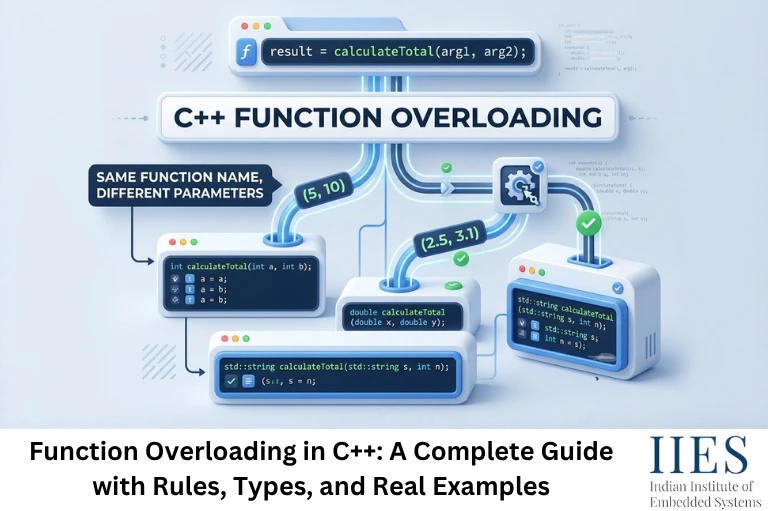
What Is Function Overloading in C++?
Function overloading is a C++ feature that lets you define multiple functions with the same name in the same scope, as long as their parameter lists are different.
The compiler tells overloaded functions apart by looking at:
- The number of arguments
- The type of arguments
- The order of argument types
#include
using namespace std;

int add(int a, int b) {
    return a + b;
}

double add(double a, double b) {
    return a + b;
}

int main() {
    cout << add(2, 3) << endl; // Calls add(int, int) -> 5
    cout << add(2.5, 3.5) << endl; // Calls add(double, double) -> 6.0
    return 0;
}
Same function name, two completely different behaviors, chosen automatically based on what you pass in.
Key point: Function overloading is a form of compile-time polymorphism, the compiler decides which version to call while compiling your code, not while it’s running.
How Does Function Overloading Work in C++?
When you call an overloaded function, the compiler doesn’t treat it as one function with multiple behaviors, it treats every overloaded version as a completely separate function with its own internal identity.
Here’s the general process:
- You call a function with a specific set of arguments.
- The compiler scans every overload of that function name currently in scope.
- It matches your arguments against each overload’s parameter list, using rules like exact match, promotion (
int to double, for example), or standard conversion. - It picks the best-matching overload. If two or more overloads match equally well, you get an ambiguous call compile-time error.
- Internally, the compiler uses a technique called name mangling, it encodes parameter types into each function’s internal name so the linker can tell overloads like
add(int, int) and add(double, double) apart at the object-code level.
This is also why C++ code doesn’t link directly into plain C the way you’d expect: C has no overloading and no name mangling, which is exactly why embedded and firmware projects that mix C and C++ rely on extern "C" blocks to keep function names compatible across both languages.

Rules of Function Overloading in C++
Not every difference between two functions counts as valid overloading. Here’s what the compiler actually enforces:
- Functions must share the same name.
- They must differ in the number, type, or order of parameters.
- Return type alone is never enough, two functions that differ only in what they return are not valid overloads.
- Overloaded functions must exist in the same scope, the same class, same namespace, or global scope.
- Default arguments can create ambiguity if they cause two overloads to match the same call equally well.
- A
const or reference/pointer qualifier on a parameter can create a distinct overload (for example, void show(int&) versus void show(const int&)), but a const on a plain pass-by-value parameter does not.
Common mistake: Trying to overload by return type only.
int getValue();
double getValue();   // Compile error: functions can't be overloaded by return type alone
Types of Function Overloading in C++
Function overloading in C++ generally falls into three categories.
1. Overloading by Number of Parameters
void greet() {
    cout << "Hello!" << endl;
}

void greet(string name) {
    cout << "Hello, " << name << "!" << endl;
}
2. Overloading by Data Type of Parameters
void printValue(int value) {
    cout << "Integer: " << value << endl;
}

void printValue(float value) {
    cout << "Float: " << value << endl;
}
3. Overloading by Order of Parameters
void display(int a, char b) {
    cout << a << " " << b << endl;
}

void display(char a, int b) {
    cout << a << " " << b << endl;
}
All three are valid because, in each case, the compiler has a clear, unambiguous way to match a function call to exactly one version.
Example of C++ Function Overloading
Here’s a complete working example that demonstrates function overloading in C++ across several parameter variations at once:
#include
using namespace std;

class Calculator {
public:
    int add(int a, int b) {
        return a + b;
    }

    double add(double a, double b) {
        return a + b;
    }

    int add(int a, int b, int c) {
        return a + b + c;
    }
};

int main() {
    Calculator calc;
    cout << calc.add(5, 10) << endl; // int version -> 15
    cout << calc.add(2.5, 3.7) << endl; // double version -> 6.2
    cout << calc.add(1, 2, 3) << endl; // three-int version -> 6
    return 0;
}
Same add() name, three different jobs, and the compiler figures out exactly which one to run every single time.
Why Is Function Overloading in C++ Used?
Function overloading exists to solve one core problem: naming fatigue. Without it, you’d need a separate function name for every data type you want to support.
It’s used to:
- Simplify APIs — one intuitive name instead of
addInt, addFloat, addDouble - Improve readability — the function name describes what it does, not what type it works on
- Get generic-feeling behavior without reaching for templates on simple cases
- Build flexible libraries Arduino’s
Serial.print() is a real-world example, overloaded to accept int, float, char*, and more through one clean function name
If you’ve ever written Serial.print(sensorValue) for an integer reading and then Serial.print(voltage) for a floating-point reading, you’ve already used function overloading in an embedded project, whether you realized it or not.
Function Overloading vs Overriding
These two terms get mixed up constantly, but they solve completely different problems.
| Aspect | Function Overloading | Function Overriding |
|---|
| Definition | Same name, different parameters, same scope | Same name and same parameters, redefined in a derived class |
| Polymorphism type | Compile-time (static) | Runtime (dynamic) |
| Inheritance required? | No | Yes, needs a base and derived class |
| Parameter list | Must be different | Must be identical |
| Return type | Can differ | Must be same or covariant |
| Keyword involved | None | virtual in the base, override in the derived (C++11+) |
| Resolved by | The compiler, at compile time | The vtable, at runtime |
Key point: If you’re changing how many or what type of arguments a function takes, that’s overloading. If you’re changing what a base class function does inside a derived class, that’s overriding.

Advantages of Function Overloading in C++
- Cleaner, more intuitive code, one function name covers multiple related behaviors
- Better code organization, related operations stay grouped under a single name
- No runtime performance cost, resolution happens entirely at compile time
- Easier-to-use libraries, callers don’t need to memorize type-specific function names
- Improved maintainability, supporting a new type means adding an overload, not renaming things across the codebase
Disadvantages of Function Overloading in C++
- Ambiguity errors — implicit type conversions can make two overloads equally valid, causing a compile-time error
- No overloading by return type alone — this limits certain design choices
- Readability can suffer — too many overloads of the same name can make it hard to know which version actually runs
- Harder debugging — when something breaks, you first have to work out which overload was actually called
- Risky with default arguments — the two features can silently conflict and produce ambiguous calls
Common Mistakes to Avoid With Function Overloading
- Confusing overloading (same scope, resolved at compile time) with overriding (needs inheritance, resolved at runtime)
- Assuming overloaded functions in a base class stay visible for overloading in a derived class, they don’t. A derived class function hides every base class overload of that name unless you bring them back with a
using Base::functionName; declaration - Overloading near-identical numeric types (
int, long, short, float, double) and getting blindsided by implicit conversions picking an unexpected overload - Assuming parameter names matter for overloading, they don’t. Only parameter types do, so
add(int a, int b) and add(int x, int y) are not valid overloads of each other; they’re duplicate declarations
Key Takeaways
- Function overloading means the same function name with different parameter lists, resolved at compile time
- Overloaded functions differentiate by number, type, or order of parameters, never by return type alone
- Function overloading differs from overriding, which needs inheritance and resolves at runtime instead of compile time
- Function overloading is used everywhere, from simple utility functions to real embedded libraries like Arduino’s
Serial.print() - The best way to get comfortable with it is to open a compiler and start experimenting, write a small overloaded utility class and watch how the compiler resolves each call
If you’re heading toward embedded systems or IoT development, this is one of those fundamentals that keeps paying off. Most hardware libraries, Arduino, mbed, ESP-IDF, lean on overloading heavily, so recognizing the pattern here makes reading real firmware code noticeably easier.