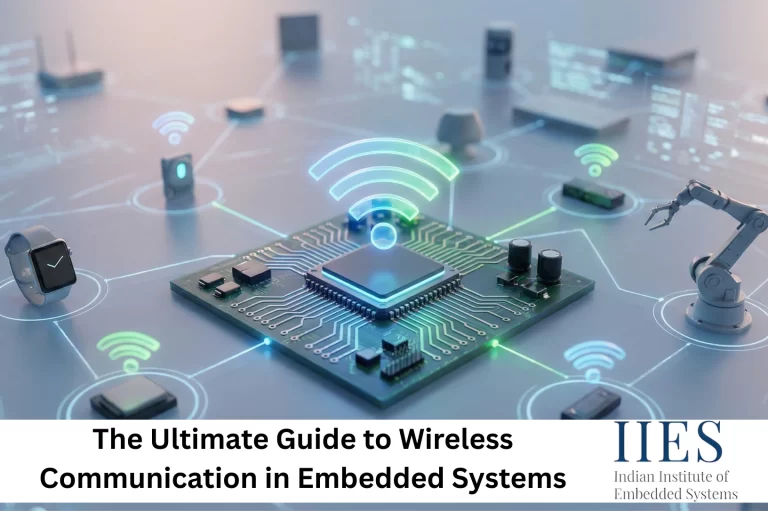
What is Wireless Communication in Embedded Systems?
Wireless communication in embedded systems refers to the exchange of data using radio frequency (RF) signals instead of wired interfaces. A typical architecture includes a microcontroller (MCU) or system-on-chip (SoC), a wireless transceiver or integrated radio module, a protocol stack, and firmware responsible for connectivity management.
Unlike wired communication, wireless systems must handle signal propagation, RF interference, bandwidth limitations, encryption, and regulatory compliance within ISM bands such as 2.4 GHz and sub-GHz frequencies.
Applications range from wearable fitness trackers and industrial monitoring nodes to smart energy meters and agricultural sensing devices. These deployments often form wireless sensor networks, where multiple distributed nodes communicate with a gateway or cloud platform for centralized data processing.

Selecting Appropriate Wireless Technologies
Choosing the right wireless protocol directly impacts latency, scalability, battery life, and deployment cost. Selection should be based on measurable system requirements rather than trends.
Key design considerations include:
- Available power source
- Required communication range
- Data throughput needs
- Environmental interference
- Budget and scalability
Wireless Technology Comparison
Feature | Wi-Fi | BLE | LoRa | Zigbee |
Frequency Band | 2.4 / 5 / 6 GHz | 2.4 GHz | Sub-GHz (433/868/915 MHz) | 2.4 GHz |
Range | 50–100 m | 10–50 m | 5–15 km | 10–100 m |
Data Rate | High (Mbps) | Low | Very Low | Moderate |
Power Consumption | High | Very Low | Ultra Low | Low |
Ideal Use Case | Cloud-connected devices | Wearables | Agriculture / Smart Cities | Mesh networks |
Wi-Fi supports high-bandwidth cloud applications. Bluetooth Low Energy is ideal for battery-powered personal devices. LoRa enables long-range communication with minimal energy usage. Zigbee is suited for mesh-based smart home systems.
Recent improvements such as Wi-Fi 7 enhance throughput and ultra-low latency performance, while Bluetooth 5.x improves range and coexistence in crowded RF environments.
Design and Integration of Hardware
Reliable wireless communication in embedded systems begins with hardware design. Even well-optimized firmware cannot compensate for poor RF layout.
Common Hardware Components
Embedded developers frequently use microcontrollers such as STM32, ATmega, ESP32, and Nordic nRF series. Modules like ESP8266 (Wi-Fi), HC-05 (Bluetooth), and RFM95 (LoRa) simplify implementation.
Stable power delivery is critical because wireless transmissions generate peak current demands.
Approximate Power Consumption
Component | Active Current | Sleep Current |
ESP32 (Wi-Fi TX) | 240–280 mA | 10–20 µA |
nRF52832 (BLE) | 5–6 mA | <1 µA |
RFM95 (LoRa TX) | ~120 mA | ~1 µA |
DHT11 Sensor | ~2.5 mA | 0 |
These values illustrate why power optimization is essential in wireless embedded systems.
MCU and Module Connectivity
Wireless modules interface with microcontrollers through UART, SPI, I2C, USB, or SDIO. SPI is often used for RF modules due to higher data rates, while UART is common for AT-command-based communication.
RF Layout Considerations
Effective PCB layout improves signal stability and range. Best practices include maintaining a proper ground plane, ensuring impedance matching, isolating digital noise sources, and optimizing antenna placement.
Protocols and Software Stack
Wireless communication typically follows a layered architecture inspired by the OSI model, progressing from physical RF transmission to application-layer data exchange.
Developers use vendor SDKs such as ESP-IDF or Nordic SDK, lightweight TCP/IP stacks like LWIP, and real-time operating systems such as FreeRTOS. RTOS-based systems enable concurrent task handling for sensing, communication, and low-power transitions, which is critical for real-time embedded communication.
Firmware Development Process
When learning how to integrate wireless communication in embedded systems, firmware architecture plays a central role.
The process begins with initializing the microcontroller and peripherals, configuring the wireless module, and establishing network connectivity. This may involve Wi-Fi association, BLE advertising, or LoRa network joining using OTAA or ABP.
Firmware must include reconnection logic, watchdog timers, state monitoring, and error handling to ensure reliability. Real-time systems must also manage latency and timing constraints carefully.
Communication Protocols
MQTT
MQTT is widely used in IoT and wireless sensor networks due to its lightweight publish-subscribe architecture. It reduces bandwidth usage and supports scalable cloud integration.
Example ESP32 MQTT initialization:
#include <WiFi.h>

#include <PubSubClient.h>

const char* ssid = "YourSSID";

const char* password = "YourPassword";

const char* mqttServer = "broker.hivemq.com";

WiFiClient espClient;

PubSubClient client(espClient);

void setup() {

  Serial.begin(115200);

  WiFi.begin(ssid, password);

  while (WiFi.status() != WL_CONNECTED) {

    delay(500);

  }

  client.setServer(mqttServer, 1883);

}
RESTful APIs
REST APIs using HTTP or HTTPS enable integration with cloud services. TLS encryption ensures secure data transmission.
BLE GATT
BLE uses the Generic Attribute Profile (GATT) for structured communication between devices and mobile applications.
Security Implementation
Security is fundamental in wireless embedded systems. Implementation includes AES encryption for BLE and Zigbee, TLS for Wi-Fi communication, secure boot mechanisms, authenticated OTA updates, and certificate-based device authentication.
Security architecture should be defined early in the system design phase to prevent vulnerabilities.
Power Management Strategies
Wireless modules consume significant energy during transmission. Engineers use duty cycling, deep sleep modes, adaptive transmission intervals, and wake-on-interrupt mechanisms to extend battery life.
For instance, ESP32 deep sleep mode reduces current consumption to approximately 10–20 µA, enabling long-term deployment in remote sensing applications.
Testing and Debugging Techniques
Reliable wireless communication requires systematic validation. Engineers use serial debugging, oscilloscopes, logic analyzers, and packet analysis tools such as Wireshark. RF testing equipment like spectrum analyzers helps identify interference in ISM bands.
Field testing ensures stability under real environmental conditions.
Practical Example: Wireless Temperature Logger
A simple example of wireless communication in embedded systems is a remote temperature monitoring system using ESP32, DHT11, Wi-Fi, MQTT, and ThingSpeak.
The device initializes Wi-Fi, reads temperature data periodically, transmits it to the cloud, and enters deep sleep mode. This demonstrates practical integration of sensing, networking, and power management.
Challenges in Wireless Embedded Systems
Engineers must manage RF interference, range limitations, tradeoffs between power and performance, congestion in wireless sensor networks, and reliable OTA update mechanisms. System-level optimization and thorough validation are essential for large-scale deployments.

Future Trends in Wireless Embedded Systems
Wireless embedded systems are entering a phase where connectivity is no longer just about transmitting data – it is about intelligence, autonomy, ultra-low power operation, and massive scalability. The next generation of systems will be faster, smarter, and significantly more energy-efficient.
1. AI at the Edge (TinyML Integration)
One of the most transformative trends is on-device artificial intelligence. Instead of sending raw sensor data to the cloud, embedded devices now run lightweight neural networks directly on microcontrollers.
TinyML enables:
- Predictive maintenance in industrial systems
- Real-time anomaly detection
- Voice recognition on low-power devices
- Health monitoring without constant internet connectivity
Edge AI reduces latency, lowers bandwidth costs, and enhances privacy – making wireless embedded systems more autonomous and reliable.
2. Ultra-Low Power & Energy Harvesting Systems
Future wireless embedded designs will focus heavily on energy independence. Engineers are integrating:
- Solar micro-harvesting
- RF energy harvesting
- Vibration-based energy systems
- Advanced deep sleep architectures
Sub-microamp sleep currents and adaptive transmission intervals will allow sensor nodes to operate for years without battery replacement, especially in smart agriculture and environmental monitoring.
3. LPWAN Expansion (Massive IoT Deployment)
Low Power Wide Area Networks are driving large-scale IoT infrastructure. Technologies such as:
are enabling long-range, low-data-rate communication across cities, industries, and rural environments.
This shift supports smart metering, smart cities, supply chain tracking, and precision farming on a global scale.
4. Wi-Fi 7 and High-Speed Industrial Connectivity
Next-generation Wi-Fi standards are redefining embedded connectivity in factories and automation systems.
Wi-Fi 7 introduces:
- Multi-gigabit throughput
- Ultra-low latency
- Better interference management
- Deterministic performance for industrial robotics
Wireless embedded systems will increasingly replace wired industrial Ethernet in controlled environments.
5. Secure-by-Design Architectures
With billions of connected endpoints, cybersecurity is becoming foundational rather than optional.
Future embedded platforms are integrating:
- Hardware Root of Trust
- Secure bootloaders
- On-chip cryptographic accelerators
- Zero-trust device authentication
Regulatory compliance and IoT security frameworks will shape firmware design from the earliest development stage.
6. Mesh Networking for Self-Healing Systems
Smart buildings, smart lighting, and industrial automation are moving toward self-healing mesh networks.
Protocols like:
- Zigbee
- Thread
- Bluetooth Mesh
allow devices to dynamically reroute data if a node fails, increasing reliability and scalability.
7. 5G and Edge Computing Integration
The rollout of 5G is enabling ultra-reliable low-latency communication (URLLC). Combined with edge computing, this allows:
- Real-time robotics control
- Remote surgery systems
- Autonomous vehicle coordination
- Smart manufacturing
Wireless embedded systems will increasingly operate as distributed intelligent nodes within 5G-enabled ecosystems.
8. Interoperability and Matter Standard Adoption
Cross-device compatibility is improving with unified standards like Matter.
This ensures seamless communication between devices from different manufacturers, accelerating smart home and IoT adoption.

Conclusion
Wireless communication in embedded systems has reshaped modern device design. It enables real-time embedded communication, scalable wireless sensor networks, and intelligent IoT ecosystems.
Successful implementation requires expertise in RF design, protocol stacks, firmware architecture, security, and energy optimization. Engineers who master these skills will lead innovation in smart infrastructure, robotics, industrial automation, and connected healthcare.
For students seeking structured, practical training in embedded and IoT technologies, the Indian Institute of Embedded Systems provides industry-focused programs designed to bridge theoretical learning with hands-on implementation.
Wireless integration is no longer optional – it is a foundational capability driving the future of embedded technology.