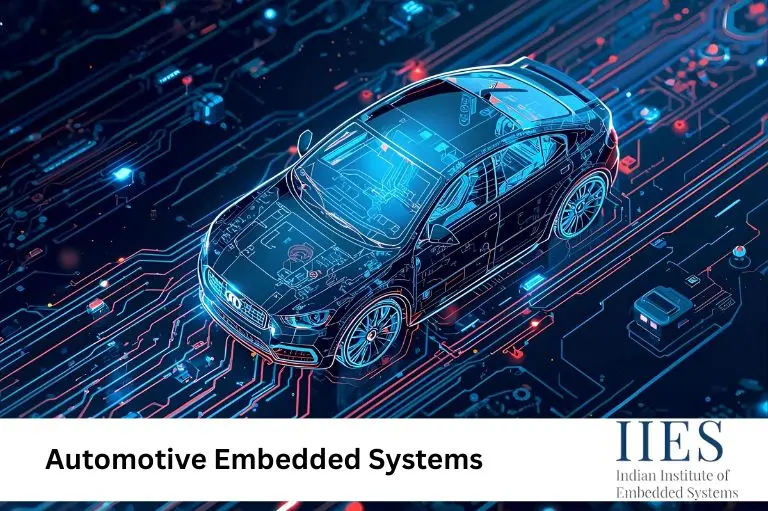
Why Automotive Embedded Systems Matter
In today’s vehicles, embedded systems are the driving force behind intelligence, automation, and safety.
From engine management and battery control to ADAS features and autonomous driving modules,
automotive embedded systems ensure precision, reliability, and next-generation mobility.
Understanding how these systems operate is crucial for engineers entering the era of software-defined vehicles,
AUTOSAR platforms, real-time computing, and in-vehicle communication networks.

What Are Embedded Systems in the Automotive Industry?
Embedded systems are specialized computing units designed to perform dedicated tasks inside a vehicle.
These systems combine hardware (automotive microcontrollers, sensors, actuators) with optimized firmware
and real-time automotive software.
Characteristics of Automotive Embedded Systems
- Real-time operation
- High reliability and functional safety
- Task-specific and resource-efficient
- Designed for harsh environmental conditions
- Use of automotive MCUs, ECUs, and RTOS
- Integration with multiple sensors and actuators
These features make embedded systems essential for applications ranging from
engine control to ADAS and connected mobility.
Automotive Embedded Systems – Quick Overview
| Property | Details |
| Usage | Control, monitoring, communication, automation |
| Includes | ECUs, sensors, actuators, communication networks |
| Speed | Real-time, deterministic |
| Standards | ISO 26262, ISO SAE 21434, AUTOSAR |
| Common Areas | ADAS, BMS, EMS, infotainment, cybersecurity |
How Automotive Embedded Systems Work
Automotive embedded systems gather data from sensors, process it using ECUs, and trigger actuators
to perform mechanical or electrical actions.
Workflow
- Sensors capture vehicle and environmental data.
- ECU processes the data using firmware/RTOS.
- Actuators perform the required operations.
- Vehicle networks enable communication across modules.
All actions occur within milliseconds to meet automotive safety requirements.
Key Technologies
- CAN protocol, LIN, FlexRay, Automotive Ethernet
- AUTOSAR Classic & Adaptive
- Automotive RTOS platforms
- AI for autonomous driving
- Automotive cybersecurity systems
Example – ADAS with Adaptive Cruise Control
ADAS systems use embedded electronics to process real-time sensor data and enhance driver safety.
- Radar inputs
- Camera feeds
- LIDAR data
- Vehicle speed sensors
These signals are processed inside high-performance ECUs running deterministic RTOS and AI algorithms.
- Automatic emergency braking
- Lane departure warning
- Blind spot detection
- Parking assistance
Example – Battery Management System (BMS) in EVs
The BMS ensures safe and optimized functioning of electric vehicle batteries.
- Cell temperature monitoring
- Voltage/current measurement
- Thermal management
- State-of-charge estimation
- Battery protection and balancing
Multiple microcontrollers, sensors, and algorithms work together to maintain EV battery health.

Difference Between Classic AUTOSAR and Adaptive AUTOSAR
| Feature | Classic AUTOSAR | Adaptive AUTOSAR |
| Use Case | Traditional ECUs | High-performance computers |
| Functionality | Real-time control | AI, autonomous driving |
| Flexibility | Static | Dynamic |
| Applications | Engine control, BMS, body ECUs | ADAS, automated driving |
Automotive Software Systems & RTOS
- Bare-metal firmware (C programming)
- Automotive RTOS (FreeRTOS, QNX, VxWorks)
- Linux for infotainment
- AUTOSAR layered architecture
- Support for V2X and zonal architecture
When to Use Classic or Adaptive AUTOSAR?
Use Classic AUTOSAR when:
- Strict real-time control is required
- Works with small ECUs, sensors, actuators
- Deterministic timing is essential
Use Adaptive AUTOSAR when:
- Developing autonomous driving systems
- High processing power is needed
- AI/ML workloads run inside the vehicle
Summary – Automotive Embedded Systems
| Component | Purpose |
| Sensors | Data collection |
| ECUs | Processing & control |
| Actuators | Mechanical response |
| Networks | In-vehicle data exchange |
| AUTOSAR | Standardized automotive software |
| Safety | ISO 26262 & ISO SAE 21434 |
Common Mistakes to Avoid
- Ignoring safety standards (ISO 26262)
- Weak cybersecurity implementation
- Overloading ECUs with non-critical tasks
- Poor thermal management in EVs
- Incorrect use of communication protocols

Conclusion
Automotive embedded systems form the core of modern smart vehicles.
As the industry transitions to software-defined architecture and AI-enabled mobility,
understanding these technologies helps engineers design safer, smarter, and more efficient automotive solutions.