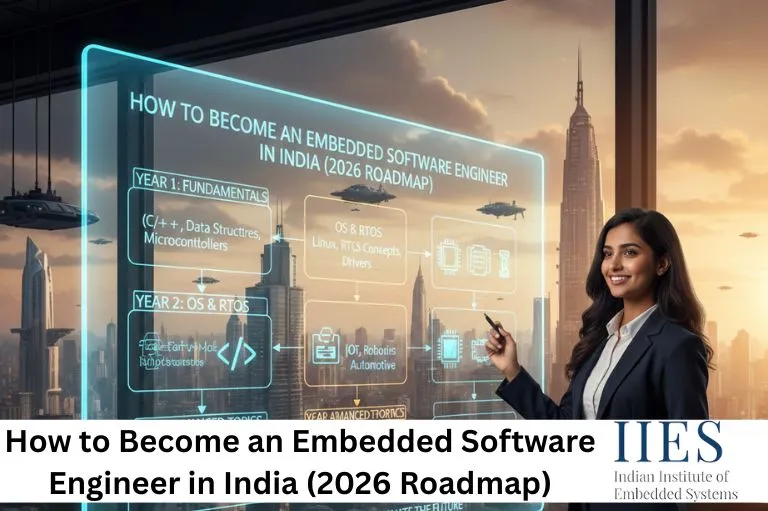
What Is Embedded Software Engineering?
Embedded software engineering involves writing programs that run inside hardware devices. Unlike regular desktop or web software, embedded systems operate with:
- Limited memory
- Limited processing power
- Real-time timing constraints
- Direct hardware interaction
Embedded software is used in:
- Smart TVs and home appliances
- Medical monitoring devices
- Automobiles and EV control systems
- Industrial PLCs and controllers
- IoT products
- Robotics systems
Because hardware reliability and timing are critical, embedded engineering is more hardware-intensive and technically specialized than general IT software roles.

Who Is an Embedded Software Engineer?
An embedded software engineer designs, develops, tests, and maintains firmware that controls electronic hardware.
They typically work with:
- Hardware engineers
- PCB designers
- System architects
- Testing and validation teams
- Product managers
Their goal is to ensure devices operate efficiently, reliably, and safely using optimized code.
Embedded Systems Career in India – Opportunities in 2026
India has become a major embedded development hub due to:
- Growth in electronics manufacturing
- Expansion of EV startups
- Semiconductor ecosystem development
- Government production-linked incentive (PLI) schemes
- Growth of IoT and Industry 4.0
Major Hiring Sectors
- Automotive & EV companies
- Semiconductor firms
- Industrial automation companies
- Consumer electronics brands
- Aerospace & defense firms
- Medical device manufacturers
- IoT startups
Long-Term Growth Path
With experience, engineers can move into:
- Firmware Lead
- System Architect
- Product Development Engineer
- R&D Specialist
- Automotive AUTOSAR Developer
- Embedded Linux Engineer
This is a stable, core engineering field with long-term demand.
Skills Required to Become an Embedded Engineer in India
To succeed in this field, you need both technical and professional skills.
1. Programming Skills (Foundation)
C programming is mandatory.
You must master:
- Data types and memory management
- Pointers and structures
- Bitwise operations
- Interrupt handling
- Stack vs Heap
- Embedded C concepts
C++ is useful for advanced systems.
Python helps in testing and automation.
2. Microcontrollers and Hardware Knowledge
You should understand:
For practice:
- Arduino
- STM32 boards
- ESP32 development kits
Hands-on hardware experience is critical.
3. Communication Protocols
Most embedded systems communicate using:
| Protocol | Use Case |
|---|
| UART | Serial communication |
| I2C | Sensor interfacing |
| SPI | High-speed peripherals |
| CAN | Automotive communication |
Understanding these protocols is essential for real-world projects.
4. RTOS (Real-Time Operating Systems)
Modern embedded products use RTOS.
Learn:
- Task scheduling
- Priority management
- Semaphores and mutex
- Inter-task communication
- Interrupt handling
- Memory allocation
FreeRTOS is widely used in industry.
5. Debugging and Testing
Debugging is one of the most important skills.
You should learn to use:
- IDE debuggers
- Breakpoints
- Logic analyzers
- Oscilloscopes
- JTAG tools
Strong debugging skills make you highly employable.

6-Month Embedded Engineer Roadmap (Practical Plan)
Month 1: C Programming + Electronics Basics
Focus:
- Loops, arrays, functions
- Pointers
- Bitwise operations
- Binary & hexadecimal systems
- Ohm’s law
- Digital logic (AND, OR, NOT)
Practice daily coding.
Goal: Build strong programming foundation.
Month 2: Microcontrollers & Arduino Projects
Focus:
- GPIO programming
- Timers
- ADC
- Serial communication
Projects:
- LED blinking
- Button interface
- Temperature sensor
- LCD display
Goal: Understand hardware-software interaction.
Month 3: ARM & Communication Protocols
Focus:
- ARM Cortex basics
- Memory maps
- UART, SPI, I2C
- Sensor interfacing
Projects:
- Bluetooth communication
- IoT dashboard
- Data logger
Goal: Work on industry-level boards.
Month 4: RTOS & Debugging
Focus:
- Multitasking
- Task scheduling
- Interrupt management
- Memory handling
- FreeRTOS basics
Projects:
- Multitasking LED system
- Sensor display with RTOS
Goal: Write real-time embedded applications.
Month 5: Major Project + Resume Building
Choose one:
- Smart home automation
- Vehicle tracking system
- IoT monitoring system
- Smart energy meter
- Industrial controller
Prepare:
- Source code
- Circuit diagram
- Technical report
- GitHub repository
- Demo video
Goal: Become job-ready.
Month 6: Interview Preparation
Prepare:
- C programming questions
- Pointers & memory
- Protocols
- RTOS concepts
- Debugging scenarios
Practice mock interviews.
Apply to startups and embedded companies.
Best Embedded Projects for Beginners
Beginner Level
- LED controller
- Digital clock
- Smart alarm
- Temperature monitoring system
Intermediate Level
Advanced Level
- Vehicle tracking system
- Industrial automation controller
- EV battery monitoring system
- Smart surveillance system
Always document your projects professionally.
How to Build a Strong Resume
Your resume should include:
- Technical skills
- Microcontrollers worked on
- Communication protocols known
- RTOS knowledge
- Project descriptions
- GitHub links
- Internship experience
Keep it one page. Focus on practical work.
Embedded Software Engineer Salary in India (2026)
Salary depends on skill depth and project exposure.
| Experience | Average Salary |
|---|
| Fresher | ₹3 – ₹6 LPA |
| 2–4 Years | ₹6 – ₹10 LPA |
| Senior | ₹10 – ₹18+ LPA |
Common Mistakes to Avoid
- Learning only theory
- Ignoring hands-on practice
- Weak C programming
- No debugging experience
- No real projects
- Copy-paste GitHub projects
Practical skills matter more than certificates.
Is Training Necessary?
Self-learning is possible. However, structured programs can help if they provide:
Before joining any institute, check:
- Curriculum depth
- Hardware access
- Alumni outcomes
- Student reviews
Choose programs that focus on hands-on learning, not just theory.
Final Conclusion
Embedded software engineering in India offers stable, technically strong, and future-ready career opportunities. If you focus on:
- Strong C programming
- Real hardware experience
- Communication protocols
- RTOS concepts
- Real-world projects
You can become job-ready within 6–8 months.The key is consistent hands-on practice, structured learning, and continuous improvement. Build real systems. Debug real problems. Document your work.That is what makes you an embedded engineer.