What Are Embedded Systems?
Embedded Systems are specialized computing systems designed to perform dedicated tasks within larger devices or machines. Unlike general-purpose computers, embedded systems are optimized for efficiency, reliability, and real-time performance.
Examples of Embedded Systems include:
- Smart TVs
- Washing machines
- Automotive control units
- Medical devices
- Industrial automation systems
- IoT devices
- Drones and robotics
- Smart home products
Embedded engineers typically work with:
- Microcontrollers
- ARM Cortex processors
- Embedded C programming
- RTOS
- Device drivers
- Communication protocols such as UART, SPI, CAN, and I2C
- Hardware and software integration
Embedded Systems remain one of the most important domains in electronics and product development.
What Is Machine Learning?
Machine Learning is a branch of Artificial Intelligence that enables computers to learn patterns from data and make predictions or decisions without being explicitly programmed for every scenario.
Machine Learning is used in:
- Recommendation systems
- Image recognition
- Voice assistants
- Fraud detection
- Healthcare applications
- Autonomous vehicles
- Predictive analytics
- Natural language processing
Machine Learning engineers commonly use:
- Python
- TensorFlow
- Scikit-learn
- PyTorch
- Data preprocessing techniques
- Statistical models
- AI algorithms
Machine Learning focuses more on software, data, and intelligent decision-making.

Embedded Systems vs Machine Learning: Quick Comparison
Feature | Embedded Systems | Machine Learning |
Focus Area | Hardware + Software | Data + Algorithms |
Programming Languages | Embedded C, C++, Python | Python, R |
Learning Curve | Moderate | Moderate to High |
Hardware Knowledge | Required | Minimal |
Mathematics Requirement | Basic | High |
Real-Time Systems | Yes | Not always |
Applications | IoT, Automotive, Consumer Electronics | AI Applications, Analytics |
Career Opportunities | Embedded Engineer | ML Engineer |
Industry Demand | High | Very High |
Future Scope | Excellent | Excellent |
Both domains have strong career potential, but they require different skill sets.
Skills Required for Embedded Systems
To build a successful career in Embedded Systems, you should learn:
- Embedded C Programming
- ARM Cortex Programming
- Microcontrollers
- RTOS concepts
- Linux for Embedded Systems
- Device drivers
- PCB fundamentals
- Communication protocols
- IoT fundamentals
- Embedded software development
These skills are highly valued in industries such as:
- Automotive
- Consumer electronics
- Aerospace
- Industrial automation
- Medical electronics
Skills Required for Machine Learning
Machine Learning requires expertise in:
- Python programming
- Statistics
- Linear algebra
- Data structures
- Data preprocessing
- AI algorithms
- Neural networks
- Deep learning frameworks
- Data visualization
- Model deployment
Machine Learning professionals work across industries including:
- Finance
- Healthcare
- E-commerce
- AI startups
- Robotics
- Cloud computing
Career Opportunities Embedded Systems Careers
Popular roles include:
- Embedded Software Engineer
- Firmware Engineer
- IoT Developer
- Automotive Embedded Engineer
- RTOS Developer
- Device Driver Developer
- Hardware Validation Engineer
Machine Learning Careers
Popular roles include:
- Machine Learning Engineer
- AI Engineer
- Data Scientist
- Computer Vision Engineer
- NLP Engineer
- AI Research Engineer
- Deep Learning Engineer
Both domains offer excellent salary growth, especially when combined with practical project experience.
Which Is Easier to Learn?
The answer depends on your interests.
Choose Embedded Systems if:
- You enjoy electronics.
- You like working with hardware.
- You are interested in IoT and microcontrollers.
- You want to build real-world products.
Choose Machine Learning if:
- You enjoy mathematics and data analysis.
- You like working with AI models.
- You are interested in intelligent software systems.
- You prefer software development over hardware.
Neither field is “easy.” Both require consistent practice and hands-on learning.
Future Scope of Embedded Systems
The demand for Embedded Systems professionals is growing because of:
- Smart vehicles
- Industrial automation
- Robotics
- Medical devices
- Smart homes
- IoT devices
- Edge computing
Every smart electronic device requires embedded software, making Embedded Systems an evergreen career choice.

Future Scope of Machine Learning
Machine Learning continues to revolutionize industries through:
- Artificial Intelligence
- Predictive analytics
- Autonomous systems
- Intelligent assistants
- Healthcare diagnostics
- Smart business solutions
The increasing adoption of AI ensures strong career opportunities worldwide.
Can Embedded Systems and Machine Learning Work Together?
Yes, and this is where the real innovation is happening.
Modern devices are becoming intelligent by combining Embedded Systems with Machine Learning.
Examples include:
- Face recognition door locks
- Smart surveillance cameras
- Driver monitoring systems
- Predictive maintenance systems
- AI-powered robots
- Smart wearables
- Healthcare monitoring devices
- Voice-controlled IoT products
This combination is commonly referred to as:
- Embedded AI
- TinyML
- Edge AI
- Machine Learning for Embedded Systems
Instead of sending data to the cloud, intelligent embedded devices can process information locally, improving:
- Speed
- Privacy
- Reliability
- Power efficiency
Embedded AI: The Future of Intelligent Devices
Embedded AI is one of the fastest-growing technologies today.
By combining:
Engineers can build intelligent products capable of:
- Real-time decision making
- Sensor data analysis
- Voice recognition
- Image classification
- Predictive maintenance
- Autonomous operations
Companies worldwide are investing heavily in Embedded AI applications for automotive, healthcare, industrial automation, and consumer electronics.
Embedded Systems vs Machine Learning: Which One Should You Choose?
Choose Embedded Systems if you:
- Love electronics and hardware.
- Want to work on smart devices.
- Enjoy programming microcontrollers.
Choose Machine Learning if you:
- Enjoy AI and data-driven applications.
- Prefer software-centric development.
- Like building intelligent models.
Choose both if you want to work on the next generation of smart products.
Final Thoughts
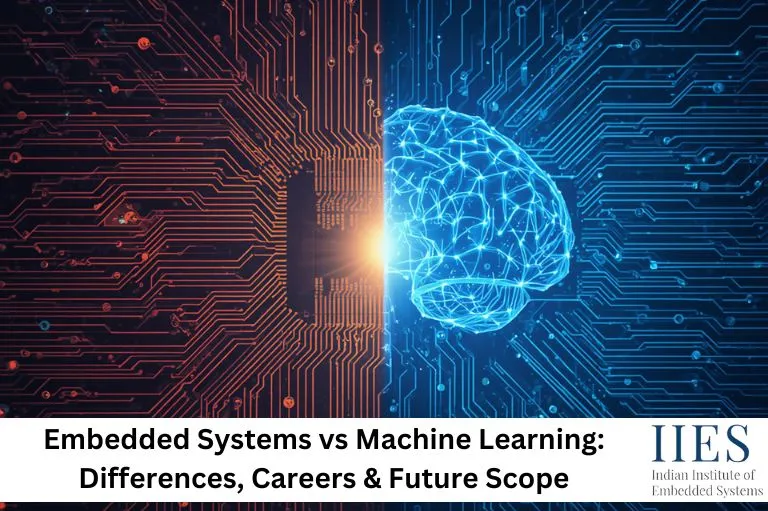
The debate between Embedded Systems vs Machine Learning should not be about choosing one over the other. Both technologies are powerful on their own, but their combination is shaping the future of intelligent devices.
The integration of Machine Learning with Embedded Systems creates smart, efficient, and autonomous products capable of performing real-time intelligent tasks. This field—often known as Embedded AI or TinyML—is becoming one of the most promising career paths in technology.
If you are planning your career for the future, learning both Embedded Systems and Machine Learning can give you a significant advantage. Together, they enable engineers to build everything from AI-powered wearables and autonomous robots to smart industrial systems and intelligent IoT devices.
The future isn’t Embedded Systems or Machine Learning—it’s intelligent Embedded Systems powered by Machine Learning.