What Is Edge Computing in IoT?
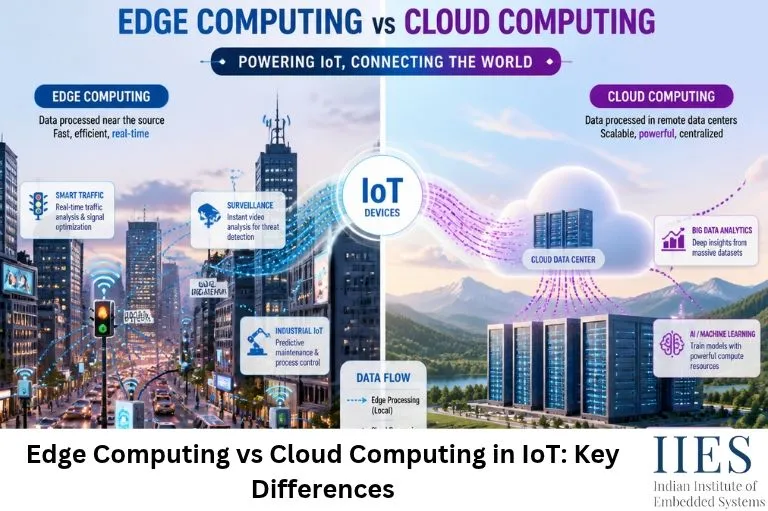
Edge computing in IoT is a distributed computing approach in which data is processed near the source where it is generated rather than sending all data to a centralized cloud server.
In an IoT environment, edge devices can include:
- Embedded microcontrollers
- IoT gateways
- Industrial PCs
- Edge servers
- Smart sensors with processing capabilities
- Single-board computers such as Raspberry Pi
These devices perform local processing, filtering, analysis, and decision-making before sending selected information to the cloud.
How Edge Computing Works in IoT
Consider an industrial machine equipped with temperature and vibration sensors.
The sensors continuously collect machine data. Instead of transmitting every reading to the cloud, an edge device analyzes the data locally.
If the temperature exceeds a predefined threshold, the edge device can immediately trigger an alarm or initiate a protective action.
The workflow is:
- Sensors collect temperature, vibration, or pressure data.
- The IoT gateway receives sensor readings.
- The edge device processes and analyzes the data locally.
- A decision is made based on predefined rules or an AI model.
- Only important information, alerts, or summarized data is transmitted to the cloud.
This approach reduces unnecessary network communication and enables faster responses.
Benefits of Edge Computing in IoT
1. Low Latency — Data processing happens close to the source, reducing the time required to send information to a remote server and receive a response.
2. Reduced Bandwidth Consumption — Instead of continuously transmitting raw sensor data, edge devices can send filtered or summarized information to the cloud.
3. Improved Reliability — Some edge applications can continue operating even when internet connectivity is temporarily unavailable.
4. Better Data Privacy — Sensitive information can be processed locally, reducing the amount of raw data transmitted over external networks.
5. Real-Time Decision-Making — Edge computing supports applications that require immediate responses, such as industrial safety systems, robotics, and autonomous machines.

What Is Cloud Computing in IoT?
Cloud computing in IoT refers to using remote internet-based servers and computing infrastructure to store, process, analyze, and manage data generated by connected devices.
Instead of depending entirely on local hardware, IoT devices transmit their data to cloud platforms.
Cloud computing provides centralized infrastructure with scalable storage, processing power, databases, analytics tools, and device management services.
Popular cloud platforms used in IoT include:
- AWS IoT
- Microsoft Azure IoT
- Google Cloud
- Oracle Cloud Infrastructure
How Cloud Computing Works in IoT
Consider a smart agriculture system with multiple soil moisture sensors installed across a large agricultural field.
These sensors collect information about soil moisture, temperature, humidity, and environmental conditions.
The collected information is transmitted through an internet connection to a cloud platform.
The cloud platform stores the information, processes historical readings, identifies patterns, and generates reports that farmers can access through a dashboard.
The workflow is:
- IoT sensors collect environmental data.
- Data is transmitted through a network connection.
- Cloud servers receive the sensor information.
- Cloud applications process and store the data.
- Analytics tools identify trends and patterns.
- Users access information through web or mobile applications.
Benefits of Cloud Computing in IoT
1. Scalable Infrastructure — Cloud platforms allow organizations to increase computing resources and storage as the number of connected devices grows.
2. Centralized Data Storage — Data from multiple IoT devices and geographical locations can be stored in a centralized environment.
3. Advanced Data Analytics — Cloud platforms support large-scale data analysis, machine learning, reporting, and historical data processing.
4. Remote Accessibility — Users can monitor and manage connected devices from different locations through internet-connected applications.
5. Integration Capabilities — Cloud infrastructure can integrate with databases, enterprise applications, analytics platforms, and other digital services.
Edge Computing vs Cloud Computing in IoT: Key Differences
Although both technologies support IoT applications, they differ in terms of processing location, latency, bandwidth requirements, storage, and connectivity.
The following table explains the major differences.
| Comparison Factor | Edge Computing | Cloud Computing |
| Processing location | Near the data source | Remote cloud servers |
| Latency | Generally low | Depends on network latency |
| Internet dependency | Can support local processing without internet | Usually requires connectivity |
| Bandwidth usage | Lower through local filtering | Can be higher when transmitting raw data |
| Data storage | Limited local storage | Large, scalable storage |
| Processing power | Limited by edge hardware | Large-scale computing resources |
| Scalability | Requires additional edge infrastructure | Easily scalable through cloud resources |
| Data privacy | Supports local data processing | Data is transmitted to cloud infrastructure |
| Real-time processing | Suitable for time-critical operations | Depends on connectivity and processing delays |
| Maintenance | Distributed hardware maintenance | Centralized infrastructure management |
Important: Edge computing does not automatically provide better security, and cloud computing is not always slower. Actual performance depends on hardware, network conditions, architecture, security controls, and application requirements.
Edge Computing Architecture in IoT
Edge computing architecture distributes processing tasks across connected devices and local computing infrastructure.
A typical IoT edge architecture contains the following components:
1. IoT Sensors and Devices
Sensors collect information from the physical environment.
Examples include:
- Temperature sensors
- Accelerometers
- Gyroscopes
- Pressure sensors
- Proximity sensors
- Motion sensors
2. Edge Devices
Edge devices receive and process data from connected sensors.
Examples include microcontrollers, embedded processors, industrial gateways, and edge computers.
3. Local Data Processing
The edge device filters, analyzes, and processes incoming information.
For example, a vibration monitoring system can identify abnormal machine vibrations without transmitting every reading to a remote server.
4. Cloud Connectivity
The edge system sends selected information to cloud platforms for long-term storage, centralized monitoring, and advanced analytics.
5. Application Layer
Users interact with the IoT system through dashboards, mobile applications, monitoring systems, and enterprise software.
Cloud Computing Architecture in IoT
Cloud-based IoT architecture uses centralized cloud infrastructure to manage data generated by connected devices.
Its major components include:
- IoT Devices: Sensors and embedded devices collect information from the environment.
- Communication Layer: Protocols such as MQTT, HTTP, and CoAP enable communication between devices and cloud services.
- Cloud Ingestion Layer: Receives incoming information from connected IoT devices.
- Data Storage Layer: Databases and cloud storage services store device information and historical records.
- Processing and Analytics Layer: Processes sensor data and performs analytics, reporting, and machine learning operations.
- Application Layer: Provides dashboards, alerts, reports, and remote device management capabilities.
This architecture is useful for applications that require centralized data management and large-scale analytics.
Edge Computing vs Cloud Computing: Real-World IoT Applications
Both computing approaches are used across different industries. The right choice depends on the application’s processing requirements, network availability, and response time.
1. Industrial IoT (IIoT)
Industrial machines use sensors to monitor temperature, vibration, pressure, and operating conditions.
Edge computing can analyze sensor readings locally and identify abnormal conditions immediately.
Cloud computing can store historical machine data, analyze long-term performance, and support predictive maintenance models.
2. Smart Healthcare
Connected medical devices collect patient information such as heart rate, temperature, and oxygen saturation.
Edge computing can support local monitoring and rapid alerts.
Cloud computing can maintain patient records, support remote monitoring, and analyze long-term health trends.
3. Smart Agriculture
IoT sensors measure soil moisture, humidity, temperature, and environmental conditions.
Edge computing can trigger irrigation systems based on local sensor readings.
Cloud computing can analyze information collected from multiple agricultural locations to support better farming decisions.
4. Smart Cities
Smart city infrastructure uses connected sensors for traffic monitoring, street lighting, environmental monitoring, and waste management.
Edge computing can process traffic information locally and support faster traffic signal responses.
Cloud computing can analyze city-wide data and help authorities understand long-term traffic patterns.
5. Autonomous Vehicles
Connected vehicles generate large volumes of data through cameras, radar, LiDAR, and other sensors.
Time-critical perception and vehicle control require local processing because relying on a remote cloud response would introduce unacceptable communication delays.
Edge computing supports local processing, while cloud infrastructure can support fleet analytics, software updates, and historical data analysis.
Edge Computing vs Cloud Computing: Which Is Better for IoT?
There is no single solution that is best for every IoT application.
The choice depends on how quickly the system must respond, how much data it generates, and whether continuous internet connectivity is available.
| Application Requirement | Recommended Approach |
| Real-time machine monitoring | Edge Computing |
| Large-scale historical data analysis | Cloud Computing |
| Local industrial automation | Edge Computing |
| Centralized IoT device management | Cloud Computing |
| Remote environmental monitoring | Cloud Computing |
| Autonomous systems | Edge Computing |
| Long-term data storage | Cloud Computing |
| Local decision-making without internet | Edge Computing |
For many modern IoT applications, combining both technologies provides the most practical solution.
Edge-to-Cloud Computing: Why IoT Systems Need Both
Edge-to-cloud computing is an architecture that combines local edge processing with centralized cloud infrastructure.
Instead of choosing only one computing model, the system distributes workloads according to their processing requirements.
For example, consider an industrial IoT predictive maintenance system.
- Sensors collect vibration and temperature data.
- An edge gateway filters incoming readings.
- A local machine learning model identifies abnormal operating conditions.
- Important alerts are generated locally.
- Selected sensor data is transmitted to the cloud.
- Cloud analytics examine historical machine performance.
- Engineers use dashboards to monitor equipment health.
This architecture provides a balance between real-time processing and large-scale data analysis.
Example of Edge-to-Cloud Architecture
| Layer | Function | Example |
| Device Layer | Collects physical data | Temperature and vibration sensors |
| Edge Layer | Processes data locally | Raspberry Pi or industrial gateway |
| Communication Layer | Transfers selected data | MQTT or HTTP |
| Cloud Layer | Stores and analyzes data | Cloud databases and analytics |
| Application Layer | Displays results | Web dashboard or mobile app |

Role of Embedded Systems in Edge Computing
Embedded systems play a major role in implementing edge computing because they provide the hardware and software required for local data processing.
An embedded system is a combination of hardware and software designed to perform specific functions within a larger electronic or mechanical system.
Common embedded platforms used in edge applications include:
- ESP32: Suitable for connected sensor applications, local processing, and lightweight IoT solutions.
- STM32: Used in industrial control, sensor processing, and real-time embedded applications.
- Raspberry Pi: Provides computing capabilities for IoT gateways, local analytics, and edge applications.
- ARM Cortex-M: Commonly used in low-power embedded devices and real-time control systems.
Programming languages such as C, C++, and Python are widely used in embedded and edge computing development.
Engineers may also work with communication protocols such as UART, SPI, I2C, CAN, and MQTT depending on the hardware and application.
For advanced applications, edge devices can run lightweight machine learning models using technologies such as TensorFlow Lite for Microcontrollers.
This allows certain AI-based tasks to run locally without continuously sending raw sensor data to the cloud.
Challenges of Edge Computing and Cloud Computing in IoT
Both computing models offer advantages, but they also introduce technical challenges.
Challenges of Edge Computing
- Limited processing power and memory on small embedded devices.
- Distributed hardware maintenance and software updates.
- Managing security across multiple edge devices.
- Handling different hardware platforms and operating environments.
- Supporting reliable communication between edge devices and cloud platforms.
Challenges of Cloud Computing
- Dependence on network connectivity for cloud-based operations.
- Communication latency for time-critical applications.
- Bandwidth costs when transmitting large amounts of sensor data.
- Managing data privacy and access controls.
- Cloud storage and computing costs as IoT deployments grow.
Understanding these challenges helps engineers design more reliable IoT architectures.
Future of Edge Computing and Cloud Computing in IoT
The future of IoT is moving towards distributed intelligence, where processing takes place across embedded devices, edge gateways, and cloud infrastructure.
Several technologies are contributing to this development.
- Edge AI: Machine learning models are increasingly being deployed directly on embedded devices and edge gateways for local inference.
- 5G Connectivity: High-speed, low-latency communication can improve connectivity between IoT devices, edge infrastructure, and cloud platforms.
- TinyML: TinyML enables machine learning models to operate on resource-constrained microcontrollers.
- Industrial Automation: Edge computing is supporting intelligent monitoring, robotics, and real-time industrial control.
- Hybrid Cloud Architectures: Organizations are combining edge and cloud infrastructure to improve processing efficiency, scalability, and data management.
As IoT deployments expand, engineers will increasingly need knowledge of embedded programming, communication protocols, edge computing, cloud platforms, and AI-based data processing.
Conclusion
Edge computing and cloud computing are two important technologies that support modern IoT systems.
Edge computing processes information closer to connected devices, making it suitable for applications that require low latency, local decision-making, and reduced network communication. Cloud computing provides centralized storage, scalable infrastructure, advanced analytics, and remote accessibility.
When comparing Edge Computing vs Cloud Computing in IoT, the important consideration is not which technology is better overall, but which processing approach best meets the application’s requirements.
In many real-world systems, combining edge and cloud computing creates an efficient architecture that supports real-time operations as well as large-scale data analysis.
For students and aspiring embedded engineers, understanding both technologies provides a strong foundation for working in Industrial IoT, embedded AI, smart devices, and connected systems.