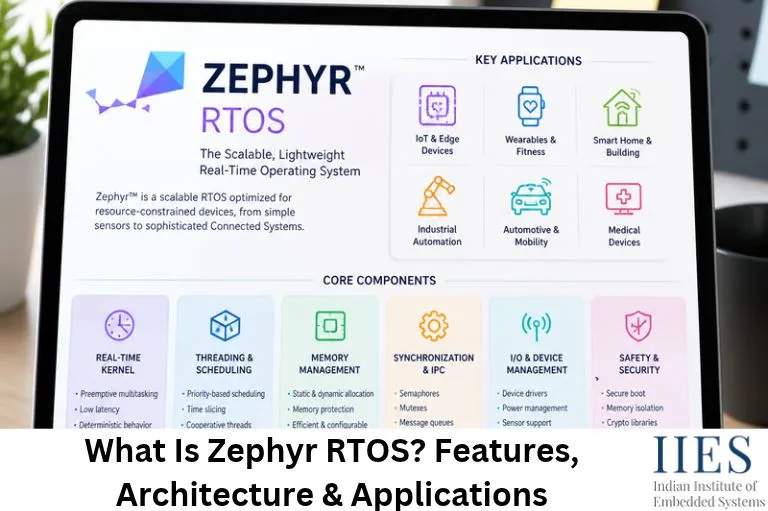
What Is Zephyr RTOS?
Zephyr RTOS is an open-source real-time operating system designed for embedded devices, microcontrollers, and IoT applications. It provides the essential software components required to develop reliable and efficient embedded applications.
Unlike traditional operating systems designed for computers, Zephyr RTOS is optimized for devices with limited processing power, memory, and storage.
It supports multiple hardware architectures, including ARM Cortex-M, RISC-V, x86, and other supported processor architectures.
Zephyr is maintained by the Zephyr Project under the Linux Foundation. It provides developers with a common software platform for building applications across different hardware platforms.
For example, developers can use Zephyr RTOS to build:
- Smart home automation devices
- Industrial monitoring systems
- Wearable electronic devices
- Wireless sensor networks
- Bluetooth-enabled embedded products
- IoT gateways and connected devices
Its modular design allows developers to include only the required software components, helping optimize memory usage and system performance.
What Are the Key Features of Zephyr RTOS?
Zephyr RTOS offers several features that make it suitable for modern embedded software development.
Multitasking Support
Multitasking allows an embedded system to execute multiple tasks efficiently. Zephyr RTOS supports multithreading, enabling developers to divide application functionality into independent threads.
For example, a temperature monitoring device may perform multiple operations:
- Read temperature sensor data.
- Process the collected information.
- Send data through a wireless connection.
- Update the display.
Each operation can be implemented as a separate thread with appropriate priorities.
Real-Time Task Scheduling
Zephyr RTOS uses a priority-based scheduler to manage thread execution. Developers can assign different priorities to threads depending on their importance.
For example, a motor control application may prioritize sensor monitoring and control operations over background communication tasks. This helps applications respond to time-sensitive events efficiently.
Device Driver Support
Device drivers allow software applications to communicate with hardware components. Zephyr RTOS provides a device driver framework that supports different peripherals and hardware interfaces.
Common interfaces include:
This makes it easier for developers to integrate sensors, communication modules, displays, and other hardware components into embedded applications.
Networking and Connectivity
Modern embedded products frequently require wireless and wired communication. Zephyr RTOS includes networking support for protocols and technologies such as:
- Bluetooth Low Energy (BLE)
- Wi-Fi, where supported by the hardware and drivers
- IPv4 and IPv6
- TCP and UDP
- MQTT
- CoAP
These capabilities make Zephyr useful for connected devices, IoT applications, and wireless sensor networks.
Memory Management
Microcontrollers generally have limited RAM and flash storage. Zephyr RTOS provides memory management features, including memory slabs, memory pools, heaps, and stack management. Developers can select suitable memory allocation methods depending on application requirements.
Security Features
Security is essential for connected embedded devices. Zephyr provides security-related capabilities such as secure boot integration, cryptographic libraries, secure firmware update support through relevant components, and hardware-based security integration where supported.

Understanding Zephyr RTOS Architecture
Embedded systems developers need to understand RTOS architecture to see how an operating system manages hardware resources and application tasks. Zephyr follows a modular architecture in which different software components work together to execute embedded applications.
| Layer | Function |
| Application Layer | Contains the program developed by embedded engineers, such as an IoT temperature monitoring application |
| Kernel Layer | Manages threads, scheduling, interrupts, synchronization, message queues, semaphores, and timers |
| Device Driver Layer | Provides an interface between the operating system and hardware peripherals |
| Hardware Abstraction Layer | Lets software work across processor architectures and boards without rewriting the application |
| Networking and Middleware | Provides networking stacks, Bluetooth support, file systems, and other components for connected applications |
The kernel ensures that different application threads execute according to their priorities and system requirements.
What Are the Different Applications of Zephyr RTOS?
Zephyr RTOS is used in embedded applications where low resource consumption, connectivity, and real-time task management are important.
Internet of Things (IoT)
Zephyr supports connected devices that collect, process, and exchange information, such as smart home controllers, environmental monitoring devices, and wireless sensor networks.
Industrial Automation
Zephyr can be used in suitable industrial embedded devices for sensor data collection, equipment monitoring, and communication between connected components.
Wearable Devices
Fitness trackers and health-monitoring devices need efficient power management and compact software. Zephyr can support these applications when the selected hardware meets the system requirements.
Smart Home Devices
Zephyr’s networking and Bluetooth capabilities make it useful for products that manage lighting, temperature, security, and connected appliances.
Wireless Sensor Networks
Zephyr supports wireless communication technologies that can be used to build sensor nodes that collect and transmit environmental or industrial information.
Zephyr RTOS vs FreeRTOS: What Is the Difference?
FreeRTOS and Zephyr RTOS are popular choices in embedded software development. Both provide real-time operating system capabilities, but they differ in architecture, available components, and development approaches.
| Feature | Zephyr RTOS | FreeRTOS |
| Source model | Open source | Open source |
| Kernel | Integrated Zephyr kernel | FreeRTOS kernel |
| Architecture | Modular OS framework | Lightweight RTOS kernel |
| Device drivers | Integrated driver framework | Generally platform or vendor supplied |
| Networking | Integrated networking components | Available through additional libraries and integrations |
| Bluetooth | Supported through Zephyr components | Depends on additional stacks and platform integrations |
| Hardware support | Multiple architectures and boards | Broad microcontroller ecosystem |
| Development tools | West, CMake, Kconfig | Toolchain and IDE dependent |
| Use cases | IoT, connected devices, embedded products | IoT, controllers, and real-time embedded applications |
Which One Should Embedded Developers Learn?
The choice depends on the project requirements. FreeRTOS is a good starting point for developers who want to understand RTOS fundamentals, task scheduling, queues, semaphores, and multitasking.
Zephyr RTOS is useful for developers who want to work with a more integrated framework that includes device drivers, networking, Bluetooth, and support for multiple hardware platforms. Learning both can help developers understand different approaches to embedded operating system development.

What Are the Types of RTOS?
Real-time operating systems are generally classified into three major categories based on their timing requirements.
Hard Real-Time Operating System
A hard real-time operating system must meet strict timing deadlines. Missing a deadline can result in system failure or serious consequences. Examples include aircraft control systems, automotive safety-critical control systems, and medical equipment requiring strict timing guarantees.
Soft Real-Time Operating System
A soft real-time operating system allows occasional deadline misses, although system performance may be affected. Examples include multimedia applications, audio processing systems, and video streaming devices.
Firm Real-Time Operating System
A firm real-time operating system treats results received after their deadlines as useless, even though occasional missed deadlines may not cause complete system failure. Examples include certain industrial inspection and monitoring systems.
Understanding these types helps embedded developers select an appropriate real-time operating system for their applications.
What Are Some Real-Time Operating System Examples?
Several real-time operating systems are used in embedded software development.
- Zephyr RTOS
- FreeRTOS
- VxWorks
- QNX
- ThreadX (Azure RTOS)
- RTEMS
- NuttX
Each operating system has different capabilities, licensing models, hardware support, and application requirements. Developers should evaluate the processor architecture, memory requirements, real-time constraints, connectivity needs, and project complexity before selecting an RTOS.
How to Start Learning Zephyr RTOS?
Developers interested in learning Zephyr RTOS should first understand the fundamentals of embedded programming and microcontroller architecture. Here is a suggested learning path.
Step 1: Learn Embedded C Programming
C programming is essential for embedded software development. Focus on:
- Pointers and memory management
- Structures and unions
- Bitwise operations
- Interrupt handling
- Register-level programming
A focused embedded C course can help build these fundamentals.
Step 2: Understand Microcontroller Architecture
Learn how microcontrollers work and understand important components such as:
- CPU architecture
- GPIO peripherals
- Timers and counters
- Interrupt controllers
- UART, SPI, and I2C communication
ARM Cortex-M programming provides a useful foundation for understanding many microcontroller-based systems.
Step 3: Understand RTOS Fundamentals
Before working with Zephyr, understand how real-time operating systems function. Learn about:
- Tasks and threads
- Task scheduling in RTOS
- Context switching
- Interrupt handling in RTOS
- Semaphores and mutexes
- Message queues
- Multitasking in embedded systems
Step 4: Set Up the Zephyr Development Environment
Zephyr development typically involves tools and components such as:
- Zephyr SDK
- West meta-tool
- CMake
- Python
- Device Tree
- Kconfig
Start with a supported development board and follow the official Zephyr documentation to configure the development environment.
Step 5: Build Practical Projects
Practical implementation helps developers understand how an RTOS works in real embedded applications. Start with simple projects such as:
- LED blinking using Zephyr
- GPIO interrupt handling
- UART communication
- Temperature sensor interfacing
- Bluetooth Low Energy communication
- Multithreaded sensor monitoring
These projects help develop practical knowledge of firmware development and embedded software architecture.
Why Are Embedded Developers Learning Zephyr RTOS?
The demand for connected embedded devices is increasing across automotive, industrial automation, consumer electronics, and IoT industries. As a result, embedded developers need to understand more than basic microcontroller programming.
Zephyr RTOS helps developers gain experience with several important areas of modern embedded software development:
- Understanding real-time operating system architecture.
- Working with multitasking and thread scheduling.
- Developing hardware device drivers.
- Implementing wireless communication.
- Building connected IoT applications.
- Working with multiple microcontroller architectures.
- Developing and debugging embedded firmware.
Knowledge of Zephyr RTOS can complement existing embedded C, ARM Cortex-M, FreeRTOS, and microcontroller programming skills.
However, learning Zephyr alone does not guarantee employment. Developers should combine RTOS knowledge with practical projects, hardware debugging, communication protocols, and strong embedded C programming fundamentals.
Conclusion
Zephyr RTOS is becoming an important technology in modern embedded software development because of its modular architecture, hardware support, networking capabilities, and real-time features.
From IoT devices and wireless sensor networks to industrial monitoring and connected electronics, Zephyr provides developers with a flexible platform for building embedded applications.
For aspiring embedded engineers, learning Zephyr RTOS alongside embedded C, microcontroller programming, ARM Cortex-M architecture, and FreeRTOS can help build a stronger technical foundation.
The most effective way to learn any RTOS is through practical implementation. Start with basic threads, understand task scheduling, interface peripherals, and gradually develop complete embedded systems projects.
Learning these technologies through practical projects and hands-on training can help students build the technical foundation required for careers in embedded software and IoT.