Understanding Pointers and Arrays in C
Before comparing both concepts, it is important to understand the relationship between arrays and pointers.
In C programming:
- An array stores multiple elements of the same data type in contiguous memory locations.
- A pointer stores the memory address of another variable.
Example:
int arr[5] = {1,2,3,4,5};

int *ptr = arr;
Here:
- arr represents the base address of the array
- ptr points to the first element of the array
This close relationship is why many developers confuse arrays and pointers. However, they are not identical.
Understanding this distinction becomes crucial when working with:
- Dynamic memory allocation
- Matrix operations
- Strings
- Linked data structures
- Function parameters
- Memory optimization

What Are Arrays of Pointers?
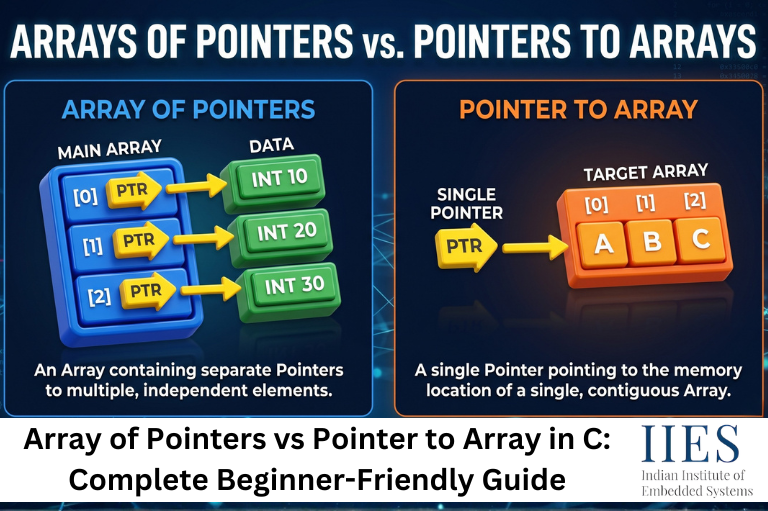
An array of pointers is an array where every element itself is a pointer.
Syntax
int *ptr[5];
Here:
- ptr is an array containing 5 integer pointers
Each pointer can point to different memory locations.
How Arrays of Pointers Work
Every element stores an address instead of actual values.
Example:
int a = 10, b = 20, c = 30;

int *ptr[3];

ptr[0] = &a;

ptr[1] = &b;

ptr[2] = &c;
Now:
- ptr[0] points to a
- ptr[1] points to b
- ptr[2] points to c
Advantages of Arrays of Pointers
1. High Flexibility
Arrays of pointers allow each pointer to reference different memory blocks.
This is useful for:
- Jagged arrays
- Variable-length strings
- Dynamic data structures
2. Efficient String Handling
In C, strings are often handled using arrays of character pointers.
Example:
char *names[] = {"Alice", "Bob", "Charlie"};Each string can have different lengths without wasting memory.
3. Useful in Complex Data Structures
Arrays of pointers are commonly used in:
- Trees
- Graphs
- Linked lists
- Hash tables
4. Better Dynamic Allocation Control
Each pointer can dynamically allocate memory independently.
Disadvantages of Arrays of Pointers
Despite flexibility, there are drawbacks.
Increased Memory Usage
Every pointer requires additional memory.
For example:
- 64-bit systems use 8 bytes per pointer
Large pointer arrays may consume significant memory.
Complex Memory Management
Developers must manually manage:
- Allocation
- Deallocation
- Null checking
Improper handling can cause:
- Memory leaks
- Dangling pointers
- Segmentation faults
Reduced Cache Performance
Since memory may not be contiguous, CPU cache performance can decrease.
What Are Pointers to Arrays?
A pointer to an array points to an entire array instead of individual elements.
Syntax
int (*ptr)[5];
This syntax often confuses beginners.
Here:
- ptr is a pointer to an array of 5 integers
How Pointers to Arrays Work
Example:
int arr[5] = {1,2,3,4,5};

int (*ptr)[5] = &arr;
Now:
- ptr points to the whole array
- (*ptr)[0] accesses the first element
Advantages of Pointers to Arrays
1. Better Memory Organization
The entire array remains in contiguous memory.
This improves:
- Cache efficiency
- Data locality
- Performance
2. Efficient Multidimensional Array Handling
Pointers to arrays are extremely useful in matrix operations.
Example:
int matrix[3][3];

int (*ptr)[3] = matrix;
This simplifies row traversal.
3. Faster Access in Numerical Applications
Scientific computing and graphics applications often prefer contiguous memory for performance reasons.
4. Easier Pointer Arithmetic
Pointer arithmetic becomes more predictable and structured.
Disadvantages of Pointers to Arrays
Reduced Flexibility
All elements must belong to the same contiguous block.
This limits dynamic resizing.
Syntax Complexity
The declaration syntax can be difficult for beginners.
Example:
int (*ptr)[10];
Many developers misread this declaration initially.
Harder Dynamic Structures
Complex data structures are usually easier with arrays of pointers.

Array of Pointers and Pointer to Array Difference
The following table highlights the major differences between the two concepts.
Feature | Arrays of Pointers | Pointers to Arrays |
Definition | Array containing pointers | Pointer pointing to entire array |
Memory Layout | Non-contiguous possible | Contiguous |
Flexibility | High | Moderate |
Performance | Slightly slower cache access | Faster memory access |
Best Use Case | Strings, linked structures | Matrices, fixed arrays |
Pointer Arithmetic | Operates on pointers | Operates on arrays |
Dynamic Allocation | Easier for irregular data | Better for structured data |
Complexity | Higher memory management | More difficult syntax |
Memory Layout Comparison
Arrays of Pointers
int *ptr[3];
Memory:
ptr[0] → Address A

ptr[1] → Address B

ptr[2] → Address C
Data may exist in different locations.
Pointer to Array
int (*ptr)[3];
Memory:
1000 → 1

1004 → 2

1008 → 3
Data stays contiguous.
This improves performance in:
When Should You Use Arrays of Pointers?
Choose arrays of pointers when:
- Working with strings
- Using jagged arrays
- Building linked structures
- Managing dynamic records
- Memory blocks vary in size
Best scenarios include:
- Text editors
- Database indexing
- Graph algorithms
- Dynamic datasets
When Should You Use Pointers to Arrays?
Choose pointers to arrays when:
- Data is fixed-size
- Performance matters
- Working with matrices
- Building numerical software
- Memory locality is important
Best scenarios include:
Common Mistakes Developers Make
Confusing Syntax
Many beginners write:
int *ptr[5];
thinking it means pointer to array.
It actually means array of pointers.
Ignoring Memory Deallocation
Arrays of pointers often require manual cleanup.
Example:
free(ptr[i]);
Failing to free memory causes leaks.
Incorrect Pointer Arithmetic
Pointer arithmetic behaves differently.
Example:
ptr + 1
For pointers to arrays, this moves to the next full array block.
Best Practices for C Programming Pointers and Arrays
Use Meaningful Variable Names
Avoid generic names like:
ptr

arr
Prefer:
studentNames

matrixPtr
Use const Wherever Possible
Example:
const char *names[];
This prevents accidental modification.
Prefer Contiguous Memory for Performance
For performance-critical applications:
- Use pointers to arrays
- Reduce memory fragmentation
Document Complex Pointer Logic
Complex pointer syntax can confuse teams.
Add comments for maintainability.
Trends in Arrays and Pointers for 2026
Modern systems programming increasingly emphasizes:
Even with newer languages emerging, C remains heavily used in:
- Operating systems
- IoT devices
- Robotics
- Embedded firmware
- Game engines
Understanding c programming pointers and arrays remains highly valuable for developers entering low-level programming domains.

Conclusion
Understanding the difference between an array of pointers and pointer to array is essential for writing efficient and maintainable C programs.
Arrays of pointers provide flexibility and are ideal for dynamic and irregular data structures. Pointers to arrays offer better memory locality and performance for structured data operations.
There is no universally “better” choice. The correct approach depends on:
- Your application requirements
- Memory constraints
- Performance goals
- Data structure design
Mastering these concepts will significantly improve your understanding of c language arrays and pointers and help you write optimized, professional-grade C programs.
If you are serious about system programming, embedded development, or mastering C programming fundamentals, learning how arrays and pointers interact is a skill that will continue to remain valuable for years to come.