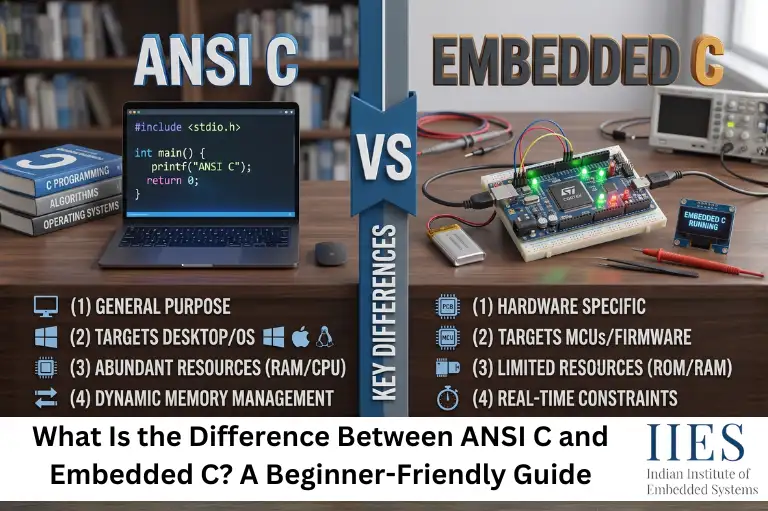
Is Embedded C Different from ANSI C?
Yes, but not because they are different programming languages. ANSI C is the standardized version of the C language, while Embedded C is ANSI C used with additional hardware-specific features for programming embedded systems and microcontrollers.
In simple terms, Embedded C builds upon ANSI C by allowing software to interact directly with hardware such as GPIO pins, timers, interrupts, ADCs, UART, SPI, and I2C peripherals.
Definition
ANSI C is the standardized version of the C programming language defined by the American National Standards Institute (ANSI).
Embedded C is the use of the C language, along with compiler extensions and hardware-specific libraries, to develop firmware for embedded systems and microcontrollers.
What Is C Programming?
C is a general-purpose programming language developed by Dennis Ritchie in the early 1970s.
It is widely used because it provides:
- High execution speed
- Low memory usage
- Direct memory access
- Structured programming
- Excellent portability
- Efficient compiler support
C became one of the most influential programming languages and forms the foundation for many modern languages, including C++, Objective-C, and parts of Python’s implementation.
Common Applications of C Programming
- Operating systems
- Compilers
- Database systems
- Networking software
- Desktop applications
- Game engines
- Device drivers
- Embedded systems
Although C is used in many domains, it does not include built-in support for microcontroller peripherals. That support is added through hardware-specific libraries and compiler features in embedded development.
What Is ANSI C?
ANSI C is the standardized version of the C language.
Before standardization, different compilers implemented C differently, making programs less portable. To solve this issue, ANSI introduced a common standard in 1989, commonly referred to as ANSI C (C89).
Its primary goal is to ensure that the same C program behaves consistently across different platforms.
Features of ANSI C
- Standard syntax and grammar
- Portable across multiple operating systems
- Independent of specific hardware
- Supports structured programming
- Rich standard library
- Compiler-independent language standard
- stdio.h
- stdlib.h
- string.h
- math.h
- ctype.h
- time.h
Example of ANSI C Code
c
#include

int main()

{

    printf("Welcome to ANSI C\n");

    return 0;

}
This program can run on various platforms such as Windows, Linux, and macOS, as long as a compatible C compiler is available.
What Is Embedded C?
Embedded C is C programming used for embedded systems.
It follows most ANSI C rules while adding compiler extensions, hardware registers, and microcontroller-specific libraries to control electronic devices.
Unlike desktop applications, Embedded C programs interact directly with hardware.
Embedded C is commonly used for:
- Reading sensors
- Controlling motors
- Driving LCD displays
- Communicating through UART
- Using SPI and I2C
- Handling interrupts
- Configuring timers
- Operating ADC and DAC modules
Popular Microcontrollers Using Embedded C
- STM32
- ESP32
- AVR ATmega
- PIC16/PIC18
- 8051
- MSP430
- NXP LPC series
- TI Tiva C
Simple Embedded C Example
c
GPIOA->ODR |= (1 << 5);
This statement sets a GPIO pin HIGH on a microcontroller. Unlike ANSI C programs, this code accesses a hardware register. It works only on supported microcontrollers and requires device-specific header files provided by the manufacturer.
Is Embedded C Different from ANSI C?
This is one of the most common questions among beginners.
The answer is yes — but only in terms of application and hardware interaction.
Embedded C is not a completely different programming language. It is based on ANSI C and extends it with hardware-specific capabilities.
ANSI C at a Glance
- Follows the ISO/ANSI C standard
- Works on general-purpose computers
- Hardware independent
- Focuses on software development
- Uses standard libraries
Embedded C at a Glance
- Based on ANSI C
- Used for embedded firmware
- Hardware dependent
- Accesses registers and peripherals
- Uses vendor-specific libraries
- Supports interrupts and memory-mapped I/O
Think of ANSI C as the foundation and Embedded C as its practical use in embedded hardware development.

Key Differences Between ANSI C and Embedded C
Feature | ANSI C | Embedded C |
Purpose | General-purpose programming | Embedded firmware development |
Platform | Desktop and server systems | Microcontrollers and embedded devices |
Hardware Access | No direct hardware control | Direct hardware register access |
Libraries | Standard C libraries | Vendor-specific hardware libraries |
Portability | Highly portable | Depends on the target hardware |
Memory Usage | Less constrained | Optimized for limited memory |
Execution Environment | Operating system | Bare-metal or RTOS |
Peripheral Control | Not available | Supports GPIO, UART, SPI, I2C, ADC, Timers |
1. Difference in the Target Platform
The biggest difference between ANSI C and Embedded C is the platform on which the program runs.
ANSI C programs are commonly developed for general-purpose computers that run operating systems such as Windows, Linux, or macOS.
Embedded C programs are designed for dedicated embedded hardware, including:
- 8-bit microcontrollers (8051, AVR ATmega)
- 16-bit microcontrollers (MSP430, PIC24)
- 32-bit microcontrollers (STM32, ESP32, NXP LPC)
- ARM Cortex-M-based embedded systems
Unlike desktop applications, embedded systems are built to perform specific tasks. As a result, the firmware must interact directly with the hardware to control peripherals and execute real-time operations.
2. Direct Hardware Access
One of the defining characteristics of Embedded C is its ability to control hardware directly.
An Embedded C program can perform tasks such as:
- Turning an LED ON or OFF
- Reading data from a temperature sensor
- Controlling a DC or servo motor
- Communicating with modules using UART, SPI, or I2C
- Configuring timers and interrupts
These operations are performed by accessing hardware registers.
Example (PIC Microcontroller)
c
PORTA = 0x01; // Set bit 0 HIGH
Example (STM32)
c
GPIOA->ODR |= (1U << 5); // Turn ON LED connected to PA5
Although both examples are written in C, the register names depend on the target microcontroller. ANSI C programs running on desktop computers typically do not access hardware registers directly because the operating system manages the hardware.
3. Memory Limitations
Embedded systems usually have far fewer hardware resources than desktop computers.
A typical microcontroller may have limited:
- RAM
- ROM
- Flash memory
- CPU processing power
Because of these constraints, Embedded C programs must be designed to use memory efficiently.
Developers often pay close attention to:
- Variable sizes
- Stack usage
- Dynamic memory allocation
- Program size
- Data storage
In many embedded applications, dynamic memory allocation (malloc() and free()) is avoided because limited memory and predictable program behavior are critical for reliable system operation.
4. Hardware-Specific Code
ANSI C is designed to be portable, allowing the same source code to run on different platforms with little or no modification.
Embedded C, however, often includes hardware-specific code that depends on the target microcontroller.
Example (STM32)
c
#include "stm32f4xx.h"
Example (AVR)
c
#include <avr/io.h>
These header files define hardware registers, peripheral addresses, and configuration settings for specific microcontroller families.
If the target hardware changes, some portions of the Embedded C program may need to be modified or rewritten.
5. Use of Compiler Extensions
Embedded C compilers often provide additional features that are not part of the ANSI C standard.
These extensions may include:
- Interrupt declarations
- Memory models
- Hardware-specific data types
- Register access keywords
- Inline assembly support
- Device-specific compiler attributes
Some commonly used compiler-specific keywords include:
- __interrupt
- __attribute__((interrupt))
- __IO
- volatile
These extensions simplify embedded programming but may reduce portability because they are supported only by specific compilers or hardware platforms.
6. Real-Time Requirements
Many embedded systems must respond to external events within a specific time limit.
Examples include:
- Automotive airbag systems
- Anti-lock Braking Systems (ABS)
- Industrial motor controllers
- Medical monitoring devices
- Drone flight controllers
To meet these timing requirements, Embedded C programming often focuses on:
- Predictable execution
- Fast interrupt response
- Timer configuration
- Real-time scheduling
- Efficient resource utilization
- Real-Time Operating Systems (RTOS)
In contrast, most ANSI C applications running on desktop operating systems do not have such strict real-time constraints because the operating system manages task scheduling and hardware resources.
Is Embedded C a Separate Programming Language?
No. This is one of the most common misconceptions among beginners.
Embedded C is not a new programming language. It is standard C used for embedded hardware, along with compiler extensions and hardware-specific libraries.
The basic language features remain the same. For example, both ANSI C and Embedded C use:
- Variables
- Data types
- Loops
- Functions
- Arrays
- Structures
- Pointers
- Operators
- Conditional statements
The difference begins when the program needs to interact with hardware.
ANSI C Example
c
int sum = a + b;
This performs a normal arithmetic operation.
Embedded C Example
c
GPIOA->ODR |= (1 << 5);
This controls a physical GPIO pin on a microcontroller. The syntax is still C, but the statement accesses a hardware register defined by the device manufacturer.

Can ANSI C Be Used in Embedded Systems?
Yes. In fact, a large portion of Embedded C programs consists of standard ANSI C code.
Most embedded firmware includes:
- Mathematical calculations
- Decision making
- Looping
- Data processing
- Buffer management
- String handling
- Function calls
These parts follow standard C programming practices. Hardware-specific code is added only where interaction with the microcontroller is required.
A typical firmware project contains both standard C code and hardware-dependent code.
Simple Representation
Embedded Firmware

├── ANSI C Logic

│   ├── Variables

│   ├── Loops

│   ├── Functions

│   ├── Algorithms

│   └── Data Processing

│

└── Hardware Control

    ├── GPIO

    ├── UART

    ├── SPI

    ├── I2C

    ├── ADC

    ├── Timers

    └── Interrupts
This combination makes Embedded C powerful for firmware development.
ANSI C and Embedded C: A Simple Relationship
A simple analogy makes the relationship easier to understand.
Imagine learning to drive. ANSI C is learning how to drive a vehicle. Embedded C is learning how to operate a specific machine, such as a crane, forklift, or excavator. The driving principles remain similar, but the controls and purpose are different.
Another way to think about it:
- ANSI C teaches you how to write programs.
- Embedded C teaches you how to make hardware perform specific tasks.
Embedded C extends the use of C by connecting software directly to electronic hardware.
Which One Should You Learn First?
For beginners, the best learning path is to start with ANSI C. It builds a solid programming foundation before introducing hardware concepts.
Recommended Learning Path
- Learn C syntax.
- Understand variables and data types.
- Practice loops and conditional statements.
- Learn functions and arrays.
- Understand pointers and structures.
- Study memory concepts.
- Begin Embedded C.
- Learn GPIO programming.
- Work with UART, SPI, and I2C.
- Explore timers and interrupts.
- Learn RTOS concepts.
- Move to Embedded Linux if required.
Following this order makes embedded programming much easier because you already understand the core language before working with hardware.
Simple Way to Understand It
If you still find the difference confusing, remember these three points:
- ANSI C defines the language.
- Embedded C applies that language to embedded hardware.
- The main difference is the environment in which the code runs.
A useful comparison is shown below.
ANSI C | Embedded C |
Learns programming concepts | Uses programming concepts to control hardware |
Runs on computers | Runs on microcontrollers |
Uses standard libraries | Uses hardware-specific libraries |
Hardware independent | Hardware dependent |
Builds software applications | Builds firmware for embedded devices |
In short, Embedded C is not a replacement for ANSI C, it is an application of ANSI C in embedded system development.

Conclusion
Understanding the relationship between ANSI C and Embedded C is one of the first steps toward becoming an embedded systems engineer.
ANSI C provides the standardized programming language and core concepts such as variables, loops, functions, pointers, and structures. Embedded C uses these same concepts while adding hardware-specific features to control microcontrollers and peripherals.
If your goal is to develop firmware for STM32, ESP32, 8051, PIC, AVR, or other embedded platforms, learning ANSI C first will make Embedded C much easier to understand.
Remember these three key points:
- ANSI C is the standardized C language.
- Embedded C is ANSI C used for embedded hardware programming.
- The biggest difference is the target platform and hardware interaction, not the programming language itself.
By mastering both, you’ll build a strong foundation for advanced topics such as RTOS, Embedded Linux, IoT, device drivers, and real-world firmware development.
If you’re looking to build practical embedded programming skills, the Indian Institute of Embedded Systems (IIES), Bangalore, offers industry-focused training that helps learners progress from C programming fundamentals to hands-on embedded systems development.