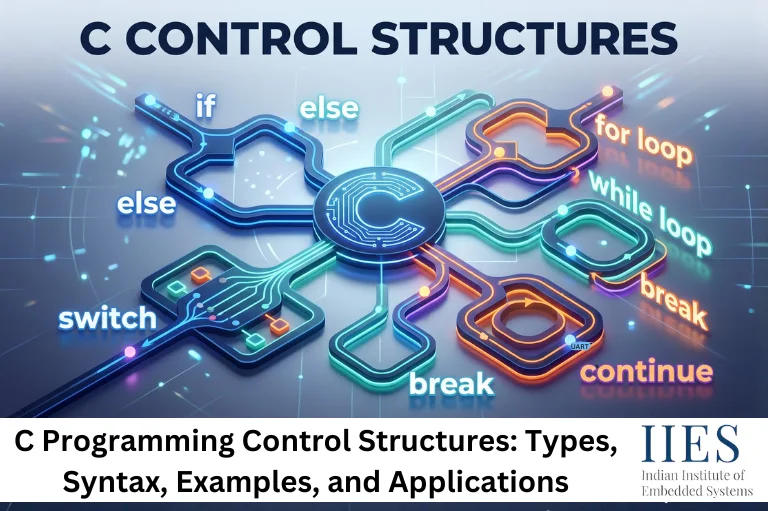
Why Control Structures Are Important in C Programming
Imagine creating a banking application that must verify account balances before processing transactions or a temperature monitoring system that continuously checks sensor readings.
Without control structures, programs would execute instructions sequentially without any ability to:
- Make decisions
- Repeat tasks
- Handle different scenarios
- Process user input dynamically
- Implement business logic
Control structures transform static code into intelligent software capable of responding to changing conditions.

Benefits of Control Structures
- Improved program flexibility
- Better code organization
- Reduced code duplication
- Enhanced efficiency
- Easier maintenance and debugging
- Better resource utilization
What Is Control Structure in C Programming?
A control structure is a programming construct that determines the order in which instructions are executed within a program.
Instead of running every statement from top to bottom, control structures allow a program to:
- Execute specific code blocks based on conditions
- Repeat actions multiple times
- Skip unnecessary operations
- Handle multiple possible outcomes
- Control program execution flow
Control structures are fundamental to writing interactive and responsive software.
Types of C Control Structures
There are three major categories of control structures in C:
Control Structure | Purpose | Examples |
Sequence Control Structure | Executes statements in order | Standard program flow |
Selection Control Structure | Makes decisions | if, if-else, switch |
Iteration Control Structure | Repeats tasks | for, while, do-while |
Let’s examine each type in detail.
Sequence Control Structure
The sequence control structure is the simplest execution model in C programming.
Statements execute one after another in the order they appear.
Example
#include

int main()

{

    printf("Start\n");

    printf("Processing\n");

    printf("End\n");

    return 0;

}
Output
Start

Processing

End
Although simple, sequence execution serves as the foundation for all other control structures.
Selection Control Structures in C
Selection control structures enable decision-making within a program.
They determine which code block should execute based on specific conditions.
IF Statements
The if statement is one of the most commonly used conditional statements in C.
Syntax
if(condition)

{

    // code executes if condition is true

}
Example
int age = 18;

if(age >= 18)

{

    printf("Eligible to vote");

}
When to Use IF Statements
- User authentication
- Input validation
- Error checking
- Feature activation
- Access control systems
IF-ELSE Statements
When there are two possible outcomes, an if-else statement provides an alternative execution path.
Example
int marks = 45;

if(marks >= 50)
{
    printf("Pass");
}
else
{
    printf("Fail");
}
Applications
- Exam result systems
- Login verification
- Product availability checks
- Financial approval systems
Nested IF Statements
Nested if statements allow multiple conditions to be checked sequentially.
Example
if(age >= 18)
{
    if(hasLicense)
    {
        printf("Can drive");
    }
}
Best Practice
Avoid excessive nesting because it can reduce readability and make debugging difficult. For complex logic, consider using functions or logical operators.
Ternary Operator
The ternary operator provides a compact alternative to simple if-else statements.
Syntax
(condition) ? value1 : value2;
Example
int result = (marks >= 50) ? 1 : 0;
Advantages
- Shorter code
- Improved readability for simple conditions
- Useful for variable assignments
Switch Statements in C
When a variable can have multiple possible values, switch statements often provide a cleaner alternative to long if-else chains.
Syntax
switch(variable)

{

    case value1:

        // code

        break;

    case value2:

        // code

        break;

    default:

        // code

}
Example
int day = 2;

switch(day)

{

    case 1:

        printf("Monday");

        break;

    case 2:

        printf("Tuesday");

        break;

    default:

        printf("Invalid Day");

}
Advantages of Switch Statements
- Cleaner code structure
- Better readability
- Easier maintenance
- Faster execution in some scenarios
- Ideal for menu-driven applications

Looping Control Structures in C
Programs frequently need to repeat tasks. Writing the same code multiple times is inefficient and difficult to maintain.
Looping structures solve this problem by allowing repeated execution of a code block.
For Loop in C
The for loop is ideal when the number of iterations is known beforehand.
Syntax
for(initialization; condition; increment)
{
    // code
}
Example
for(int i = 1; i <= 5; i++)

{
    printf("%d\n", i);
}
Output
1
2
3
4
5
Common Applications
- Array traversal
- Matrix operations
- Embedded programming
- Data processing
- Counting operations
While Loop in C
The while loop executes as long as a condition remains true.
Syntax
while(condition)
{
    // code
}
Example
int count = 1;
while(count <= 5)
{
    printf("%d\n", count);
    count++;
}
Best Use Cases
- User input validation
- Event monitoring
- Real-time applications
- Sensor data collection
- Network communication tasks
Do While Loop in C
The do while loop guarantees at least one execution before checking the condition.
Syntax
do
{
    // code
}
while(condition);
Example
int num = 1;
do
{

    printf("%d\n", num);

    num++;

}
while(num <= 5);
Practical Use Cases
- Menu-driven applications
- Login systems
- User prompts
- Validation workflows
- Interactive software
Comparison of Loop Structures
Feature | For Loop | While Loop | Do While Loop |
Condition Checked | Before execution | Before execution | After execution |
Minimum Executions | 0 | 0 | 1 |
Best For | Fixed iterations | Unknown iterations | Mandatory first execution |
Readability | High | Medium | Medium |
Difference Between Selection and Iteration Control Structures
Feature | Selection Control Structure | Iteration Control Structure |
Purpose | Makes decisions | Repeats operations |
Examples | if, if-else, switch | for, while, do-while |
Execution | Executes selected path | Executes repeatedly |
Use Cases | Validation, decision-making | Data processing, automation |
Understanding this difference helps programmers choose the most appropriate structure for a given problem.
Real-World Applications of C Control Structures
Control structures are heavily used across various industries.
Microcontrollers continuously monitor sensors using loops and make decisions using conditional statements.
Automotive Software
Vehicle control units rely on decision-making logic for braking systems, engine management, and safety monitoring.
Operating Systems
Task scheduling, process management, and resource allocation depend heavily on efficient control flow mechanisms.
IoT Devices
Smart devices process environmental data using loops and conditional structures to automate actions.
Industrial Automation
Manufacturing systems use control structures to manage machinery, monitor processes, and ensure safety.
Common Mistakes to Avoid
Even experienced developers make mistakes when working with control structures.
Missing Curly Braces
if(condition)
statement;
Using braces improves readability and prevents logical errors.
Infinite Loops
while(1)
{
}
Infinite loops can consume system resources unnecessarily if not intentionally designed.
Overcomplicated Conditions
Avoid writing lengthy and confusing conditional expressions.
Instead of deeply nested conditions, use simpler logic whenever possible.
if(isValidUser && hasPermission)
This is often more readable than multiple nested conditions.
Uninitialized Variables
Always initialize variables before using them in conditions or loops.
int count = 0;
Uninitialized variables can produce unpredictable behavior.
Best Practices for Writing Efficient C Control Structures
Use Meaningful Variable Names
Good naming improves code readability.
int studentMarks;
is better than:
int x;
Keep Logic Simple
Simple logic is easier to maintain, test, and debug.
Prefer Switch for Multiple Choices
Switch statements can improve readability when handling many possible values.
Reduce Deep Nesting
Break complex logic into smaller functions rather than stacking multiple nested conditions.
Test Edge Cases
Verify program behavior for:
- Empty input
- Maximum values
- Minimum values
- Invalid data
- Boundary conditions
Control Structure Flowchart Concept
A typical control flow in a C program follows this sequence:
- Start Program
- Receive Input
- Evaluate Conditions
- Execute Decision Logic
- Repeat Tasks if Necessary
- Produce Output
- End Program
This structured flow helps create predictable and maintainable software systems.
Future Trends in Programming Logic and Control Structures (2026 and Beyond)
Although programming languages continue evolving, the core concepts of decision-making remain unchanged.
Emerging trends include:
AI-Assisted Code Generation
Modern development tools increasingly suggest optimized control structures automatically.
Smarter Compilers
Compilers are becoming better at optimizing loops and conditional logic.
Automated Optimization Tools
Tools can now detect inefficient code patterns and recommend improvements.
Advanced Static Code Analysis
Automated analyzers identify logical errors before deployment.
Safer Programming Frameworks
Modern development environments help reduce bugs related to control flow and logic errors.
Even with these innovations, mastering control structures remains essential because they form the foundation of algorithm design and software engineering.

Conclusion
Understanding C control structures is one of the most important steps in becoming a proficient programmer. From simple sequence execution to advanced decision-making using conditional statements, and repetitive processing through for loops, while loops, and do-while loops, these concepts drive the behavior of virtually every software application.
Whether you’re building embedded systems, developing operating system components, creating IoT solutions, or learning C programming fundamentals, mastering control structures will help you write cleaner, faster, and more reliable code. By applying the best practices and practical examples discussed in this guide, you’ll be better equipped to create scalable applications and solve programming challenges efficiently.