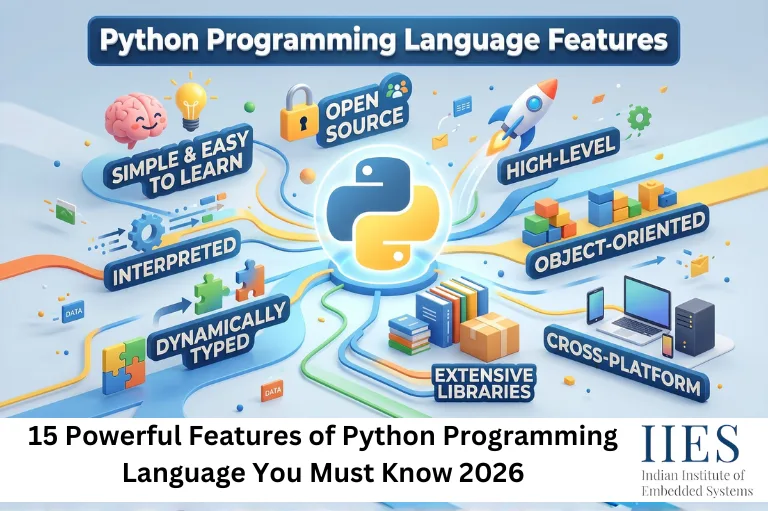
Why Understanding the Features of Python Matters
Before learning any programming language, it is important to understand its strengths and practical advantages. The features of Python directly influence developer productivity, project scalability, maintenance, and application performance.
For students and beginners, Python offers a smooth learning curve. For businesses and startups, Python reduces development time and cost. For data scientists and AI engineers, Python provides powerful libraries and frameworks that simplify complex tasks.
Some major reasons why developers choose Python include:
- Faster development process
- Easier debugging and maintenance
- Large ecosystem of libraries
- Strong community support
- Cross-platform compatibility
- High demand in the job market
These advantages come from the core design and architecture of the language itself.

15 Features of Python Programming Language
1. Python is Easy to Learn and Use
One of the biggest reasons for Python’s success is that Python is easy to learn. Its syntax closely resembles the English language, making it beginner-friendly and highly readable.
Unlike many other programming languages, Python avoids unnecessary complexity. Developers can write fewer lines of code to achieve more functionality.
Example
print("Hello World")This simplicity helps students and beginners understand programming concepts quickly without getting overwhelmed by complicated syntax.
2. Python is a High Level Language
Python is a high level language, meaning developers do not need to manage low-level system details like memory allocation manually.
The language abstracts complex operations and allows programmers to focus more on logic and application development rather than hardware management.
Benefits of High-Level Programming
- Faster coding
- Better productivity
- Easier debugging
- Improved readability
- Reduced development complexity
This feature makes Python ideal for modern software development.
3. Python is an Interpreted Language
Python is an interpreted language, which means the code is executed line by line instead of being compiled all at once.
This provides several advantages:
- Easier debugging
- Faster testing
- Rapid prototyping
- Immediate output execution
Because Python is interpreted language, developers can quickly identify and fix errors during development.
4. Python Supports Dynamic Typing
Another major feature is that Python is a dynamically typed language. Developers do not need to declare variable data types explicitly.
Example
x = 10

x = "Python"
Here, the same variable can store different types of data at runtime.
Dynamic typing in Python increases flexibility and reduces unnecessary code. It also speeds up development, especially for large applications and automation projects.
Since Python supports dynamic typing, developers can build applications more efficiently compared to statically typed languages.
5. Python is an Object Oriented Programming Language
Python is an object oriented programming language that supports concepts like:
- Classes
- Objects
- Inheritance
- Encapsulation
- Polymorphism
Object-oriented programming helps developers create modular, reusable, and scalable applications.
Real-World Example
Applications like banking software, e-commerce platforms, and management systems heavily rely on object-oriented programming structures.
Python’s OOP capabilities make it easier to manage large codebases and enterprise-level applications.
6. Python is Free and Open Source
Another reason for Python’s massive adoption is that Python is free and open source.
Developers can download, use, and modify Python without paying licensing fees. Its open-source nature encourages innovation and community contributions.
This has led to the growth of thousands of libraries, frameworks, and tools built around Python.
Popular open-source Python frameworks include:
- Django
- Flask
- TensorFlow
- PyTorch
- Pandas
7. Python is Portable
Python is portable, meaning applications written in Python can run on different operating systems with minimal changes.
A Python program developed on Windows can usually run on:
This portability reduces compatibility issues and simplifies deployment processes.
Because Python is a portable language, businesses can develop cross-platform applications more efficiently.
8. Python is Cross Platform Compatible
Modern applications need to work across multiple environments and devices. Python is cross platform compatible, allowing developers to build software that works seamlessly on various operating systems.
This feature is especially useful for:
- Web applications
- Cloud platforms
- Automation tools
- Enterprise software
- Data science projects
Cross-platform support helps organizations save development time and infrastructure costs.
9. Python Has a Huge Standard Library
Python includes a massive standard library with built-in modules for:
- File handling
- Networking
- Data processing
- Web services
- Regular expressions
- Database connectivity
This reduces the need to write code from scratch.
Example Libraries
Purpose | Python Library |
Data Analysis | Pandas |
Numerical Computing | NumPy |
Machine Learning | Scikit-learn |
Web Development | Django |
Automation | Selenium |
The extensive ecosystem is one of the strongest features of Python.

10. Python is Case Sensitive
Python is case sensitive, meaning uppercase and lowercase letters are treated differently.
Example
name = "Python"

Name = "Programming"

Here, both variables are different.
Although simple, this feature helps maintain coding standards and avoids naming conflicts in large applications.
11. Python Improves Developer Productivity
Python allows developers to complete projects faster because of:
- Simple syntax
- Fewer lines of code
- Reusable modules
- Powerful frameworks
Compared to many traditional programming languages, Python development cycles are significantly shorter.
This is why startups and tech companies prefer Python for rapid application development.
Python has become the leading language for:
Libraries like TensorFlow, Keras, and PyTorch simplify AI model development.
Python’s clean syntax and huge ecosystem make it ideal for handling complex data-driven applications.
13. Python Supports Automation and Scripting
Python is extensively used for automation tasks such as:
- File management
- Web scraping
- Testing
- Data extraction
- Task scheduling
Automation scripts written in Python help businesses save time and reduce manual work.
Practical Use Case
Many companies automate Excel reports, emails, and server monitoring tasks using Python scripts.
Python has one of the largest developer communities in the world.
Developers can easily find:
- Tutorials
- Open-source projects
- Forums
- Documentation
- Coding resources
This strong community support makes troubleshooting easier and accelerates learning.
15. Python Continues to Evolve
Python continues to improve with regular updates and enhancements.
Recent versions focus on:
- Better performance
- Improved security
- Enhanced libraries
- Faster execution
- AI integration support
As technology evolves, Python remains highly relevant for future software development trends.
Latest Python Updates and Features
Python continues to evolve with updates focused on better performance, developer productivity, and modern application development. Recent Python versions introduce several improvements that make coding faster, easier, and more efficient.
Improved Performance
Latest Python updates include internal optimizations that improve execution speed and overall application performance.
Better Error Messages
Python now provides clearer and more detailed error messages, helping beginners identify and fix coding mistakes more easily.
Enhanced Debugging Tools
New debugging and profiling improvements help developers analyze and optimize applications more effectively.
Flexible F-String Formatting
Python’s f-string syntax has become more flexible, allowing cleaner and more readable string formatting.
Advanced Type Annotations
Improved type annotation support makes code easier to maintain and helps developers build scalable applications.
Easy to Learn and Use
Python’s simple and readable syntax makes it beginner-friendly and one of the easiest programming languages to learn.
Extensive Libraries and Frameworks
Python offers powerful libraries and frameworks like Django, Flask, TensorFlow, Pandas, and NumPy for web development, AI, automation, and data science.
Cross-Platform Compatibility
Python works smoothly on Windows, macOS, and Linux, making it a highly portable programming language.
Ideal for AI, Machine Learning, and Automation
Python remains one of the top choices for artificial intelligence, machine learning, data science, and automation projects because of its flexibility and huge ecosystem.
Future of Python in 2026 and Beyond
Python’s future looks extremely strong due to increasing demand in:
As businesses continue investing in automation and AI technologies, Python’s importance will continue growing.
Its beginner-friendly nature and enterprise-level capabilities ensure long-term relevance in the tech industry.

Conclusion
The growing popularity of Python is not accidental. The powerful features of Python make it one of the most versatile and beginner-friendly programming languages available today.
From the fact that Python is easy to learn to its support for dynamic typing, object-oriented programming, automation, artificial intelligence, and cross-platform compatibility, Python offers everything developers need for modern application development.
Whether you want to become a software developer, data scientist, AI engineer, or automation expert, learning Python can open doors to countless career opportunities.
As technology continues evolving, Python will remain a dominant force in programming, making it one of the best languages to learn both now and in the future.