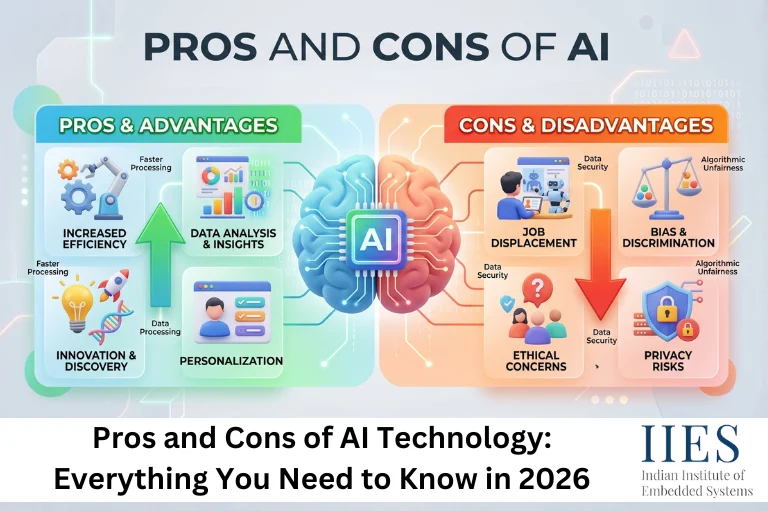
Artificial Intelligence refers to computer systems designed to simulate human intelligence. These systems can analyze data, recognize patterns, make decisions, understand language, and continuously improve through machine learning.
AI technologies are now widely used in:
- Business automation
- Healthcare diagnostics
- Customer support chatbots
- Data analytics tools
- Fraud detection systems
- Smart assistants
- Autonomous vehicles
- Content recommendations
- Cybersecurity platforms
As AI continues evolving, its influence on industries and daily life keeps expanding.

Pros of AI
1. Automation and Efficiency
One of the biggest advantages of AI is automation and efficiency. AI systems can automate repetitive and time-consuming tasks that previously required human intervention.
Industries such as manufacturing, logistics, banking, and retail use AI-powered automation to improve workflows and reduce operational costs.
Examples include:
- Automated quality control in factories
- AI-powered accounting software
- Smart inventory management
- Automated email filtering
- AI-driven scheduling systems
Businesses using AI for business automation often experience:
Benefit | Impact |
Faster operations | Reduced manual workload |
Lower costs | Improved scalability |
Fewer errors | Better accuracy |
Higher productivity | Increased efficiency |
AI automation allows employees to focus on strategic and creative work instead of repetitive processes.
2. Enhanced Productivity
AI tools significantly improve workplace productivity by helping teams process information faster and make data-driven decisions.
Modern AI analytics tools can:
- Analyze large datasets instantly
- Generate business insights
- Predict customer behavior
- Optimize marketing campaigns
- Assist project management
For example, content creators now use AI to assist with:
- Keyword research
- Content optimization
- Trend analysis
- Workflow management
Instead of replacing humans entirely, AI often acts as a productivity enhancer.
3. AI Advantages in Healthcare
Healthcare is one of the industries experiencing the most transformative benefits from AI.
AI advantages in healthcare include:
- Early disease detection
- Medical image analysis
- Drug discovery
- Personalized treatment recommendations
- Remote patient monitoring
AI systems can process medical records and identify patterns that doctors may overlook. This improves diagnostic accuracy and patient outcomes.
Real-World Example
AI-powered diagnostic systems can detect certain cancers from imaging scans faster than traditional analysis methods. Researchers also use AI drug discovery systems to accelerate medicine development.
This technology became especially valuable after global healthcare systems began investing heavily in digital health infrastructure.
4. 24/7 Customer Support
AI customer service tools such as chatbots and virtual assistants provide 24/7 customer support without downtime.
Benefits include:
- Faster response times
- Reduced customer wait periods
- Lower support costs
- Consistent communication
Businesses now use AI chatbots across:
- E-commerce platforms
- Banking applications
- Healthcare portals
- Travel websites
Customers can receive instant assistance even outside business hours.
However, companies still need human support agents for complex emotional or technical situations.
5. Data Analysis and Pattern Recognition
AI systems excel at processing massive amounts of information quickly.
AI-powered analytics can help organizations:
- Detect fraud
- Forecast trends
- Predict equipment failures
- Analyze consumer behavior
- Improve cybersecurity systems
In finance, AI can identify suspicious transaction patterns in real time. In retail, AI algorithms analyze shopping habits to improve product recommendations.
This ability to recognize patterns is one of the strongest advantages of artificial intelligence.
6. Personalization and User Experience
AI improves personalization by analyzing user behavior and preferences.
Popular examples include:
- Netflix content recommendations
- Spotify music suggestions
- E-commerce product recommendations
- Personalized advertisements
AI helps businesses create more relevant customer experiences, leading to:
- Higher engagement
- Better retention rates
- Increased sales conversions
Consumers increasingly expect personalized digital experiences in modern applications.
7. Innovation and Creativity
AI is also contributing to innovation and creativity across multiple industries.
AI-powered systems now assist with:
- Graphic design
- Music composition
- Video editing
- Content generation
- Product design
Rather than replacing human creativity entirely, AI acts as a collaborative tool that accelerates experimentation and idea generation.
8. Environmental Benefits
AI can contribute significantly to environmental sustainability.
AI environmental benefits include:
- Smart energy management
- Waste reduction
- Climate modeling
- Precision agriculture
- Optimized transportation systems
For example:
- AI-powered irrigation systems reduce water waste
- Smart grids optimize electricity distribution
- AI logistics reduce fuel consumption
Governments and environmental organizations increasingly use AI to monitor climate patterns and improve sustainability planning.
9. Accessibility and Inclusion
AI technologies improve accessibility for individuals with disabilities.
Examples include:
- Speech recognition tools
- AI-powered subtitles
- Screen-reading software
- Smart mobility assistance
- Real-time translation systems
These technologies help create more inclusive digital environments and improve accessibility in education, workplaces, and public services.
10. Scientific Advancements
AI is accelerating scientific research across various fields.
Researchers use AI in:
- Space exploration
- Climate research
- Genomics
- Physics simulations
- Drug development
AI systems can process enormous scientific datasets much faster than traditional methods, helping scientists identify patterns and discoveries more efficiently.
This has opened new opportunities for innovation in medicine, energy, and advanced technologies.
11.Benefits of AI in Education
Artificial Intelligence is transforming education by making learning more personalized, interactive, and accessible. Schools, universities, and online learning platforms are increasingly using AI-powered tools to improve both teaching and student performance.
- Personalized Learning: AI can analyze student progress and recommend customized lessons based on individual learning speed and understanding levels.
- AI Tutors and Smart Classrooms: Virtual tutors and AI-powered classroom systems help students receive instant support and improve engagement during learning sessions.
- Automated Grading Systems: AI reduces teachers’ workload by automatically evaluating assignments, quizzes, and assessments with faster accuracy.
- Accessibility and Inclusion: Speech recognition, text-to-speech tools, and real-time translation help students with disabilities or language barriers access education more effectively.
- Improved Online Learning: AI learning platforms can suggest courses, track progress, and provide instant feedback, making digital education more efficient and interactive.
As AI technology continues evolving, it is expected to play a major role in shaping smarter and more accessible education systems in 2026 and beyond.

Cons of AI
1. Job Displacement and AI Impact on Jobs
One of the biggest concerns surrounding AI is job displacement.
As automation increases, certain repetitive roles may become obsolete. Industries heavily affected include:
- Manufacturing
- Retail
- Transportation
- Data entry
- Basic customer support
The AI impact on jobs is already visible in many sectors.
Jobs Most Vulnerable to Automation
Industry | High Automation Risk |
Manufacturing | Assembly line tasks |
Retail | Checkout operations |
Transportation | Autonomous driving |
Customer support | Basic inquiries |
Administration | Data processing |
However, AI is also creating new opportunities in:
- AI development
- Cybersecurity
- Data science
- Prompt engineering
- AI ethics consulting
The challenge lies in workforce reskilling and adaptation.
2. Privacy Concerns
AI systems depend heavily on data collection and user behavior analysis.
This creates major AI privacy concerns involving:
- Data tracking
- Facial recognition
- Surveillance systems
- Personal information misuse
Many users worry about how companies collect, store, and use their data.
Governments worldwide are introducing stricter AI data protection regulations to address these concerns.
3. AI Bias and Fairness Issues
AI systems can inherit biases from training data.
If the data used to train AI contains discrimination or imbalance, the system may produce unfair outcomes.
Examples include:
- Biased hiring systems
- Facial recognition inaccuracies
- Unequal loan approval systems
AI bias and fairness remain major challenges for developers and policymakers.
Creating fair AI systems requires:
- Diverse datasets
- Transparent algorithms
- Continuous auditing
- Ethical testing practices
4. Ethical Issues in AI
Ethical issues in AI continue to generate debate worldwide.
Questions include:
- Should AI make life-or-death decisions?
- Who is responsible for AI mistakes?
- How should autonomous weapons be regulated?
AI ethical concerns are especially important in sectors like:
- Healthcare
- Military technology
- Law enforcement
- Autonomous transportation
Responsible AI development requires strong ethical frameworks and accountability.
5. Dependence on Technology
Heavy dependence on AI may reduce human critical thinking and problem-solving abilities.
People increasingly rely on AI for:
- Navigation
- Writing assistance
- Decision-making
- Information retrieval
Overdependence could weaken certain cognitive skills over time.
Maintaining a balance between AI assistance and human expertise is essential.
6. AI Security Risks
As AI technologies become more advanced, cyber threats also evolve.
AI security risks include:
- Deepfake technology
- AI-generated malware
- Automated cyberattacks
- Identity theft
- Misinformation campaigns
Cybercriminals can misuse AI tools for malicious purposes, making cybersecurity more challenging.
Organizations must invest heavily in AI-driven security systems and ethical safeguards.
7. Complexity and Lack of Transparency
Many advanced AI systems operate as “black box” models.
This means users may not fully understand how AI arrives at specific decisions.
Lack of transparency creates problems involving:
- Accountability
- Trust
- Regulatory compliance
- Decision explainability
Explainable AI is becoming an important focus area for researchers and businesses.
AI vs Human Intelligence
Although AI can process information rapidly, it still differs significantly from human intelligence.
AI | Human Intelligence |
Processes massive data quickly | Uses emotional intelligence |
Works continuously | Requires rest |
Excellent at pattern recognition | Strong creativity and intuition |
Learns from datasets | Learns from life experiences |
Highly scalable | Emotionally adaptive |
AI remains a tool rather than a replacement for human reasoning, empathy, and creativity.
Future of AI in 2026 and Beyond
AI is expected to become even more integrated into daily life over the next decade.
Major trends include:
- Generative AI expansion
- AI-powered robotics
- Autonomous systems
- Smarter healthcare diagnostics
- AI-driven cybersecurity
- Hyper-personalized digital experiences
Businesses adopting AI responsibly will likely gain competitive advantages in efficiency and innovation.
At the same time, governments and organizations will need stronger regulations to address privacy, ethics, and workforce transformation.
Best Practices for Responsible AI Usage
To maximize AI opportunities while reducing risks:
Businesses Should:
- Implement ethical AI guidelines
- Improve AI transparency
- Protect customer data
- Regularly audit AI systems
- Train employees for AI adaptation
Individuals Should:
- Understand AI limitations
- Protect personal information
- Verify AI-generated content
- Continue developing critical thinking skills
Responsible adoption is key to sustainable AI growth.

Conclusion
Artificial Intelligence is transforming industries, economies, and everyday experiences at an unprecedented pace. From business automation and healthcare innovation to customer service and environmental sustainability, AI offers enormous potential for progress.
However, concerns around job displacement, AI privacy concerns, ethical issues, and security risks cannot be ignored. The future of AI depends on responsible development, transparent regulations, and balanced human-AI collaboration.
Understanding the pros and cons of artificial intelligence helps individuals and organizations make smarter decisions in a rapidly evolving digital world. As AI continues advancing beyond 2026, staying informed and adapting responsibly will become more important than ever.