Why STM32 Microcontrollers Matter in Modern Embedded Systems
With the rapid growth of IoT, Industry 4.0, EVs, medical electronics, robotics, and AI-enabled edge devices, developers need microcontrollers that provide:
- Scalability from low-power to high-performance
- Long-term availability
- Strong software ecosystem
- Industry acceptance
STM32 microcontrollers meet all these requirements, making them a preferred choice for both learning and professional product development. Their broad adoption in both educational programs and industrial projects highlights their significance for engineers at all levels.

1. Wide Range of STM32 Product Families (Scalability Advantage)
One of the biggest strengths of STM32 microcontrollers is the breadth of product families, allowing engineers to scale designs without changing vendors or toolchains.
Major STM32 Series Explained
STM32 Series | Key Focus | Typical Applications |
STM32F Series | General-purpose performance | Industrial control, consumer electronics, robotics |
STM32L Series | Ultra-low power | Wearables, battery-powered IoT devices, environmental sensors |
STM32H Series | High performance | Motor control, image processing, AI at edge, industrial automation |
STM32G Series | Cost-optimized | Power supplies, appliances, consumer electronics |
STM32WB | Wireless + MCU | Bluetooth Low Energy devices, IoT connectivity |
STM32MP | MPU + MCU | Linux-based industrial systems, human-machine interface (HMI) devices |
Many companies start product prototyping with STM32F series and later migrate to STM32H or STM32MP without rewriting the entire codebase, saving both time and cost.
These families provide a smooth learning curve for students while giving engineers the freedom to scale products across different performance and power requirements.
2. Advanced Power Management for Energy-Efficient Designs
Power efficiency is no longer optional, it is a design requirement. STM32 microcontrollers are engineered with advanced power management capabilities that help extend battery life and reduce energy costs.
Key Power-Saving Features
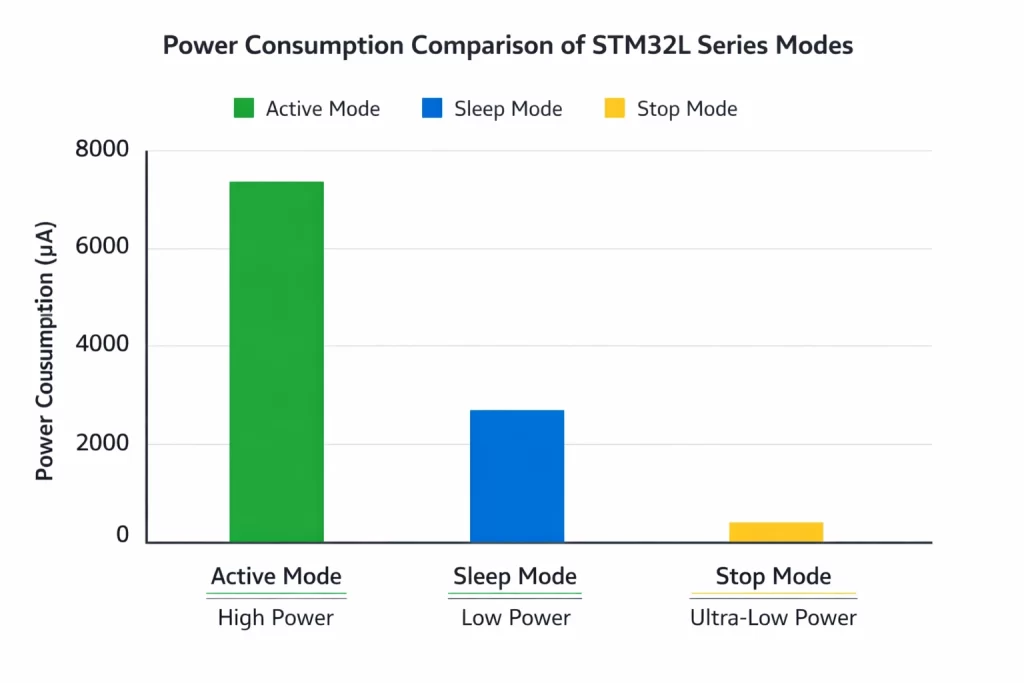
- Multiple Low-Power Modes: Sleep, Stop, Standby, and Shutdown modes for granular control
- Dynamic Voltage and Frequency Scaling (DVFS) to match performance with demand
- Low-Power Timers and RTC that operate even in deep sleep
- Independent peripheral clock gating to minimize unnecessary power usage
Real-World Example
In IoT sensor nodes deployed in agriculture or smart cities, STM32L series MCUs can operate for years on a single battery, waking only to collect and transmit data. This is crucial for remote monitoring systems where changing batteries frequently is impractical.
- Power consumption comparison: Active Mode vs Sleep vs Stop Mode in STM32L series
3. Rich Peripheral Set for Faster Product Development
STM32 microcontrollers integrate a wide variety of peripherals, reducing the need for external components and lowering system cost. This makes it faster and simpler to design embedded systems.

Commonly Used STM32 Peripherals
- Timers & PWM: Ideal for robotics, motor control, and power electronics
- Communication Interfaces: UART, I2C, SPI, CAN, USB, Ethernet, and wireless interfaces for IoT
- Analog Blocks: ADC, DAC, Op-Amps, Comparators for precision sensing and control
- Advanced Peripherals: DMA (Direct Memory Access), CRC, Hardware Encryption for security and efficient data handling
Many embedded system interviews focus on STM32 peripherals such as timers, ADCs, DMA, and communication protocols. Hands-on experience with these peripherals on real STM32 boards gives a significant advantage and helps answer scenario-based technical questions confidently.
With STM32 peripherals, engineers can implement real-time tasks efficiently, making systems more reliable and reducing CPU overhead.
4. ARM Cortex-Based High-Performance Cores
STM32 microcontrollers are built on ARM Cortex-M cores, providing predictable real-time performance, low latency, and excellent software support.
STM32 Core Comparison
ARM Core | STM32 Series | Use Case |
Cortex-M0/M0+ | F0, L0 | Low-cost, low-power devices for simple control tasks |
Cortex-M3 | F1 | Industrial controllers, motor control, and sensors |
Cortex-M4 | F3, F4, L4 | DSP, motor control, signal processing applications |
Cortex-M7 | F7, H7 | High-speed computing, image processing, AI at the edge |
Cortex-M33 | L5 | Secure IoT & TrustZone, enhanced cybersecurity features |
Future-Ready Advantage
Cortex-M33 based STM32L5 series introduces ARM TrustZone, making STM32 suitable for secure embedded and IoT applications where data integrity and protection against cyber attacks are critical.
5. Comprehensive STM32 Development Ecosystem
STM32’s popularity is strongly supported by its developer-friendly ecosystem, reducing development time and learning curves. It ensures students and engineers can focus on designing applications instead of building toolchains from scratch.
STM32 Software & Tools
- STM32CubeMX – Simplifies project setup, pin configuration, and clock tree design
- STM32CubeIDE – Integrated IDE for coding, debugging, and simulation
- HAL & LL Libraries – High-level and low-level APIs for beginners and advanced users
- CMSIS – ARM standard software interface for portability and performance
Hardware Support
- Nucleo Boards – Affordable boards ideal for students and beginners
- Discovery Kits – Feature-rich boards for prototyping and advanced projects
- Professional Debuggers – ST-Link, J-Link for efficient debugging and testing
At IIES, students work hands-on with STM32CubeIDE, real hardware boards, and industry-based projects to gain job-ready embedded system skills.
Career & Industry Relevance of STM32 Microcontrollers
STM32 skills are highly valued in roles such as:
- Embedded Systems Engineer
- Firmware Developer
- Automotive Software Engineer
- IoT Developer
- Robotics Engineer
Industries actively hiring STM32 professionals include automotive, medical electronics, EVs, industrial automation, aerospace, and consumer electronics. Learning STM32 today opens doors to multiple career paths and makes professionals adaptable to emerging technologies.