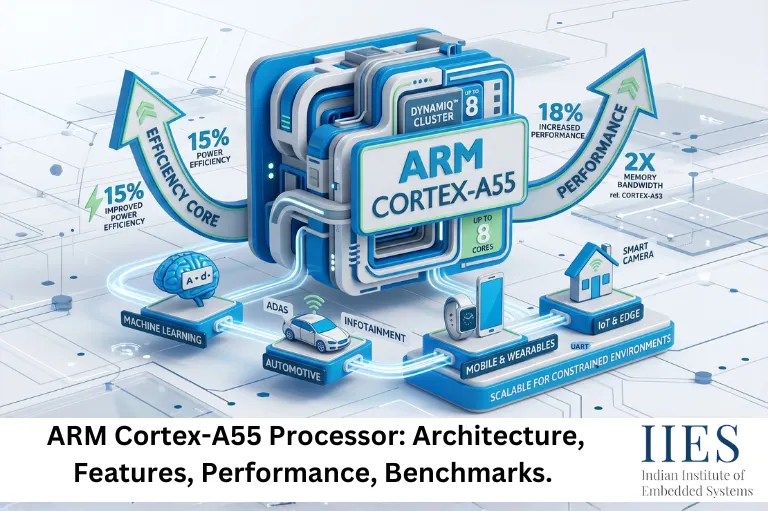
Why the ARM Cortex-A55 Still Matters in Modern Computing
As devices become smarter and more connected, manufacturers face a constant challenge:
- Deliver better performance
- Reduce battery consumption
- Minimize heat generation
- Lower manufacturing costs
High-performance cores alone cannot solve these problems. Modern SoCs rely heavily on efficiency cores that handle background tasks, system processes, AI workloads, connectivity operations, and lightweight applications.
This is exactly where the ARM Cortex-A55 processor excels.
Its role is not to compete with flagship cores but to maximize system efficiency while maintaining smooth performance across everyday workloads.

Understanding the ARM Cortex-A55 Architecture
What is ARM Cortex-A55?
The ARM Cortex-A55 is a high-efficiency CPU core developed by ARM Holdings and introduced as the successor to Cortex-A53.
It is based on:
- ARMv8.2-A architecture
- DynamIQ technology
- Out-of-order execution pipeline
- Enhanced branch prediction
- Improved memory subsystem
- Machine learning acceleration support
Unlike previous ARM CPU designs, the Cortex-A55 was built specifically to work alongside more powerful cores inside heterogeneous computing systems.
Key Architectural Highlights
Feature | ARM Cortex-A55 |
Architecture | ARMv8.2-A |
Core Type | Efficiency Core |
Maximum Cluster Size | 8 Cores |
DynamIQ Support | Yes |
L2 Cache | Up to 256KB per core |
Shared L3 Cache | Supported |
TrustZone Security | Yes |
NEON SIMD | Yes |
Machine Learning Optimization | Yes |
Key Features of the Cortex A55 Processor
1. DynamIQ Technology
One of the most important innovations in the Cortex-A55 architecture is ARM DynamIQ.
DynamIQ enables manufacturers to combine:
- Cortex-A55 efficiency cores
- Cortex-A75 performance cores
- Cortex-A76 performance cores
- Modern Cortex-A720 cores
within a single cluster.
This allows the operating system to intelligently assign workloads to the most appropriate CPU core.
Example
When you:
- Open social media → Cortex-A55 handles the task
- Play a high-end game → Cortex-A76 or Cortex-X series takes over
- Stream music in the background → Cortex-A55 continues running efficiently
This significantly improves battery life.
2. Superior Power Efficiency
The Cortex-A55 was specifically designed for energy-conscious applications.
Compared with Cortex-A53:
- Better IPC performance
- Lower power consumption
- Reduced thermal output
- Improved battery endurance
This makes it highly suitable for:
3. Enhanced Memory Subsystem
Memory performance plays a critical role in CPU responsiveness.
The ARM Cortex-A55 architecture includes:
- Improved cache hierarchy
- Lower memory latency
- Better prefetch mechanisms
- Shared L3 cache support
These enhancements reduce bottlenecks and improve application responsiveness.
4. Advanced Security Features
Security has become a major requirement across modern devices.
The Cortex-A55 integrates:
- TrustZone technology
- Secure boot support
- Hardware-level isolation
- Secure execution environments
These capabilities are particularly valuable in:
- Mobile banking
- Digital payments
- Automotive systems
- Industrial IoT
- Healthcare devices
5. Machine Learning and AI Acceleration
AI workloads are increasingly moving to edge devices.
The Cortex-A55 supports:
- ARM NEON SIMD extensions
- Neural network acceleration
- Image classification
- Voice recognition
- Edge AI inference
This allows devices to process AI workloads locally without excessive cloud dependency.
ARM Cortex-A55 Benchmark Performance
When discussing ARM Cortex-A55 benchmarks, it is important to understand that benchmark scores vary depending on:
- Manufacturing node
- Clock speed
- Cache configuration
- SoC implementation
Generally, Cortex-A55 delivers:
Strengths
- Excellent efficiency-per-watt
- Strong sustained performance
- Low thermal throttling
- Better multi-core scalability
Limitations
- Not designed for flagship gaming
- Lower peak performance than Cortex-A76 and newer cores
- Slower for heavy content creation workloads
However, for most daily tasks, the Cortex-A55 remains highly capable.
Cortex A55 vs Cortex A75 vs Cortex A76 vs Cortex A720 vs Cortex X925
The answer depends entirely on workload requirements.
Processor | Category | Performance | Power Efficiency |
Cortex-A55 | Efficiency Core | Moderate | Excellent |
Cortex-A75 | Performance Core | High | Good |
Cortex-A76 | Performance Core | Very High | Good |
Cortex-A720 | Premium Efficiency Core | Extremely High | Excellent |
Cortex-X925 | Flagship Performance Core | Industry Leading | Lower Efficiency |
When Cortex-A55 Makes More Sense
Choose Cortex-A55 when:
- Battery life matters
- Thermal limits are strict
- Cost-sensitive devices are being developed
- Continuous background processing is required
When Cortex-X925 Makes More Sense
Choose Cortex-X925 when:
- AI workloads are intensive
- Gaming performance is critical
- High-end smartphones are being developed
- Maximum single-thread performance is required
Real-World Applications of ARM Cortex-A55
Smartphones and Tablets
Many smartphone chipsets still use Cortex-A55 cores for:
- Background tasks
- Notifications
- Audio playback
- Connectivity management
This extends battery life significantly.
The Cortex-A55 processor is widely deployed in:
- Smart home hubs
- Industrial gateways
- Smart appliances
- Connected sensors
Its low power consumption makes it ideal for always-on systems.
Automotive Systems
Modern vehicles require efficient processors for:
- Infotainment
- Telematics
- Driver assistance systems
- Vehicle monitoring
The Cortex-A55 provides the right balance of performance and efficiency.
Common embedded applications include:
- Robotics
- Factory automation
- Medical devices
- Smart displays
- Security systems
Its scalability makes it highly adaptable across industries.
Wearable Devices
Smartwatches and fitness trackers benefit from:
- Long battery life
- Low heat generation
- Continuous sensor processing
These are key strengths of the Cortex-A55 architecture.

Practical Embedded Systems Project Example
Consider an industrial monitoring gateway.
Hardware Stack
- ARM Cortex-A55 processor
- Temperature sensors
- Wireless communication module
- Edge AI analytics engine
Workflow
- Collect sensor data
- Process data locally
- Run anomaly detection algorithms
- Send alerts to cloud systems
- Generate maintenance reports
The Cortex-A55 efficiently handles these tasks while maintaining low power consumption.
ARM Cortex-A55 in 2026 and Beyond
While newer CPU cores dominate flagship devices, Cortex-A55 continues to be relevant because:
Emerging Trends
- Edge AI deployment
- Industrial IoT growth
- Smart city infrastructure
- Automotive computing expansion
- Energy-efficient embedded platforms
Manufacturers increasingly prioritize efficiency alongside raw performance.
As a result, the Cortex-A55 remains a valuable component in modern SoC designs.
Best Practices When Working with Cortex-A55
Do
- Optimize memory access patterns
- Use NEON instructions where applicable
- Leverage multi-threading effectively
- Profile workloads regularly
- Minimize unnecessary background processes
Avoid
- Treating Cortex-A55 as a high-performance core
- Running compute-heavy workloads on efficiency clusters
- Ignoring thermal optimization
- Poor cache utilization

Conclusion
The ARM Cortex-A55 continues to be one of the most important efficiency-focused CPU cores in the ARM ecosystem. Its combination of power efficiency, security, scalability, machine learning support, and DynamIQ integration makes it an ideal choice for smartphones, IoT devices, embedded systems, automotive platforms, and wearable technologies.
Although newer processors such as Cortex-A720 and Cortex-X925 push performance boundaries, the Cortex A55 processor remains highly relevant because modern computing increasingly values efficiency alongside raw speed. For developers, engineers, and embedded system professionals, understanding the ARM Cortex-A55 architecture provides valuable insight into how today’s intelligent devices achieve long battery life, reliable performance, and scalable computing power.eeeeeeeeeeeeee