What is AMBA?
AMBA (Advanced Microcontroller Bus Architecture) is an open-standard on-chip communication specification developed by ARM for connecting functional blocks inside an SoC.
AMBA stands for Advanced Microcontroller Bus Architecture.
Rather than creating custom communication interfaces for every design, engineers use AMBA protocols to ensure different IP blocks can communicate using a common set of rules.
Key goals of AMBA include:
- Standardized SoC communication
- Faster IP integration
- Reduced development cost
- Improved scalability
- Easier verification and testing
- Better interoperability between vendors
Today, AMBA is considered the de facto standard for ARM-based SoC development.

Definition and Abbreviation of AMBA
AMBA, as mentioned earlier, stands for Advanced Microcontroller Bus Architecture. It is a set of specifications developed by ARM to standardize the way on-chip communication and integration occur within SoCs. By defining the rules and guidelines for bus architecture, AMBA makes it easier for different components and IP blocks to work together cohesively.
Historical Background and Development
The story of AMBA’s development is closely tied to ARM’s evolution as a semiconductor industry leader. It all began in the early 1990s when ARM noticed the growing complexity of SoC design and the need for a standardized way to integrate various components.
AMBA was introduced as a solution to this problem. Since then, it has evolved through several generations, each catering to the changing requirements of SoC design.
Significance in the Semiconductor Industry
AMBA has become the de facto standard for on-chip communication and integration. By providing a common language for different IP blocks and components, AMBA has streamlined the design process, reducing time-to-market and development costs.
It has also enabled the creation of complex SoCs that power:
- Smartphones
- IoT devices
- Automotive systems
- Industrial controllers
- AI accelerators
- Consumer electronics
AMBA’s widespread adoption makes it one of the most influential standards in semiconductor design.
What Are the Core Components of AMBA Architecture?
The AMBA architecture consists of several bus protocols optimized for different performance requirements.
Major AMBA Protocols
Protocol | Full Form | Primary Use | Performance |
APB | Advanced Peripheral Bus | Low-speed peripherals | Low |
AHB | Advanced High-performance Bus | Processor and memory communication | Medium-High |
AXI | Advanced eXtensible Interface | High-performance SoCs | Very High |
ACE | AXI Coherency Extensions | Multi-core systems | Very High |
CHI | Coherent Hub Interface | Advanced coherent interconnects | Ultra High |
APB (Advanced Peripheral Bus)
APB is designed for simple peripheral devices such as:
- UART
- GPIO
- Timers
- Watchdog modules
- RTC blocks
Its simple design reduces silicon area and power consumption.
AHB (Advanced High-performance Bus)
AHB provides higher bandwidth and supports:
- Burst transfers
- Multiple bus masters
- High-speed memory access
It is commonly used between CPUs, DMA controllers, and memory subsystems.
AXI (Advanced eXtensible Interface)
AXI is the most widely used AMBA protocol in modern SoCs.
Key features include:
- Separate read and write channels
- Multiple outstanding transactions
- Burst transfers
- Out-of-order transaction completion
- High throughput
Most ARM Cortex-A based processors use AXI extensively.
Typical AMBA-Based SoC Architecture
The AMBA architecture uses different bus protocols to connect high-performance processing blocks and low-speed peripherals within an SoC. AXI handles high-bandwidth communication, while APB connects simple peripherals through an AHB/APB bridge.
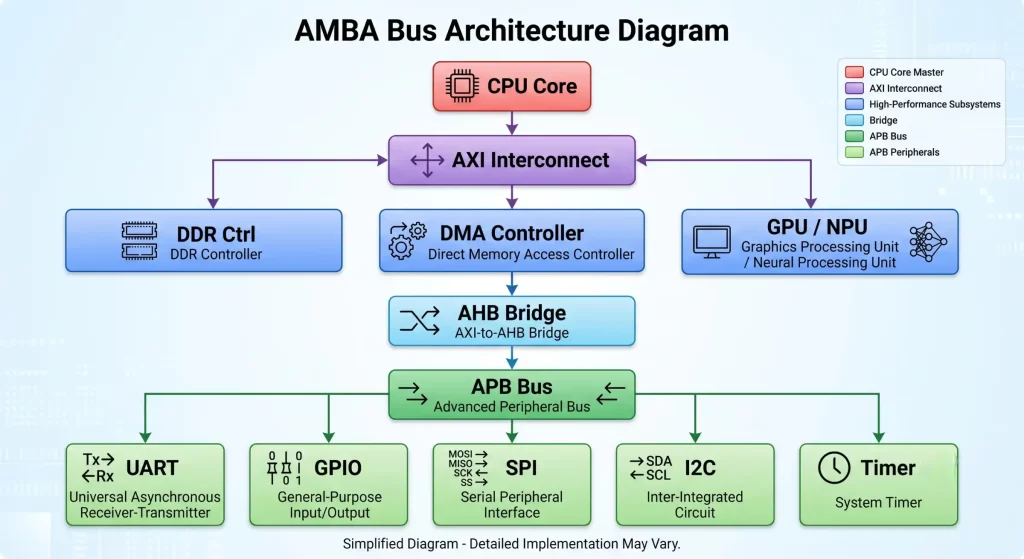
Key Components
Protocol | Typical Use |
AXI | CPU, DDR, GPU, NPU |
AHB | High-speed system bus |
APB | UART, GPIO, SPI, I2C |
Bridge | Connects AHB and APB |
Many beginners assume AMBA is only useful in large processors. In practice, even relatively small microcontroller-based SoCs benefit from AMBA because it simplifies integration and verification.
Major Benefits
Standardization
Different IP vendors can develop components independently while maintaining compatibility.
Faster Development
Engineers can integrate pre-verified IP blocks without redesigning communication interfaces.
Reusability
AMBA-compliant IP blocks can be reused across multiple projects.
Scalability
Designs can grow from simple MCUs to multi-core processors without changing the overall architecture philosophy.
Reduced Verification Effort
A standardized interface significantly reduces debugging complexity.
Expert Insight
A common integration mistake occurs when engineers focus only on bandwidth requirements and ignore arbitration latency. In many real-world SoCs, latency bottlenecks often appear before bandwidth limitations become critical.
Where Is AMBA Used?
Where is AMBA used? Nearly every modern ARM-based SoC contains one or more AMBA protocols.
Consumer Electronics
- Smartphones
- Tablets
- Smart TVs
- Wearable devices
Automotive Systems
- ADAS controllers
- Infotainment systems
- Engine control units
- Digital dashboards
Industrial Automation
- PLCs
- Industrial gateways
- Motion controllers
- Robotics systems
IoT Devices
- Smart sensors
- Connected appliances
- Smart home hubs
- Edge AI devices
Aerospace and Defense
- Avionics controllers
- Mission computers
- Radar systems

How Does AMBA Communication Work?
A simplified AMBA communication workflow follows these steps:
Step 1: Request Generation
The master device initiates a transaction.
Examples:
- CPU
- DMA Controller
- Accelerator Engine
Step 2: Address Transfer
The destination address is transmitted.
Step 3: Arbitration
The interconnect determines which master gets bus access.
Step 4: Data Transfer
Read or write data moves between source and destination.
Step 5: Response Generation
The target acknowledges successful completion.
This structured workflow ensures reliable communication among multiple IP blocks.
AMBA AHB vs APB vs AXI Comparison
Feature | APB | AHB | AXI |
Complexity | Low | Medium | High |
Throughput | Low | Medium | Very High |
Burst Support | No | Yes | Yes |
Pipelining | No | Limited | Extensive |
Multiple Outstanding Transactions | No | No | Yes |
Typical Use | Peripherals | Memory Interface | High-Speed SoC Fabric |
Power Consumption | Lowest | Moderate | Higher |
When Should You Use Each?
Use APB when:
- Peripheral speed is not critical
- Low power is required
Use AHB when:
- Moderate bandwidth is needed
- Simpler architecture is preferred
Use AXI when:
- High-performance processing is required
- Multi-core operation exists
- AI and multimedia workloads are present
Common Mistakes When Working With AMBA (And How to Fix Them)
Mistake 1: Selecting AXI for Every Block
Not every subsystem requires AXI.
Fix: Use APB for simple peripherals and reserve AXI for high-bandwidth paths.
Mistake 2: Ignoring Clock Domain Crossings
Different IP blocks often operate at different clock frequencies.
Fix: Implement proper synchronizers and CDC verification.
Mistake 3: Underestimating Verification Complexity
As transaction concurrency increases, verification becomes significantly harder.
Fix: Use protocol checkers and formal verification tools.
Mistake 4: Poor Interconnect Planning
A badly designed interconnect can create performance bottlenecks.
Fix: Analyze traffic patterns before architecture selection.
How Has AMBA Evolved Over Time?
How has AMBA evolved? The architecture has continuously adapted to changing semiconductor requirements.
Generation | Key Advancement |
AMBA 1 | Basic SoC communication |
AMBA 2 | AHB and APB introduction |
AMBA 3 | AXI introduction |
AMBA 4 | AXI4, AXI4-Lite, AXI4-Stream |
AMBA 5 | CHI and advanced coherency support |
The shift toward multi-core computing, AI acceleration, and heterogeneous processing drove much of this evolution.
Modern AMBA 5 implementations support coherent communication among CPUs, GPUs, NPUs, and accelerators.
Future Trends in AMBA for 2026 and Beyond
The next generation of SoCs increasingly relies on:
- AI accelerators
- Edge computing platforms
- Chiplet architectures
- High-bandwidth memory systems
- Multi-core heterogeneous processing
As these technologies mature, AMBA interconnects continue evolving to deliver:
- Lower latency
- Higher throughput
- Improved coherency
- Better power efficiency
AMBA 5 CHI-based fabrics are already becoming common in advanced processors designed for AI workloads and data-intensive applications.
Conclusion
The AMBA protocol remains the foundation of modern ARM-based System-on-Chip design. By providing standardized communication through protocols such as APB, AHB, and AXI, AMBA enables efficient integration of processors, memory, peripherals, and accelerators.
Understanding AMBA architecture, knowing where AMBA is used, and recognizing why engineers use AMBA are essential skills for embedded systems and semiconductor professionals. As SoCs continue growing in complexity, AMBA’s role in ensuring scalability, interoperability, and performance will become even more important.
For students pursuing embedded systems careers, mastering AMBA concepts provides a strong foundation for advanced SoC design, verification, FPGA development, and semiconductor engineering.