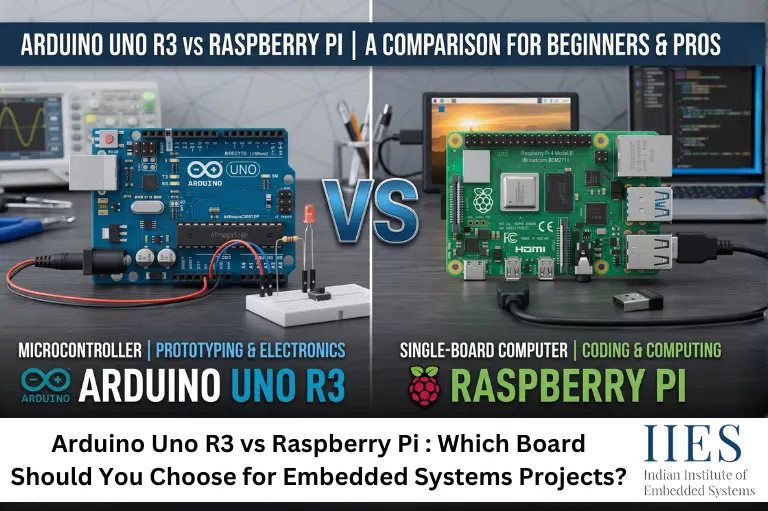
What Is Arduino Uno R3?
Arduino Uno R3 is an open-source microcontroller development board based on the ATmega328P microcontroller designed for embedded control applications.
Unlike a computer, Arduino does not run an operating system. The program executes directly on the microcontroller, resulting in predictable timing and fast hardware response.

Arduino Uno R3 Features and Specifications
Specification | Arduino Uno R3 |
Microcontroller | ATmega328P |
Operating Voltage | 5V |
Clock Speed | 16 MHz |
Flash Memory | 32 KB |
SRAM | 2 KB |
EEPROM | 1 KB |
Digital I/O Pins | 14 |
PWM Pins | 6 |
Analog Inputs | 6 |
USB Interface | USB Type-B |
Programming Language | C/C++ |
Typical Current Consumption | 40–50 mA |
One practical advantage experienced engineers appreciate is deterministic timing. When a digital output must toggle at precise intervals or a sensor must be sampled at exact frequencies, Arduino provides consistent performance without operating-system interruptions.
What Is Raspberry Pi?
Raspberry Pi is a single-board computer (SBC) capable of running Linux and supporting multitasking applications.
Unlike Arduino, Raspberry Pi includes a processor, RAM, storage support, networking capabilities, graphics processing, and operating system support.
Modern Raspberry Pi boards can perform tasks similar to desktop computers while maintaining a compact form factor.
Raspberry Pi Features
Specification | Raspberry Pi 5 |
Processor | Quad-Core ARM Cortex-A76 |
Clock Speed | Up to 2.4 GHz |
RAM | 4GB / 8GB |
Operating System | Raspberry Pi OS (Linux) |
Networking | Ethernet, Wi-Fi, Bluetooth |
USB Ports | USB 2.0 & USB 3.0 |
Display Support | Dual 4K Displays |
Storage | MicroSD |
Programming Languages | Python, C, C++, Java, Go |
Because Raspberry Pi runs Linux, developers can host web servers, run databases, perform image processing, and execute machine learning models directly on the board.
What Is the Difference Between Arduino and Raspberry Pi?
The fundamental difference is architecture.
Arduino is a microcontroller platform. Raspberry Pi is a computer.
A microcontroller focuses on direct hardware control. A computer focuses on processing, multitasking, and software execution.
Arduino Uno R3 vs Raspberry Pi Comparison Table
Feature | Arduino Uno R3 | Raspberry Pi |
Type | Microcontroller Board | Single Board Computer |
Operating System | No | Yes (Linux) |
Boot Time | Instant | 20–60 Seconds |
Programming | C/C++ | Python, C/C++, Java and more |
Real-Time Performance | Excellent | Limited |
Processing Power | Low | Very High |
Power Consumption | Very Low | Higher |
Networking | External Modules Required | Built-In |
Multimedia Support | No | Yes |
Cost | Lower | Higher |
Learning Curve | Easier | Moderate |
For embedded systems involving sensors, actuators, relays, motors, and industrial controls, Arduino often provides a simpler solution.
For applications involving networking, image processing, AI, cloud connectivity, and graphical interfaces, Raspberry Pi offers significantly greater capabilities.
When Arduino Uno R3 Is the Better Choice
Choose Arduino Uno R3 if:
- You need real-time control
- Your project runs on batteries
- You are learning embedded systems
- You are interfacing directly with sensors and actuators
- Cost and simplicity are priorities
When Raspberry Pi Is the Better Choice
Choose Raspberry Pi if:
- You need Linux-based applications
- Your project requires networking
- You want to run AI or computer vision
- You need database or web server functionality
- Your application requires high computational power

Arduino vs Raspberry Pi Power Consumption
One of the biggest differences between the two platforms is power efficiency.
Arduino Uno R3 Power Consumption
Typical current consumption:
- 40–50 mA during operation
- Can run for extended periods on batteries
- Suitable for remote monitoring systems
Raspberry Pi Power Consumption
Depending on workload:
- Typically 600 mA to 3 A
- Requires a stable power supply
- Battery-powered deployments need larger battery packs
This explains why Arduino is commonly used in agricultural monitoring, environmental sensing, wearable devices, and battery-powered IoT products.
Many beginners assume Raspberry Pi is always the better choice because it is more powerful. In practice, unnecessary processing power often increases energy consumption, system cost, and software complexity.
Arduino vs Raspberry Pi for Beginners
For most electronics beginners, Arduino remains the easiest starting point.
Arduino Uno R3 Learning Advantages
- Simple setup process
- Easy-to-understand IDE
- No Linux knowledge required
- Faster project completion
- Extensive educational resources
A typical Arduino project can be completed within minutes after installation.
Why Beginners Choose Raspberry Pi
- Learn Linux administration
- Learn Python programming
- Build web applications
- Explore AI and machine learning
- Develop networking projects
Students interested specifically in embedded systems usually progress faster by learning Arduino first and Raspberry Pi later.
When Should You Use Arduino Uno R3?
Arduino Uno R3 excels when hardware interaction is the primary requirement.
Arduino Uno R3 Applications
- Industrial automation prototypes
- Smart irrigation systems
- Home automation controllers
- Sensor monitoring systems
- Motor control projects
- Line-following robots
- Security alarm systems
- Environmental data loggers
A common industrial use case involves monitoring temperature and humidity sensors while controlling pumps or fans based on threshold values.
Because the program runs directly on the microcontroller, response times remain predictable.
When Should You Use Raspberry Pi?
Raspberry Pi becomes the better choice when computing power and connectivity are priorities.
Raspberry Pi Applications
- AI and machine learning systems
- Video surveillance systems
- Edge computing devices
- Network servers
- Smart home hubs
- Voice assistants
- Digital signage
- Industrial dashboards
For example, a smart security camera performing facial recognition cannot realistically run on an Arduino Uno R3. The computational requirements demand a platform like Raspberry Pi.
How Do Professional Embedded Engineers Use Both Together?
In commercial products, engineers often combine both platforms.
Typical Workflow
- Arduino collects sensor data.
- Arduino performs real-time control.
- Raspberry Pi receives data.
- Raspberry Pi processes data.
- Raspberry Pi uploads information to cloud servers.
- Users monitor the system remotely.
This architecture combines the strengths of both platforms.
A practical example is an industrial monitoring system where Arduino manages sensor acquisition while Raspberry Pi handles analytics, networking, and dashboard visualization.
Common Mistakes When Choosing Between Arduino and Raspberry Pi
Choosing Raspberry Pi for Simple Sensor Projects
Many beginners use Raspberry Pi when Arduino would perform the task more efficiently.
Fix: Use Arduino for simple sensing and control applications.
Ignoring Power Requirements
Battery-powered projects often fail because Raspberry Pi requires significantly more power.
Fix: Calculate power budgets before selecting hardware.
Expecting Arduino to Handle AI Workloads
Arduino’s memory and processing limitations make advanced AI impractical.
Fix: Use Raspberry Pi for computer vision, AI, and machine learning applications.
Neglecting Real-Time Requirements
Linux scheduling can introduce timing variations.
Fix: Use Arduino for strict real-time control tasks.
Trends and Future Relevance
As of 2026, embedded development increasingly combines microcontrollers with edge-computing platforms. Industry demand for IoT, Industry 4.0, robotics, and AI-enabled devices continues to grow.
ARM-based processors dominate modern embedded designs, while microcontrollers remain essential for real-time control systems. The trend is not Arduino versus Raspberry Pi but rather Arduino and Raspberry Pi working together within intelligent connected systems.
Engineers entering embedded systems today benefit from understanding both platforms because modern products frequently integrate low-power controllers with high-performance computing nodes.

Conclusion
The choice between Arduino Uno R3 vs Raspberry Pi depends entirely on project requirements.
If your application focuses on sensors, actuators, motor control, real-time operation, low power consumption, and embedded hardware interaction, Arduino Uno R3 remains one of the best platforms available.
If your project requires Linux, networking, multimedia processing, artificial intelligence, web services, or high-performance computing, Raspberry Pi is the stronger option.
For aspiring embedded engineers, learning both platforms provides the most practical foundation. Arduino teaches hardware-level programming and microcontroller fundamentals, while Raspberry Pi introduces Linux, networking, and edge computing concepts increasingly used in modern embedded products.