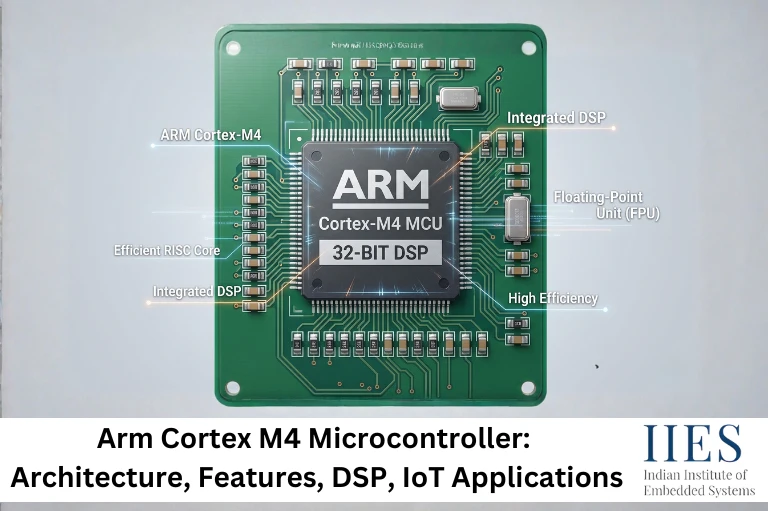
What Is an Arm Cortex M4 Microcontroller?
The Arm Cortex M4 microcontroller is a high-performance 32-bit embedded processor core from the Arm Cortex-M family, specifically designed for deterministic real-time applications that require efficient signal processing, fast interrupt handling, and low energy consumption.
Unlike a complete microcontroller, the Cortex M4 is a processor core licensed by Arm to semiconductor manufacturers such as STMicroelectronics, NXP, Texas Instruments, Microchip, Renesas, Silicon Labs, and Nordic Semiconductor. Each manufacturer integrates the Cortex M4 core with its own memory, peripherals, communication interfaces, analog modules, timers, and security features to create complete microcontroller units (MCUs).
The Cortex M4 was developed to bridge the gap between traditional low-power microcontrollers and high-performance embedded processors. It delivers significantly better computational capability than earlier Cortex-M devices while maintaining excellent power efficiency, making it suitable for applications that require both real-time responsiveness and extended battery life.
Some of its defining capabilities include:
- 32-bit Armv7E-M architecture
- Digital Signal Processing (DSP) instruction extensions
- Optional single-precision Floating Point Unit (FPU)
- Nested Vectored Interrupt Controller (NVIC)
- Low interrupt latency
- Multiple low-power operating modes
- Excellent code density using the Thumb-2 instruction set
- Wide ecosystem support through CMSIS and modern embedded development tools
Today, millions of Cortex M4-based microcontrollers are deployed in embedded products worldwide, powering everything from fitness trackers and medical devices to automotive electronics and industrial control systems.

Why Is the Arm Cortex M4 Important?
Modern embedded systems require high processing performance while maintaining low power consumption. The Arm Cortex M4 meets these demands with built-in Digital Signal Processing (DSP) instructions and an optional Floating Point Unit (FPU), enabling faster execution of tasks such as signal filtering, Fast Fourier Transform (FFT), motor control, and audio processing. This combination of performance and energy efficiency makes the Cortex M4 an ideal choice for IoT devices, industrial automation, robotics, and other real-time embedded applications.
Some of the major reasons for its widespread adoption include:
- Excellent balance between processing performance and power consumption
- Optimized for real-time embedded applications
- Hardware support for Digital Signal Processing
- Broad ecosystem with mature development tools
- Long-term industry adoption across multiple semiconductor vendors
- Scalable architecture suitable for products ranging from wearable devices to industrial controllers
Because of these advantages, the Cortex M4 continues to be a preferred processor core for embedded product development, academic research, IoT innovation, and commercial electronic systems.
Understanding the Arm Cortex-M Family
The Cortex M4 belongs to the broader Arm Cortex-M family, a series of processor cores specifically designed for embedded and microcontroller applications. Each processor targets different performance levels, memory requirements, and application domains while maintaining software compatibility across the ecosystem.
Instead of creating a completely different processor for every application, Arm designed multiple Cortex-M cores that allow manufacturers to select the right balance of performance, power consumption, and cost.
| Cortex Processor | Primary Focus | Typical Applications |
| Cortex-M0 | Ultra-low power and low cost | Basic sensors, consumer electronics, simple IoT devices |
| Cortex-M0+ | Improved efficiency | Battery-powered embedded products |
| Cortex-M3 | General-purpose embedded control | Industrial control, automation, instrumentation |
| Cortex-M4 | DSP + Real-time processing | IoT, robotics, medical devices, motor control, smart products |
| Cortex-M7 | High-performance embedded computing | Advanced industrial systems, multimedia, automotive |
| Cortex-M23 | Secure low-power applications | Entry-level IoT with security |
| Cortex-M33 | Security with TrustZone support | Connected embedded systems, IoT gateways |
| Cortex-M55 | AI and Machine Learning acceleration | TinyML, Edge AI, intelligent sensors |
| Cortex-M85 | Premium embedded performance | AI-enabled industrial and automotive applications |
Among these processors, the Cortex M4 occupies a unique position by offering advanced signal processing capabilities without significantly increasing power consumption. This balance has made it one of the most successful Cortex-M processors in commercial embedded products.
What Makes the Cortex M4 Different?
The Arm Cortex M4 stands out in the Cortex-M family by combining high processing performance, low power consumption, and built-in Digital Signal Processing (DSP) capabilities. Unlike the Cortex-M3, it includes DSP instructions that accelerate tasks such as digital filtering, motor control, audio processing, and sensor data analysis.
Many Cortex M4-based microcontrollers also feature an optional Floating Point Unit (FPU), which performs floating-point calculations in hardware for faster execution of complex algorithms. In addition, the integrated Nested Vectored Interrupt Controller (NVIC) provides low-latency interrupt handling, making the processor ideal for real-time embedded applications.
The Cortex M4 is supported by the CMSIS (Cortex Microcontroller Software Interface Standard) framework, enabling portable firmware development across multiple vendors and simplifying software development.
As a result, Cortex M4 microcontrollers are widely used in:
- Smart healthcare monitoring systems
- Smart agriculture controllers
- Smart city infrastructure
- Industrial automation equipment
- Robotics platforms
- Wearable electronics
- Audio processing devices
- Consumer IoT products
- Motor control applications
- Intelligent sensing systems
Its ability to combine low power consumption, deterministic real-time performance, DSP acceleration, and a mature software ecosystem continues to make the Arm Cortex M4 one of the most widely deployed embedded processor cores in the industry.
Cortex M4 Architecture Explained
The Arm Cortex M4 architecture is based on the Armv7E-M architecture, designed for high-performance real-time embedded applications. It combines a 32-bit processor core with Digital Signal Processing (DSP) instructions, an optional Floating Point Unit (FPU), and efficient interrupt handling to deliver fast processing while maintaining low power consumption. This architecture is widely used in IoT devices, robotics, industrial automation, medical electronics, and smart consumer products.
Harvard Architecture
The Cortex M4 uses a modified Harvard Architecture, where instruction and data memories have separate buses. This allows the processor to fetch instructions and access data simultaneously, improving execution speed and overall system efficiency.
Three-Stage Pipeline
The processor executes instructions through a three-stage pipeline consisting of Fetch, Decode, and Execute. This pipeline increases CPU efficiency, reduces instruction execution time, and ensures smooth real-time performance.
| Stage | Function |
| Fetch | Retrieves the instruction from memory |
| Decode | Decodes the instruction |
| Execute | Executes the operation |
Memory and Interrupt Management
The Cortex M4 features a 32-bit linear memory architecture and an integrated Nested Vectored Interrupt Controller (NVIC). Together, they enable efficient memory access, low interrupt latency, and fast responses to external events, making the processor ideal for time-critical embedded applications.
DSP and Floating Point Support
A major advantage of the Cortex M4 architecture is its built-in Digital Signal Processing (DSP) extension and optional Floating Point Unit (FPU). These hardware features accelerate mathematical operations such as filtering, FFT, motor control, sensor fusion, and audio processing while reducing CPU workload and improving application performance.
CMSIS Software Framework
The Cortex M4 is supported by CMSIS (Cortex Microcontroller Software Interface Standard), which provides standardized APIs, DSP libraries, RTOS interfaces, and debugging support. This simplifies firmware development and allows developers to build portable applications across different Cortex M4-based microcontrollers.
Key Features of the Arm Cortex M4 Microcontroller
The Arm Cortex M4 microcontroller combines processing performance, energy efficiency, and real-time capabilities, making it suitable for a wide range of embedded applications.
| Feature | Description |
| 32-bit Armv7E-M Core | High-performance embedded processing |
| DSP Extension | Accelerates digital signal processing tasks |
| Optional FPU | Fast floating-point calculations |
| Thumb-2 Instruction Set | Compact and efficient code execution |
| NVIC | Low-latency interrupt handling |
| Harvard Architecture | Simultaneous instruction and data access |
| Low Power Modes | Extended battery life |
| CMSIS Support | Simplified software development |
| High Code Density | Optimized Flash memory usage |
| Deterministic Performance | Reliable real-time operation |
Scalability and Power Efficiency
One of the reasons the Cortex M4 remains popular in embedded systems is its ability to balance processing performance with low energy consumption.
Manufacturers can integrate the Cortex M4 into products ranging from compact wearable devices to complex industrial controllers without significantly increasing power requirements.
Power-Efficient Features
- Sleep mode
- Deep sleep mode
- Clock gating
- Peripheral power control
- Low operating voltage
- Fast wake-up time
Scalability Benefits
- Suitable for battery-powered devices
- Supports small and large embedded systems
- Easily integrates with wireless communication modules
- Compatible with RTOS-based applications
- Supports complex IoT workloads
This balance of performance and efficiency makes the Cortex M4 an excellent choice for IoT ARM microcontroller development, where long battery life and reliable real-time processing are equally important.
Single-Core Series of Arm Cortex M4 Microcontrollers
Single-core Arm Cortex M4 microcontrollers are the most widely used Cortex M4-based MCUs in embedded systems. They feature one Cortex M4 CPU core that efficiently handles control tasks, communication, and Digital Signal Processing (DSP) while maintaining low power consumption.
These microcontrollers are ideal for applications that require reliable real-time performance without the complexity of multiple processing cores.
Key Characteristics
- Single 32-bit Arm Cortex M4 core
- DSP instruction support
- Optional Floating Point Unit (FPU)
- Low interrupt latency
- Low power consumption
- Cost-effective embedded solution
- Wide ecosystem support
Common Applications
- Smart home devices
- Industrial sensors
- Medical monitoring systems
- Wearable electronics
- Consumer IoT products
- Robotics controllers
- Motor control systems
Popular Single-Core Cortex M4 Microcontrollers
| Microcontroller Family | Manufacturer | Typical Applications |
| STM32F4 Series | STMicroelectronics | Industrial automation, robotics, IoT |
| STM32L4 Series | STMicroelectronics | Battery-powered IoT devices |
| LPC54000 Series | NXP | Smart consumer products |
| TM4C123 Series | Texas Instruments | Industrial control |
| ATSAME70 Series | Microchip | High-performance embedded systems |
| EFM32 Giant Gecko | Silicon Labs | Low-power embedded applications |
Single-core Cortex M4 microcontrollers remain the preferred choice for most embedded applications because they provide an excellent balance between processing capability, development complexity, and cost.
Dual-Core Series (High Performance) of Arm Cortex M4 Microcontrollers
As embedded applications become more advanced, some manufacturers combine the Cortex M4 with another processor core to improve performance and task separation.
In these devices, the Cortex M4 typically manages real-time operations while the second core handles application-level processing or user interfaces.
This architecture improves responsiveness without compromising deterministic performance.
Benefits of Dual-Core Architectures
- Better multitasking
- Improved real-time performance
- Efficient workload distribution
- Lower latency
- Reduced CPU bottlenecks
- Enhanced system reliability
Popular Dual-Core Cortex M4-Based Microcontrollers
| Microcontroller | Processor Configuration | Typical Applications |
| STM32H745 | Cortex-M7 + Cortex-M4 | Industrial automation, HMI |
| STM32H747 | Cortex-M7 + Cortex-M4 | Robotics, medical systems |
| STM32H757 | Cortex-M7 + Cortex-M4 | Advanced embedded control |
| i.MX RT1170 | Cortex-M7 + Cortex-M4 | Edge AI, multimedia, industrial IoT |
In these systems, developers can dedicate the Cortex M4 to sensor acquisition, communication protocols, or motor control while assigning graphics, networking, or complex computations to the higher-performance Cortex-M7 core.

Cortex M4 Benchmarks
The Cortex M4 benchmarks demonstrate why this processor continues to be a preferred choice for embedded systems requiring efficient signal processing and real-time control.
Although actual performance varies depending on the manufacturer, clock frequency, compiler optimization, and memory configuration, the Cortex M4 consistently delivers excellent performance per watt.
Typical Performance Characteristics
| Parameter | Typical Value |
| Architecture | Armv7E-M |
| Data Width | 32-bit |
| Maximum Clock Speed | Up to 240 MHz (device dependent) |
| DSP Support | Yes |
| Floating Point Unit | Optional |
| Pipeline | 3-stage |
| Interrupt Latency | Very Low |
| Code Density | High |
Performance Strengths
- Fast mathematical computations
- Efficient DSP processing
- Low interrupt latency
- Excellent energy efficiency
- High real-time responsiveness
Compared to earlier Cortex-M processors, the Cortex M4 executes DSP-intensive workloads much faster while maintaining low power consumption.
Popular Arm Cortex M4 Microcontroller Families
Many leading semiconductor manufacturers license the Arm Cortex M4 core and integrate it into their own microcontroller families.
Each family offers different combinations of memory, peripherals, communication interfaces, analog modules, and security features.
STM32 Cortex M4 Series
The STM32 family is one of the most popular Cortex M4 platforms in education and industry.
Popular Series
- STM32F3
- STM32F4
- STM32L4
- STM32G4
- STM32WB (wireless)
Best For
- Industrial automation
- Robotics
- Medical electronics
- IoT development
- Motor control
NXP Cortex M4 Series
NXP provides Cortex M4 microcontrollers designed for industrial, automotive, and consumer electronics.
Popular Series
- LPC4300
- LPC54000
- i.MX RT crossover MCUs
Best For
- Audio processing
- Human-machine interfaces
- Industrial control
- Smart consumer products
Texas Instruments Cortex M4 Series
Texas Instruments combines Cortex M4 performance with high-quality analog peripherals and industrial-grade reliability.
Popular Series
Best For
- Factory automation
- Measurement systems
- Communication equipment
- Energy management
Microchip Cortex M4 Series
Microchip offers Cortex M4 microcontrollers focused on embedded control and industrial applications.
Popular Series
Best For
- Industrial automation
- Medical equipment
- Motor control
- Smart embedded products
Silicon Labs Cortex M4 Series
Silicon Labs focuses on low-power wireless embedded applications.
Popular Series
- EFM32 Giant Gecko
- EFR32 Wireless Gecko
Best For
- Smart home devices
- Wireless IoT
- Bluetooth products
- Battery-powered sensors
Key Advantages of Arm Cortex M4 MCUs
The Arm Cortex M4 microcontroller offers several advantages that make it one of the most versatile embedded processor cores available today.
| Advantage | Benefit |
| High Processing Performance | Executes complex embedded applications efficiently |
| DSP Instructions | Accelerates signal processing algorithms |
| Floating Point Support | Improves mathematical computation speed |
| Low Power Consumption | Extends battery life |
| Excellent Real-Time Performance | Fast interrupt handling |
| Broad Software Ecosystem | Easy development using CMSIS and RTOS |
| High Code Density | Smaller firmware size |
| Wide Vendor Support | Multiple MCU options from leading manufacturers |
| Long Product Availability | Suitable for industrial products with long life cycles |
These advantages make Cortex M4-based MCUs suitable for both entry-level embedded systems and sophisticated industrial products.
Arm Cortex M4 vs Cortex M3 vs Cortex M7
Choosing the right Cortex-M processor depends on application requirements such as computational complexity, power consumption, and real-time performance.
| Feature | Cortex-M3 | Cortex-M4 | Cortex-M7 |
| Architecture | Armv7-M | Armv7E-M | Armv7E-M |
| DSP Instructions | No | Yes | Yes |
| Floating Point Unit | No | Optional | Optional |
| Performance | Medium | High | Very High |
| Power Consumption | Low | Low | Moderate |
| Real-Time Capability | Excellent | Excellent | Excellent |
| Signal Processing | Limited | Excellent | Excellent |
| Cost | Lower | Moderate | Higher |
| Ideal Applications | General embedded control | IoT, robotics, medical, motor control | Multimedia, AI, advanced industrial systems |
For most embedded developers, the Cortex M4 provides the best balance between processing capability, DSP performance, power efficiency, and overall system cost.
Why the Cortex M4 Remains Popular for Embedded Development
Despite the availability of newer Cortex-M processors, the Cortex M4 continues to be widely used across the embedded industry.
Several factors contribute to its long-term popularity.
- Mature software ecosystem
- Extensive documentation
- Broad vendor availability
- Strong RTOS support
- Proven industrial reliability
- Excellent power-to-performance ratio
- Rich development board ecosystem
- Large developer community
Its compatibility with popular development environments such as Keil MDK, STM32CubeIDE, IAR Embedded Workbench, SEGGER Embedded Studio, and GCC-based toolchains further simplifies firmware development.
For engineers building reliable embedded products, the Cortex M4 remains a practical and future-ready processor core.
Arm Cortex M4 and IoT Development
The Arm Cortex M4 microcontroller has become one of the most widely used processors for IoT (Internet of Things) development. Its combination of real-time performance, low power consumption, DSP capabilities, and extensive peripheral support enables developers to build intelligent and connected devices for various industries.
Whether processing sensor data, controlling actuators, or communicating over wireless networks, the Cortex M4 provides the performance required while maintaining excellent energy efficiency.
Common communication protocols used with Cortex M4-based IoT devices include:
These communication interfaces allow Cortex M4 microcontrollers to connect seamlessly with cloud platforms, gateways, mobile applications, and industrial control systems.
Real-World Applications of Arm Cortex M4
Smart Healthcare
Healthcare devices require reliable processing, low latency, and long battery life. Cortex M4-based microcontrollers meet these requirements while supporting advanced sensor processing.
Common Applications
- Wearable health monitors
- ECG and heart-rate monitoring
- Blood glucose monitoring
- Portable medical equipment
- Patient monitoring systems
- Smart inhalers
- Fitness trackers
Smart Agriculture
Modern farming relies on IoT devices to monitor environmental conditions and automate irrigation systems.
Typical Applications
- Soil moisture monitoring
- Weather stations
- Smart irrigation controllers
- Crop health monitoring
- Livestock tracking
- Precision agriculture
The Cortex M4 processes sensor data locally, reducing cloud dependency and improving response time.
Smart Cities
Smart city infrastructure depends on embedded systems that continuously monitor and control urban services.
Applications
- Intelligent street lighting
- Smart parking systems
- Traffic monitoring
- Waste management
- Air quality monitoring
- Environmental sensing
- Public safety systems
These systems benefit from the Cortex M4’s real-time processing and low power operation.
Smart Home Devices
Many connected home appliances are powered by Cortex M4-based microcontrollers.
Examples include:
- Smart thermostats
- Smart lighting
- Video doorbells
- Security cameras
- Smart locks
- Voice-enabled appliances
- Home automation hubs
Industrial Automation
Industrial environments demand reliable and deterministic performance.
Cortex M4 Applications
- PLC controllers
- Factory automation
- Motor control
- Predictive maintenance
- Machine monitoring
- Conveyor control
- Industrial sensors
Fast interrupt handling makes the Cortex M4 particularly suitable for industrial control systems.
Robotics
Robotic systems require accurate sensor processing and precise motor control.
Typical Cortex M4 applications include:
- Mobile robots
- Drone flight controllers
- Robotic arms
- Autonomous guided vehicles (AGVs)
- Educational robots
The integrated DSP instructions improve control loop performance and sensor fusion algorithms.
Best Practices for Arm Cortex M4 Development
Following established development practices improves firmware quality, system reliability, and long-term maintainability.
Recommended Practices
- Use CMSIS libraries whenever possible.
- Keep interrupt service routines (ISRs) short.
- Enable compiler optimization after testing.
- Minimize dynamic memory allocation.
- Use DMA for high-speed data transfers.
- Select appropriate low-power modes.
- Follow modular firmware architecture.
- Maintain proper documentation and code comments.
- Use version control systems such as Git.
- Perform hardware-in-the-loop testing before deployment.
Common Mistakes and How to Avoid Them
| Common Mistake | Impact | Recommended Solution |
| Long interrupt routines | Increased latency | Keep ISRs as short as possible |
| Ignoring power modes | Reduced battery life | Use sleep and deep sleep modes |
| Excessive polling | Higher CPU usage | Prefer interrupt-driven programming |
| Poor clock configuration | Performance issues | Configure system clocks carefully |
| Stack overflow | System crashes | Monitor stack usage during testing |
| Memory fragmentation | Unstable firmware | Avoid unnecessary dynamic allocation |
| Missing watchdog timer | System hangs | Enable watchdog protection |
Future Trends of Cortex M4 in IoT
Although newer Cortex-M processors continue to emerge, the Cortex M4 remains highly relevant due to its mature ecosystem and proven reliability.
Several trends are expected to shape its future adoption.
Edge Intelligence
More IoT devices are processing data locally, reducing cloud dependency and improving response times.
AI-Assisted Embedded Development
Modern development tools increasingly integrate AI for code generation, debugging, and optimization, accelerating firmware development.
TinyML Integration
The Cortex M4 continues to support lightweight machine learning models for predictive maintenance, gesture recognition, and anomaly detection.
Industrial IoT Expansion
Factories are adopting intelligent sensors and connected equipment powered by Cortex M4 microcontrollers.
Energy-Efficient Embedded Systems
Battery-powered devices continue to benefit from the Cortex M4’s efficient power management capabilities.
Secure Connected Devices
Manufacturers are integrating stronger security features alongside Cortex M4-based platforms to protect connected IoT products.
The Cortex M4 is expected to remain a key processor for embedded and IoT applications for years to come.

Conclusion
The Arm Cortex M4 microcontroller has established itself as one of the most capable processor cores for embedded systems by combining high processing performance, low power consumption, Digital Signal Processing (DSP), and optional floating-point support. Its flexibility makes it suitable for a wide range of applications, including smart healthcare, industrial automation, robotics, consumer electronics, and IoT development.
Supported by a mature software ecosystem, extensive development tools, and broad adoption across leading semiconductor manufacturers, the Cortex M4 continues to be a practical choice for students, developers, and engineers. Whether you are building your first embedded project or developing advanced real-time systems, understanding the Cortex M4 architecture and its capabilities provides a strong foundation for modern embedded system design.