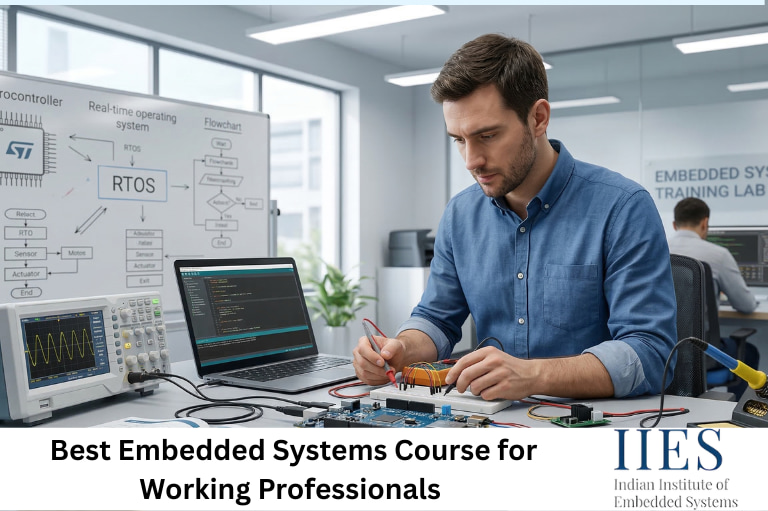
Why Working Professionals Are Switching to Embedded Systems
Many engineers working in service-based roles often want to move into a more technical product development career. Embedded systems provide an opportunity to work directly with hardware devices, firmware development, and intelligent electronic systems.
Key reasons professionals choose embedded systems training for working professionals include:
- Increasing demand for IoT devices and smart electronics
- Opportunities in automotive embedded systems and electric vehicles
- Growing need for robotics and industrial automation
- Strong demand in semiconductor and hardware product companies
- High career growth potential for firmware engineers
Industries using embedded systems include:
Industry | Embedded Applications |
Automotive | Electronic control units (ECUs), ADAS systems |
Healthcare | Patient monitoring devices |
Consumer Electronics | Smart TVs, wearables, home automation |
Industrial Automation | PLC systems and robotic controllers |
IoT | Smart sensors and connected devices |
Because of these opportunities, many professionals search for embedded systems training for working professionals near Bengaluru Karnataka.

Embedded Systems Course Details for Working Professionals
A well-designed embedded systems course for working professionals is structured to allow engineers to learn while continuing their full-time job.
Typical Course Duration
Training Mode | Duration |
Weekend Embedded Systems Training | 4–6 months |
Evening Classes | 4–5 months |
Fast Track Bootcamp | 10–12 weeks |
Embedded Systems Training Online | Flexible schedule |
Many institutes offer weekend embedded systems training in Bangalore specifically designed for working engineers.
Different Types of Embedded Systems Courses
Professionals may choose specialized programs depending on their career goals.
Embedded C Programming Course
The embedded C programming course is the foundation of embedded software development.
Core topics include:
- C programming for microcontrollers
- Bit manipulation and memory management
- Interrupt programming
- Peripheral control
- Firmware debugging
Advanced training may include advanced embedded C programming concepts used in real-world firmware development.
Embedded Linux and ARM Programming Course
Many modern devices use powerful processors running Linux-based systems. An embedded Linux and ARM programming course teaches:
These skills are widely used in IoT gateways, robotics platforms, and networking devices.
Advanced Embedded Systems Course
An advanced embedded systems course focuses on real-time systems and complex embedded architectures.
Typical topics include:
Advanced Embedded Systems Syllabus for Working Professionals
A structured program generally includes the following modules.
Module | Topics Covered |
Embedded C Programming | Pointers, interrupts, memory handling |
Microcontrollers | ARM Cortex architecture |
Embedded Linux | Kernel basics and drivers |
Communication Protocols | SPI, UART, I2C, CAN |
RTOS | Task scheduling and concurrency |
IoT Integration | Sensor and network connectivity |
Embedded AI Course | Edge AI and TinyML |
Embedded Systems Projects for Practical Learning
Projects are essential in embedded training programs.
Beginner Projects
- Temperature monitoring system
- LED display controller
- Smart lighting system
Intermediate Projects
- IoT based energy monitoring
- Smart parking system
- Wireless sensor network
Advanced Projects
- Autonomous robot controller
- Industrial automation controller
- Embedded AI object detection system
These embedded systems projects help learners build practical portfolios.

Advanced Embedded AI Course – Future of Embedded Engineering
Modern embedded devices increasingly integrate artificial intelligence capabilities.
Embedded AI training includes:
- TinyML development
- Sensor data processing
- Edge AI inference
- Neural network deployment on microcontrollers
Edge computing allows devices to process data locally without relying on cloud infrastructure.
Embedded Systems Career Opportunities
Professionals completing an embedded systems course with placement for working professionals can work in multiple engineering roles.
Popular Job Roles
- Embedded Software Engineer
- Firmware Developer
- IoT Engineer
- Device Driver Developer
- Robotics Engineer
- Automotive Embedded Engineer
Salary Trends in India
Experience | Average Salary |
Entry Level | ₹4 – ₹6 LPA |
3–5 Years | ₹7 – ₹12 LPA |
Senior Engineers | ₹15+ LPA |
Many product companies hiring embedded engineers include Intel, Texas Instruments, Qualcomm, and Bosch, which have major engineering centers in Bangalore.
Daily Learning Schedule for Working Professionals
Balancing a full-time job while learning embedded development can feel challenging. A structured schedule helps working professionals build consistent progress without burnout. Most professionals successfully learn embedded systems by dedicating 1–2 hours on weekdays and longer sessions on weekends.
Below is a practical weekly study plan designed for those enrolled in an embedded systems course for working professionals or attending weekend embedded systems training in Bangalore.
Weekly Study Plan for Working Professionals
Day | Learning Activity |
Monday | Study Embedded C programming concepts such as pointers, memory handling, and firmware logic |
Tuesday | Learn microcontroller architecture and understand registers and memory mapping |
Wednesday | Practice peripheral programming including timers, ADC, and GPIO |
Thursday | Study communication protocols such as UART, SPI, and I2C |
Friday | Explore embedded Linux basics and kernel interaction |
Saturday | Perform lab practice and debugging using development boards |
Sunday | Work on embedded systems projects |
Recommended Daily Time Allocation
Activity | Time Required |
Concept learning | 45–60 minutes |
Practical coding | 30–45 minutes |
Hardware experimentation | 30 minutes |
Debugging and revision | 15–20 minutes |
Tips for Working Professionals Learning Embedded Systems
- Focus on hands-on practice rather than only theory
- Work on small embedded systems projects every week
- Practice embedded C programming regularly
- Use development boards to understand real hardware behavior
- Review concepts during weekends
Following this structured approach helps professionals complete an advanced embedded systems course efficiently.
Useful Learning Resources for Embedded Systems
Learning embedded systems becomes easier when professionals use official documentation, developer tools, and hardware references provided by semiconductor companies.
Many professionals enrolled in an embedded systems course for working professionals use these resources to deepen their understanding.
Recommended Learning Resources
Resource Type | Description |
Microcontroller Architecture Documentation | Explains processor design and instruction sets |
Firmware Development Guides | Embedded C programming and interfacing |
Hardware Development Manuals | Embedded hardware design |
Device Driver Documentation | Embedded Linux driver development |
Development Toolchains | Compilers, debuggers, IDEs |
Official Industry Documentation
Some of the most widely used embedded development resources are provided by:
- Arm Ltd.
- STMicroelectronics
- Texas Instruments
These companies design microcontrollers used in automotive electronics, robotics systems, IoT devices, and industrial automation.
Why These Resources Are Important
Engineers rely on these resources to understand:
- Microcontroller register configuration
- Peripheral programming
- Hardware debugging techniques
- Firmware optimization for real-time systems
Common Mistakes When Learning Embedded Systems
Understanding common mistakes helps professionals learn faster.
1. Skipping C Programming Fundamentals
Embedded development relies heavily on C programming, including pointers, bit operations, and memory management.
2. Learning Theory Without Projects
Embedded systems require practical experimentation with hardware boards.
Examples include:
- Sensor monitoring systems
- IoT automation devices
- Communication protocol demonstrations
3. Ignoring Debugging Tools
Important debugging tools include:
Tool | Purpose |
JTAG Debugger | Firmware debugging |
Logic Analyzer | Signal timing analysis |
Oscilloscope | Hardware signal visualization |
Serial Monitor | Communication debugging |
4. Not Understanding Hardware Architecture
Engineers must understand both software and hardware interactions.
5. Jumping Directly to Advanced Topics
A better learning sequence is:
- C programming
- Embedded C programming
- Microcontrollers
- Communication protocols
- RTOS
- Embedded Linux and ARM programming
How Difficult Is Embedded Systems for Working Professionals?
Embedded systems combine hardware and software concepts, which may initially seem challenging.
However, with structured training and consistent practice, professionals can build strong skills within 4–6 months.
Key Areas to Learn
- Embedded C programming
- Microcontroller architecture
- Hardware interfacing
- Communication protocols
- Real-time system behavior
- Firmware debugging
Efficient Learning Approach
Learning Component | Purpose |
Programming practice | Build Embedded C expertise |
Hardware experimentation | Understand microcontrollers |
Debugging exercises | Diagnose system issues |
Real-world projects | Apply knowledge practically |
By following a structured path, professionals can gradually move toward embedded Linux development, RTOS programming, and embedded AI systems.
Key Features of a High-Quality Embedded Systems Training Program
When selecting embedded courses for working professionals, look for these features:
- Industry experienced trainers
- Real hardware lab access
- Embedded systems projects
- ARM and Linux training modules
- Career guidance and resume support
- Placement assistance programs
Many institutes offer embedded systems training in Bangalore with 100% placement assistance.
Embedded Systems Course in Bangalore for Working Professionals
Bangalore is one of India’s largest technology hubs with strong presence in:
- Semiconductor companies
- Automotive electronics firms
- Robotics startups
- IoT product companies
Because of this ecosystem, many professionals search for top rated best embedded systems course for working professionals in Bangalore.
Embedded Certification for Working Professionals
For professionals who cannot attend classroom sessions due to work schedules, many institutes now offer embedded certification for working professionals through flexible and online training programs. At the Indian Institute of Embedded Systems, these certification programs are designed specifically for engineers who want to upgrade their skills in embedded technologies while continuing their full-time jobs.
The training focuses on practical learning and industry-relevant technologies such as embedded C programming, ARM microcontrollers, embedded Linux, and real-time system development. This approach helps working professionals gain hands-on experience with embedded hardware and software used in real-world product development.
An embedded certification for working professionals typically includes structured modules, hands-on labs, and project-based learning so that learners can build strong firmware development skills and practical expertise in embedded system design.
Benefits of Embedded Certification for Working Professionals
- Flexible learning schedule suitable for full-time engineers
- Recorded lectures for self-paced study
- Remote hardware labs and simulation environments
- Industry-recognized certification after course completion
These programs provide flexible embedded systems online training that allows professionals to learn essential topics such as embedded C programming, microcontroller development, embedded Linux, and ARM programming while managing their work responsibilities.
Embedded Systems Industry Growth
Industry reports show strong growth in embedded technologies.
Key trends include:
- Global embedded systems market projected to exceed $160 billion by 2030
- IoT ecosystem expected to reach 30+ billion connected devices
- Rapid expansion in electric vehicles and smart manufacturing
This growth creates significant opportunities for engineers pursuing an advanced embedded systems course.

Final Thoughts
Choosing the best embedded systems course for working professionals can open doors to careers in IoT, robotics, automotive electronics, industrial automation, and smart devices.
With structured training, practical embedded systems projects, and expertise in embedded C programming, embedded Linux, and ARM architecture, working professionals can successfully transition into high-demand engineering roles.