What Is Assembly Language in C Programming
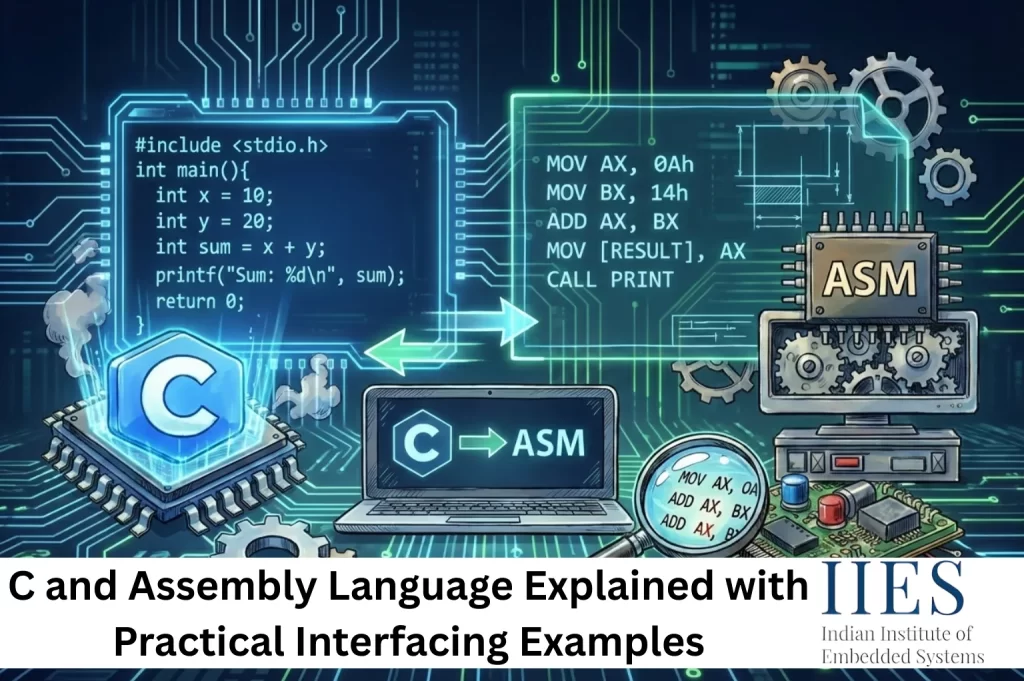
Assembly Language is a low‑level programming language that communicates directly with the CPU using instructions such as MOV, ADD, and SUB. When you write a C program, it does not run directly on the hardware. Instead, the C compiler converts the code into Assembly Language and then into machine code.
This means every C program internally relies on Assembly, even though it is hidden from the developer. Understanding assembly language in C programming helps you see what happens behind the scenes and how to improve execution speed and efficiency.
Example:
int sum = a + b;
This simple line is translated into Assembly instructions that load values into registers, perform the addition, and store the result.
Understanding Assembly inside C helps you see what happens in the background and how to improve performance.
Why Combine C and Assembly Language
Using C and Assembly Language together provides several advantages:
Performance Optimization: Assembly executes closer to the hardware, making it ideal for critical sections like encryption, image processing, and embedded systems.
- Hardware Access – Some operations, like accessing registers or I/O ports, can only be done with Assembly instructions.
- Learning and Debugging – Studying Assembly code generated by C helps understand compiler behavior, calling conventions, and machine-level execution.

How C Calls Assembly – Inline Assembly in C
C allows developers to write Assembly instructions directly inside C code using inline assembly. This approach enables optimization of specific logic while keeping the rest of the program clean and readable.
Example using GCC Inline Assembly
#include

int main() {
    int a = 10, b = 20, result;
    __asm__ ("addl %%ebx, %%eax;"
             : "=a" (result)
             : "a" (a), "b" (b));
    printf("Result = %d\n", result);
    return 0;
}
Explanation
- __asm__ tells the compiler to include Assembly code.
- %%eax and %%ebx are CPU registers.
- The colons define how data moves between C and Assembly.
Inline Assembly is a common technique in assembly language in C programming when precise hardware control is required.
How Assembly Calls C Functions
Assembly programs can also call C functions, allowing two‑way communication between languages. This is useful when a low‑level routine needs to reuse high‑level C logic.
Steps
- Declare the C function as extern in your Assembly code.
- Compile both files separately and link them using GCC.
Example
// myfunc.c
int add(int x, int y) {
    return x + y;
}
; main.asm
extern add
global _start

section .text
_start:
    mov rdi, 5
    mov rsi, 10
    call add
    ; result stored in RAX
Compile and Link
gcc -c myfunc.c -o myfunc.o
nasm -f elf64 main.asm -o main.o
gcc main.o myfunc.o -o output
This technique shows how C and Assembly Language share data through registers and the system stack.

The Role of the Stack in C and Assembly Communication
The stack plays a vital role when C and Assembly interact:
- Function parameters are pushed onto the stack.
- The return address is stored to resume after the call.
- Return values are stored in registers such as EAX or RAX.
A proper understanding of stack behavior is essential when mixing C and Assembly Language, as incorrect usage can cause crashes or data corruption.
Difference Between C and Assembly Language
Understanding the difference between C and Assembly Language helps developers decide when to use each.
| Feature | C Language | Assembly Language |
|---|
| Level | High‑level | Low‑level |
| Portability | Platform independent | Platform dependent |
| Readability | Easy to read | Difficult to maintain |
| Performance | Fast | Extremely fast |
| Hardware Control | Limited | Full control |
This difference explains why C is widely used for system development while Assembly is reserved for performance‑critical sections.
Common Calling Conventions
- cdecl – Default in C; the caller cleans the stack.
- stdcall – Used in Windows API; the callee cleans the stack.
- fastcall – Passes arguments through registers for speed.
When mixing assembly language in C programming, both sides must follow the same calling convention to ensure stability.
Real‑World Applications of C and Assembly Language
- Embedded systems and device drivers
- Operating system kernels
- Cryptography and signal processing
- Game engines and graphics libraries
- Firmware development

Final Thoughts
C and Assembly Language together provide a powerful way to build efficient, hardware‑aware software. C offers structure and portability, while Assembly delivers maximum performance and control. By understanding their interaction, developers can write optimized programs that meet modern system demands.