

STM32 ADC: Analog Sensor Reading INTRODUCTION Because they enable microcontrollers to communicate with the analog world, analog-to-digital converters, or ADCs, are essential components of embedded systems. The ADC is a flexible and necessary peripheral for STM32 microcontrollers that enable the transformation of an analog voltage …
Read more

Step-by-Step Guide to Connecting LEDs with the 8051 Microcontroller INTRODUCTION Just as a “Hello World!” program is an essential starting point for learning a new programming language, controlling an LED with an 8051 microcontroller serves as a foundational exercise for embedded systems enthusiasts. This basic …
Read more
Understanding Pointer Arithmetic: From Basics to Advanced Concepts INTRODUCTION Pointer arithmetic is a powerful concept in C programming, enabling manipulation of memory addresses rather than just data values. This blog delves into the operations that can be performed on pointers, including incrementing, decrementing, adding, and …
Read more

Exploring the Differences Between Formatted and Unformatted I/O in C INTRODUCTION Discover the fundamentals of formatted and unformatted input/output functions in C programming. This comprehensive guide explains how formatted I/O functions like printf and scanf provide flexibility for displaying and receiving various data types with …
Read more
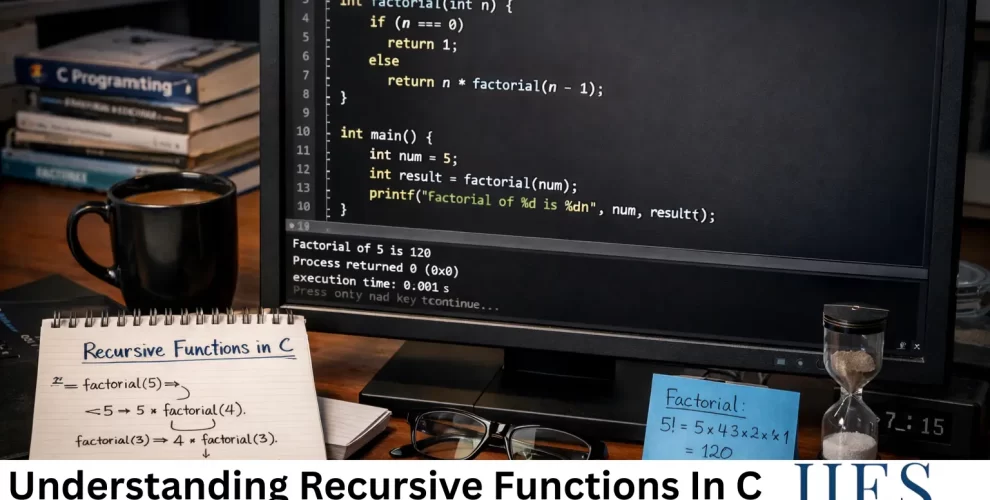
Understanding Recursive Functions In C With Simple And Practical Examples Recursive functions in C programming are an important concept and a core topic for engineering students, especially those preparing for careers in embedded systems, software development, and core programming roles. Understanding recursive functions in C …
Read more
Built-in vs User-defined Functions in C++ Functions are the building blocks of efficient and modular programming in C++. They enable developers to perform specific tasks, improve code readability, and reuse logic across programs. A function is defined using a return type, a name, and optional …
Read more
Break and Continue in Loops: Enhancing C++ Control Flow INTRODUCTION Jump statements in C++ are powerful tools that control the flow of execution in a program. These statements—break, continue, goto, and return—allow developers to manage loops, conditionals, and function behaviors more efficiently. Break is used to exit loops or …
Read more
When to Use Do-While Loops in C++? INTRODUCTION Loops are a fundamental concept in programming, allowing developers to automate repetitive tasks efficiently. In C++, loops enable the execution of a block of code multiple times based on specific conditions, making them indispensable for tasks like …
Read more

How Deeply Is Embedded Technology Shaping Your World? INTRODUCTION The inception of embedded systems dates back to the 1960s, originating with the Apollo Guidance Computer (AGC), which was created by Charles Stark Draper at the MIT Instrumentation Laboratory. The AGC delivered the necessary computational resources …
Read more