What are Digital Circuits?
Digital circuits are electronic circuits that process information using binary values (0 and 1). These circuits are built using logic gates such as AND, OR, NOT, NAND, and NOR.
Based on how outputs are generated, digital circuits are classified into two categories:
- Combinational Circuits
- Sequential Circuits

Combinational Circuits
Definition
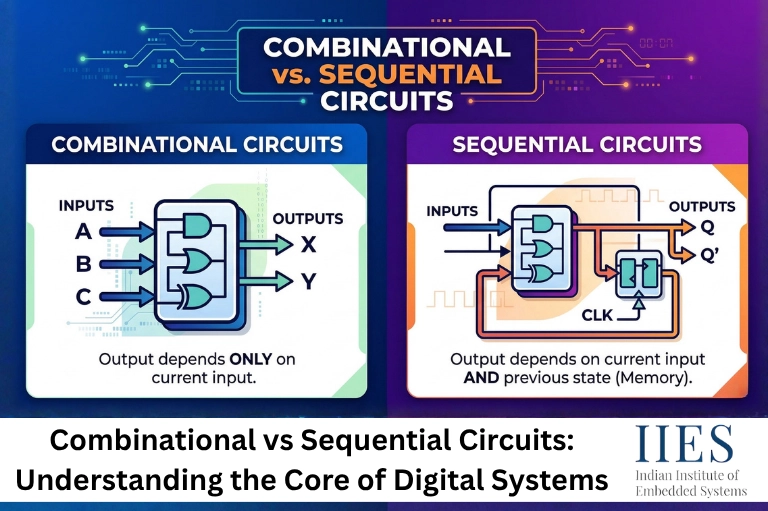
A combinational circuit is a digital circuit in which the output depends only on the present input values.
In other words, the circuit does not store any previous information. Whenever the input changes, the output immediately changes according to the logic function.
Key Characteristics
- Output depends only on current inputs
- No memory element
- No feedback path
- Simple design
Block Representation
Input → Logic Gates → Output
Examples of Combinational Circuits
Some commonly used combinational circuits include:
- Adders (Half Adder, Full Adder)
- Subtractors
- Multiplexers (MUX)
- Demultiplexers (DEMUX)
- Encoders
- Decoders
- Comparators
Example: Half Adder
A half adder is a combinational circuit used to add two binary digits.
Inputs
Outputs
Truth Table
| A | B | Sum | Carry |
|---|
| 0 | 0 | 0 | 0 |
| 0 | 1 | 1 | 0 |
| 1 | 0 | 1 | 0 |
| 1 | 1 | 0 | 1 |
Half adders are widely used in arithmetic logic units (ALU) in processors.
Sequential Circuits
Definition
A sequential circuit is a digital circuit in which the output depends on:
- Current inputs
- Previous state of the circuit
This means sequential circuits have memory.
Key Characteristics
- Output depends on present inputs and past outputs
- Contains memory elements
- Uses feedback paths
- Often controlled by a clock signal
Block Representation
Input → Logic Circuit → Memory Element → Output
Memory Elements Used
Sequential circuits store data using:
Examples of Sequential Circuits
Common sequential circuits include:
- Counters
- Shift registers
- Registers
- Memory units
- Finite state machines
Example: Flip-Flop
A flip-flop is a memory device that can store one bit of information.
Types of Flip-Flops
- SR Flip-Flop
- JK Flip-Flop
- D Flip-Flop
- T Flip-Flop
Flip-flops are used in:
- Registers
- Counters
- Memory devices

Key Differences Between Combinational and Sequential Circuits
| Feature | Combinational Circuit | Sequential Circuit |
|---|
| Output Depends On | Present input only | Present input + past output |
| Memory | No memory | Has memory |
| Feedback | No feedback path | Feedback path present |
| Clock Signal | Not required | Often required |
| Complexity | Simple | More complex |
Practical Applications
Applications of Combinational Circuits
- Arithmetic operations in processors
- Data routing systems
- Code conversion
- Digital signal processing
Applications of Sequential Circuits
- Digital clocks
- Computer memory
- Microprocessors
- Communication systems
- Embedded controllers
Why These Circuits are Important in Embedded Systems
Modern embedded systems such as microcontrollers and processors rely heavily on both combinational and sequential circuits.
For example:
- Combinational circuits perform logical calculations.
- Sequential circuits store data and control operations.
Together, they form the core architecture of digital devices used in:
Conclusion
Combinational and sequential circuits are the core building blocks of digital systems. While combinational circuits perform logic operations based on current inputs, sequential circuits add memory and allow systems to remember previous states.
Understanding the difference between these two circuits is crucial for designing digital systems, microprocessors, and embedded devices.
As technology continues to advance, these circuits remain fundamental to modern electronics and computing.