Why Microcontroller Selection Matters
In modern embedded systems microcontrollers, your choice affects:
- Development speed
- Power consumption
- Cost efficiency
- Scalability
- Ease of programming
A poor choice can lead to redesigns, increased costs, or performance bottlenecks. That’s why a proper microcontroller selection guide is essential, especially in 2026, where IoT and automation demand smarter decisions.

What is an 8051 Microcontroller?
The 8051 microcontroller is one of the oldest and most widely studied microcontrollers. Introduced decades ago, it is still used in academic environments and simple industrial systems.
The 8051 architecture follows a Harvard architecture with separate memory spaces for program and data. It is an 8-bit microcontroller with:
- Limited RAM and ROM
- Basic instruction set
- Low processing power
Advantages of 8051 Microcontroller
- Simple and easy to understand
- Widely used in education
- Low cost
- Stable for basic control systems
Advantages and Disadvantages of 8051 Microcontroller
Advantages:
- Easy to learn for beginners
- Good for small embedded applications
- Large legacy support
Disadvantages:
- Limited performance
- Outdated compared to modern controllers
- Less support for advanced peripherals
What is a PIC Microcontroller?
The PIC microcontroller (Peripheral Interface Controller) is known for its efficiency and industrial reliability.
PIC Architecture
The PIC architecture is based on a Harvard architecture with RISC (Reduced Instruction Set Computing), making it faster and more efficient than 8051.
PIC Microcontroller Features
- Wide range of variants (8-bit, 16-bit, 32-bit)
- Built-in peripherals (ADC, PWM, timers)
- Low power consumption
- High efficiency
Advantages of PIC Microcontroller Over 8051
- Faster execution speed
- Better power efficiency
- More peripherals and flexibility
- Suitable for industrial applications
What is Arduino?
The Arduino microcontroller is not just a chip, it’s a complete development platform designed for ease of use.
Arduino Architecture
The Arduino architecture typically uses AVR or ARM-based microcontrollers with a simplified interface for developers.
Key Features of Arduino
- Easy-to-use Arduino IDE
- Massive community support
- Plug-and-play hardware ecosystem
- Extensive libraries
Why Arduino is Popular
- Ideal for beginners
- Fast prototyping
- Minimal hardware knowledge required
Arduino vs 8051 vs PIC Microcontrollers Architecture Comparison
Feature | 8051 Microcontroller | PIC Microcontroller | Arduino (AVR/ARM-based) |
Architecture Type | Harvard Architecture | Harvard (RISC Architecture) | AVR (Harvard) / ARM (Advanced RISC) |
Core | 8-bit core | 8-bit / 16-bit / 32-bit cores | 8-bit (AVR) / 32-bit (ARM Cortex) |
Processing Speed | Low | Medium to High | Medium to High |
Clock Speed | ~12 MHz typical (up to ~33 MHz max) | ~4 MHz to 64 MHz (varies by model) | ~16 MHz (Uno) to 84+ MHz (ARM boards) |
RAM (Data Memory) | Very limited (128B – 256B typical) | 368B to several KB | 2 KB (Uno) to 96 KB+ (ARM boards) |
ROM / Flash Memory | 4 KB – 64 KB | 1 KB – 512 KB | 32 KB (Uno) to 512 KB+ |
Instruction Set | CISC (Complex Instruction Set) | RISC (Reduced Instruction Set) | RISC-based |
Execution Speed | Slower (12 clock cycles per instruction) | Faster (1 instruction per cycle typical) | Fast (optimized libraries + hardware) |
Peripherals | Limited | Wide range (ADC, PWM, UART, SPI) | Extensive (depends on board + libraries) |
Power Efficiency | Low | High (optimized for low power) | Moderate |
Complexity Level | Low (basic) | Medium | Beginner-friendly |
Programming Comparison
- 8051 programming requires Embedded C or Assembly with tools like Keil
- PIC programming uses MPLAB and is more optimized but slightly complex
- Arduino programming uses simplified C++ in Arduino IDE
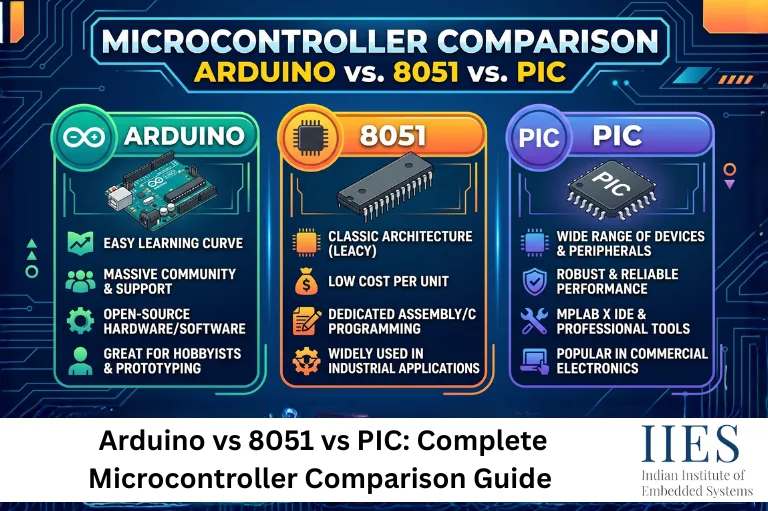
Verdict: Arduino is easiest, PIC is efficient, 8051 is foundational.
Performance & Power
When comparing performance factors, the 8051 microcontroller offers low speed and limited scalability, making it suitable only for basic applications. In contrast, the PIC microcontroller provides medium to high speed along with high power efficiency and excellent scalability, which makes it ideal for industrial and long-term projects. The Arduino microcontroller also delivers medium to high speed and good scalability, but its power efficiency is moderate, making it more suitable for prototyping, learning, and flexible development rather than highly optimized low-power systems.
For low power microcontroller comparison, PIC clearly stands out.
Ease of Use
- 8051: Steep learning curve today
- PIC: Moderate complexity
- Arduino: Extremely beginner-friendly
Cost & Availability
- 8051: Cheapest
- PIC: Moderate
- Arduino: Slightly higher but worth for beginners
Development Tools and Software for Each Microcontroller
The choice of development tools plays a major role in how quickly and efficiently you can build, test, and deploy your projects. Each microcontroller—8051, PIC, and Arduino—has its own ecosystem of compilers, IDEs, and debugging tools.
8051 Microcontroller Tools
Working with the 8051 microcontroller typically involves low-level programming, which makes tool selection important.
Common Tools:
- Keil µVision IDE – Most widely used for 8051 programming
- Embedded C Compiler – Used for writing and compiling code
- Proteus Simulator – Helps simulate circuits before hardware implementation
- Flash Programmers – Used to upload code to the microcontroller
Key Characteristics:
- Requires manual configuration and setup
- Strong focus on register-level programming
- Ideal for learning core embedded concepts
PIC Microcontroller Tools
The PIC microcontroller ecosystem is more advanced and designed for professional development.
Common Tools:
- MPLAB X IDE – Official development environment from Microchip
- XC8 / XC16 / XC32 Compilers – Based on PIC architecture (8-bit, 16-bit, 32-bit)
- MPLAB Code Configurator (MCC) – Simplifies peripheral configuration
- PICkit Programmer/Debugger – Used for uploading and debugging code
Key Characteristics:
- Strong debugging and optimization features
- Better hardware control compared to Arduino
- Supports scalable and industrial-level applications
Arduino Microcontroller Tools
The Arduino microcontroller is known for its simplicity and beginner-friendly ecosystem.
Common Tools:
- Arduino IDE – Simple and widely used programming environment
- Arduino Libraries – Pre-built functions for sensors, communication, and devices
- Serial Monitor – Built-in tool for debugging and testing
- PlatformIO (Advanced) – For more professional and scalable development
Key Characteristics:
- Minimal setup required
- Large community support
- Fast prototyping with ready-to-use modules
Real-World Applications of 8051, PIC, and Arduino Microcontrollers
Where 8051 is Still Used
- Educational labs
- Simple automation systems
- Legacy industrial equipment
Where PIC Microcontrollers Excel
- Industrial control systems
- Automotive electronics
- Medical devices
Arduino Use Cases
- IoT projects
- Home automation
- Robotics
- Rapid prototyping

Practical Example: Choosing the Right Microcontroller
Case 1: Beginner Student Project
Best choice: Arduino
Reason: Easy programming, fast results
Case 2: Battery-Powered IoT Device
Best choice: PIC
Reason: Low power consumption
Best choice: 8051
Reason: Strong foundational understanding
Microcontroller Selection Guide
Choosing the right microcontroller is not just about specifications—it’s about aligning your project requirements with the right platform. Follow this step-by-step approach to make a smarter decision.
1. Define Project Complexity
Start by understanding what your project actually needs.
- For simple tasks like LED control, basic sensors, or small automation → a basic microcontroller like the 8051 microcontroller is sufficient.
- For medium-level applications like motor control, communication systems, or embedded logic → consider a PIC microcontroller.
- For complex projects such as IoT systems, robotics, or rapid prototyping → Arduino microcontroller is often the best choice due to its flexibility and ecosystem.
Clearly defining complexity prevents overengineering and reduces cost.
2. Consider Power Requirements
Power consumption plays a critical role, especially in battery-operated devices.
- If your project runs on batteries or requires long-term operation → choose a low power microcontroller like PIC.
- If power is not a major constraint (e.g., lab projects or prototypes) → Arduino works well.
- Older controllers like 8051 generally consume more power and are less optimized for modern low-energy applications.
Efficient power planning improves product reliability and lifespan.
3. Check Available Tools and Support
Development tools and ecosystem support can significantly impact your workflow.
- Arduino programming uses Arduino IDE, which is beginner-friendly and supported by a large community.
- PIC programming uses MPLAB, offering advanced debugging and control for professional development.
- 8051 programming often relies on tools like Keil, which require more manual configuration.
A strong ecosystem means faster development, easier debugging, and better learning resources.
4. Evaluate Budget
Cost is always a practical factor, especially for students and large-scale production.
- 8051 is generally the most affordable option for basic applications.
- PIC offers a balance between cost and performance.
- Arduino boards may seem costlier, but they reduce development time and effort, which can save money overall.
Always consider both hardware cost and development cost, not just the price of the board.
5. Choose Based on Scalability
Think beyond your current project and consider future expansion.
- If your project may grow into a commercial product → PIC microcontroller is more scalable and industry-friendly.
- If you need flexibility for upgrades and quick modifications → Arduino is a strong choice.
- 8051 has limited scalability and is better suited for fixed, small-scale applications.
Planning for scalability ensures your design remains relevant as requirements evolve.
A good microcontroller choice balances performance, power efficiency, ease of use, and long-term scalability. Instead of picking the most popular option, choose the one that best fits your specific use case.
Common Mistakes to Avoid
- Choosing 8051 for advanced projects
- Using Arduino in production without optimization
- Ignoring power consumption in IoT designs
- Not considering ecosystem support
Future Trends in Microcontrollers (2026 and Beyond)
The landscape of embedded systems microcontrollers is evolving rapidly:
- Rise of AI-enabled microcontrollers
- Growth of IoT-focused boards like ESP32
- Increased focus on low power designs
- Integration with cloud platforms
Arduino continues to dominate prototyping, while PIC remains strong in industry. The 8051 is gradually fading but still relevant in learning environments.
Best Practices for Choosing and Mastering Microcontrollers
Getting good results with microcontrollers is not just about selecting the right hardware—it’s about following a smart learning and development approach. These best practices will help you build stronger skills, avoid common pitfalls, and create more effective projects.
Start with Arduino for a Smooth Learning Curve
If you’re new to embedded systems, begin with the Arduino microcontroller. Its simplified programming environment, ready-to-use libraries, and strong community support allow you to quickly understand core concepts like digital I/O, sensors, and communication protocols.
Starting with Arduino helps you:
- Build confidence through quick results
- Focus on logic instead of low-level complexity
- Experiment with multiple project ideas in less time
Progress to PIC for Better Control and Efficiency
Once you are comfortable with basics, move to the PIC microcontroller. It offers more control over hardware, better performance, and improved power efficiency—especially important for real-world and industrial applications.
Working with PIC helps you:
- Understand optimized coding practices
- Work with low-level hardware control
- Design power-efficient systems
Learn 8051 for Strong Fundamentals
Even though it is considered outdated for modern applications, the 8051 microcontroller is still valuable for learning.
It helps you:
- Understand microcontroller architecture deeply
- Learn memory organization and instruction sets
- Build a strong foundation in embedded C and hardware interaction
This foundational knowledge makes it easier to transition to advanced microcontrollers later.
Focus on Real-World Projects, Not Just Theory
Theory alone is not enough in embedded systems. Practical implementation is where real learning happens.
Instead of only reading concepts:
- Build sensor-based projects
- Create automation systems
- Try communication-based applications like UART, I2C, or SPI
Real-world projects improve problem-solving skills and prepare you for industry-level challenges.
Always Plan for Long-Term Scalability
Before selecting a microcontroller, think about the future scope of your project.
Ask yourself:
- Will this project grow into a larger system?
- Will I need more processing power later?
- Is power efficiency important in future versions?
Choosing a scalable option like Arduino (for prototyping) or PIC (for production) ensures your project can evolve without major redesigns.
Final Takeaway
A structured approach, starting simple, building fundamentals, and gradually moving to advanced platforms, will give you both practical skills and long-term success in embedded systems development.

Conclusion
The debate of Arduino vs 8051 vs PIC isn’t about which is universally better, it’s about choosing the right tool for the job.
- Choose Arduino for ease, speed, and prototyping
- Choose PIC microcontroller for performance and efficiency
- Choose 8051 microcontroller for learning fundamentals
Understanding their architecture, programming, and applications helps you make smarter decisions and build better projects. As embedded systems continue to evolve, selecting the right microcontroller will remain a critical skill for engineers and developers.