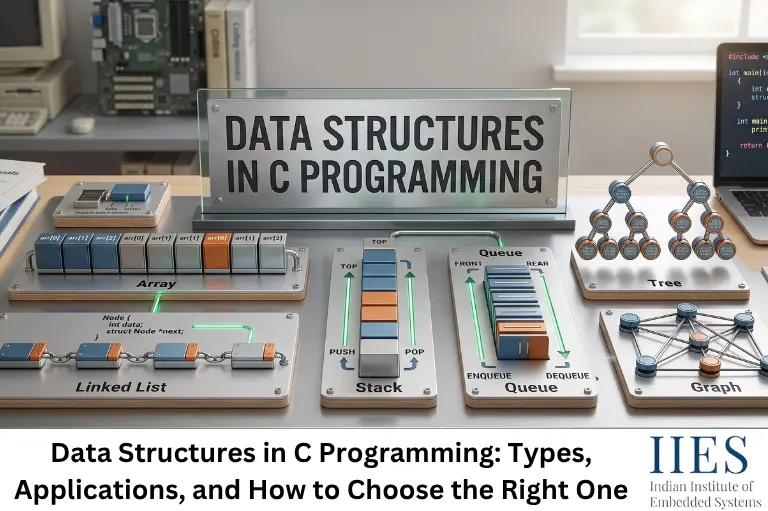
What Are Data Structures in C Programming?
A data structure is a way of organizing and storing data in memory so it can be accessed and modified efficiently. In C, that means deciding how a group of values sits in memory and what operations, insert, delete, search, traverse, you’re allowed to perform on them.
Think of it this way: a shelf of numbered boxes lets you jump straight to box #7. A chain of connected boxes, each pointing to the next, doesn’t give you that shortcut – but it lets you add or remove a box without disturbing the rest. Neither is “better.” They’re built for different jobs.
In C specifically, a data structure is usually built from three ingredients:
- Structs – to group related data into one unit
- Pointers – to link pieces of data together in memory
- Dynamic memory functions (
malloc, calloc, realloc, free) – to grow or shrink structures at runtime
This hands-on approach is exactly what makes C such a strong language to actually learn data structures in, rather than just use them. Once you understand why a linked list works because you wrote the pointer logic yourself, using one in Python or Java feels almost too easy.

Why Should You Learn Data Structures in C Programs?
Learning data structures in C pays off because nearly everything you build later, from a command-line tool to embedded firmware, depends on choosing the right one for speed and memory efficiency. A few concrete reasons it’s worth the effort:
- Efficient memory use – critical when you’re working with microcontrollers that have kilobytes, not gigabytes, of RAM
- Faster code – the right structure can turn an O(n) search into an O(1) lookup
- Better debugging instincts – most tricky bugs (memory leaks, dangling pointers, buffer overflows) trace back to how data was structured in the first place
- Stronger interview performance – data structures and algorithms remain the backbone of technical interviews across the industry
- A clearer picture of how systems work – operating systems, compilers, databases, and RTOS schedulers are all built from these exact structures
- A real foundation for embedded and IoT development – circular buffers, task queues, and memory pools are just data structures wearing a different name
If you’re aiming to write firmware or build IoT devices, this isn’t optional knowledge, it’s the difference between code that fits on a chip and code that doesn’t.
Types of Data Structures in C Programming
Zooming out one level before diving in: data structures in C fall into two broad groups.
- Primitive data structures – the basic building blocks:
int, float, char, and pointers. Each holds a single value directly. - Non-primitive data structures – built on top of primitives to hold collections of data: arrays, linked lists, stacks, queues, trees, and graphs.
Non-primitive structures split further based on how their elements relate to one another:
| Category | How Data Is Arranged | Examples |
|---|
| Linear | Elements connect one after another, in sequence | Arrays, Linked Lists, Stacks, Queues |
| Non-Linear | Elements connect in a hierarchy or network, not a straight line | Trees, Graphs, Heaps |
One more practical distinction worth knowing: static structures (like arrays) have a size fixed at compile time, while dynamic structures (like linked lists and trees) grow and shrink at runtime using malloc and free. On memory-constrained hardware, this distinction often matters more than which category a structure technically falls into.
Linear Data Structures
1. Arrays
An array stores a fixed number of elements of the same type in contiguous memory. Because elements sit right next to each other, you can jump to any index instantly.
c
int sensorReadings[5] = {24, 26, 25, 27, 23};
printf("%d", sensorReadings[2]);  // Instantly accesses the 3rd value
- Fast, index-based access – O(1)
- Size is fixed once declared (in a standard static array)
- Inserting or deleting in the middle means shifting everything after it – O(n)
- Extends naturally to multiple dimensions (2D arrays) for grid-like data, think sensor matrices or image pixels
2. Linked Lists
A linked list stores elements as nodes, where each node holds data and a pointer to the next node. Nothing needs to sit next to anything else in memory.
c
struct Node {
    int data;
    struct Node* next;
};
- Grows and shrinks at runtime – no fixed size
- Insertion and deletion are fast once you’re at the right spot – O(1)
- No instant index access – you walk the chain node by node – O(n)
- Comes in singly, doubly, and circular variants, each trading extra memory for extra flexibility
3. Stacks
A stack follows Last In, First Out (LIFO), the last item added is the first one removed, like a stack of plates where you only ever take from the top.
Technically, a stack is an abstract data type (ADT) — defined by its behavior, not its implementation. You can build one on top of either an array or a linked list.
c
#define MAX 10
int stack[MAX], top = -1;

void push(int value) { stack[++top] = value; }
int pop() { return stack[top--]; }
- Core operations:
push, pop, peek - Powers function calls (the call stack), undo operations, and expression evaluation
- Constant-time O(1) push and pop
4. Queues
A queue follows First In, First Out (FIFO) — the first item added is the first one out, like a line at a ticket counter. Like a stack, a queue is an abstract data type that can be implemented with an array or a linked list underneath.
- Core operations:
enqueue, dequeue - Variants: circular queue (reuses fixed memory efficiently — a favorite for embedded buffering), priority queue (elements served by priority instead of arrival order), and deque (insertion/removal from both ends)
- Common in task scheduling, print spooling, and buffered data streams
Linear structures handle sequences well, but real-world data is often hierarchical, like a file system, or interconnected, like a network. That’s where non-linear structures take over.

Types of Non-Linear Data Structures in C
Non-linear data structures don’t arrange elements in a straight line, each element can connect to multiple others, which makes them ideal for representing hierarchies and relationships.
Trees
A tree organizes data into a parent-child hierarchy that starts from a single root node.
c
struct TreeNode {
    int data;
    struct TreeNode* left;
    struct TreeNode* right;
};
- Binary Tree — each node has at most two children
- Binary Search Tree (BST) — left child < parent < right child, which enables fast searches (O(log n) on average)
- Balanced trees (AVL, Red-Black), self-adjust after insertions and deletions to keep that O(log n) guarantee even in the worst case
Used for hierarchical data like file directories, fast lookups, and decision logic in device firmware.
Graphs
A graph is a set of vertices (nodes) connected by edges. Unlike trees, graphs have no strict hierarchy, any node can connect to any other node.
- Directed vs. undirected – do connections have a one-way direction?
- Weighted vs. unweighted – do connections carry a cost or distance?
- Represented in C using either an adjacency matrix (simple, but memory-heavy) or an adjacency list (memory-efficient for sparse graphs)
Used for network routing, dependency resolution, and modeling how devices connect in an IoT mesh network.
Heaps
A heap is a complete binary tree where every parent is either always larger (max-heap) or always smaller (min-heap) than its children.
- The root always holds the maximum or minimum value, retrievable in O(1)
- The backbone of priority queues and heap sort
- Used in scheduling systems, where the “next” item is always the highest-priority one
Tries (Prefix Trees)
A trie is a less commonly taught but genuinely useful structure that stores strings character by character, sharing common prefixes between words.
- Extremely fast prefix search, the engine behind autocomplete, spell-checkers, and command parsing in device interfaces
- Trades some memory for a significant speed gain on string-heavy data
A note on hash tables: they don’t fit neatly into “linear” or “non-linear” – a hash table uses a hash function to map keys directly to array positions, often handling collisions with a linked list at each slot. They’re worth knowing well because they deliver near-O(1) average-case search, insert, and delete, making them one of the most practical structures once arrays and linked lists feel comfortable.
Applications of Data Structures in C
Data structures in C power everything from compilers and databases to the firmware running inside the smallest microcontrollers.
General Software Applications
- Arrays — image pixel data, lookup tables, fixed-size buffers
- Linked lists — dynamic memory allocators, undo/redo history
- Stacks — compilers (syntax parsing), browser back-button history, recursive function calls
- Queues — print queues, CPU task scheduling, message queues
- Trees — database indexing (B-trees), file systems, autocomplete suggestions
- Graphs — GPS navigation, social network connections, recommendation engines
- Hash tables — caching, compiler symbol tables, fast key-based lookups
This is where C’s data structures really earn their keep:
- Circular queues buffer incoming bytes in UART, SPI, and I2C communication — critical when an interrupt fires faster than the main loop can process it
- Stacks manage function calls and interrupt context, and running out of stack space is one of the most common crashes on RAM-limited microcontrollers
- Linked lists power dynamic task lists and memory pools in RTOS environments like FreeRTOS
- Trees organize configuration parameters and file allocation tables in embedded storage
- Graphs model device connections in mesh networking protocols like Zigbee and Thread
- Hash tables give near-instant lookups for things like GPIO pin mappings or sensor calibration data
How to Choose the Right Data Structure for Your C Program
There’s no single “best” data structure — only the one that fits what your program actually needs to do. Before writing a line of code, it helps to ask:
- What operation happens most often? Frequent searching favors hash tables or BSTs; frequent insertion/deletion favors linked lists
- Do you know the data size in advance? Fixed, known size → array. Unpredictable, changing size → linked list or another dynamic structure
- How much memory can you spare? On constrained hardware, static arrays and circular buffers beat pointer-heavy structures that fragment memory over time
- Do you need hierarchy or relationships? Hierarchical data → tree. Networked relationships → graph
- Is the access pattern random or sequential? Random access → array. Sequential processing → linked list or queue
Quick Decision Cheat Sheet
| If you need to… | Use this structure |
|---|
| Access elements instantly by position | Array |
| Frequently insert/delete without shifting data | Linked List |
| Reverse order or track state (undo, call stack) | Stack |
| Process items in arrival order | Queue |
| Buffer streaming data with fixed memory | Circular Queue |
| Search hierarchical or sorted data quickly | Binary Search Tree |
| Model connections between entities | Graph |
| Get near-instant lookups by key | Hash Table |
Time and Space Complexity at a Glance
| Data Structure | Search | Insertion | Deletion | Memory Behavior |
|---|
| Array | O(n) | O(n) | O(n) | Fixed, contiguous |
| Linked List | O(n) | O(1)* | O(1)* | Dynamic |
| Stack / Queue | O(n) | O(1) | O(1) | Dynamic or fixed |
| Balanced BST | O(log n) | O(log n) | O(log n) | Dynamic |
| Hash Table | O(1)** | O(1)** | O(1)** | Dynamic |
| Graph (adjacency list) | O(V + E) | O(1) | O(V + E) | Dynamic |
*At a known position. **Average case — worst case can degrade with heavy collisions.
Common Mistakes to Avoid When Working with Data Structures in C
C gives you full control over memory, which also means it gives you full responsibility for it. A few mistakes show up again and again:
- Skipping bounds checks on arrays, leading to buffer overflows and corrupted memory
- Forgetting to
free() dynamically allocated nodes, causing memory leaks in long-running programs — a real problem in always-on embedded devices - Leaving dangling pointers after freeing memory, then accessing them anyway
- Not initializing pointers, leading to unpredictable “wild pointer” behavior
- Deep recursion on constrained stacks — recursive tree or graph traversal can silently overflow the stack on a microcontroller with only a few KB of RAM
- Picking a structure out of habit instead of checking what the actual access pattern needs
Catching these early saves hours of debugging later, and on embedded hardware, some of them won’t show up until the device is already out in the field.

Final Thoughts
Data structures in C aren’t a box to check before an exam — they’re the actual decisions that shape how your programs perform, especially once you’re working close to hardware where every byte of RAM counts. Start with arrays and linked lists until they feel intuitive, build stacks and queues on top of them, and trees and graphs will make a lot more sense once you see the pattern connecting all of them.
The best way to really understand any of this is to implement each structure yourself in C at least once, with no shortcuts. That’s where it actually clicks.