What Are the Data Types in ANSI C Programming?
In the world of programming, data types play a crucial role in defining the nature of information that can be stored and manipulated by a program. They provide a set of rules and constraints that determine how the computer interprets and operates on the data. ANSI C (C89/C90) introduced standard data types to ensure portability and consistency across different systems.
When it comes to ANSI C programming, understanding the various data types is essential for writing efficient and reliable code. In this blog, we will delve into the world of data types, explore their importance, and create a solid foundation of knowledge for programmers.

Basic Data Types
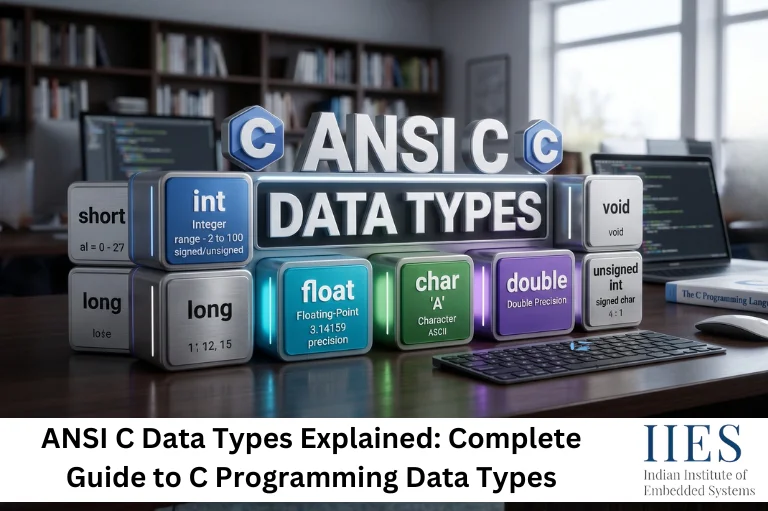
The basic data types in ANSI C are int, char, float, and double. Each of these types has its own range of values and memory allocation.
The int data type is used to represent integers and can be positive, negative, or zero. It is typically allocated 4 bytes of memory, allowing it to store values ranging from -2,147,483,648 to 2,147,483,647.
Individual characters are stored using the char data type. It requires 1 byte of memory and can hold characters from the ASCII character set, including letters, digits, and special characters.
The float data type is used to hold single-precision floating-point numbers. It requires 4 bytes of memory and can represent decimal numbers with moderate precision.
The double data type is used to store floating-point numbers with double precision. It requires 8 bytes of memory and can represent decimal numbers with higher precision than the float data type.
To declare and initialize variables using these basic data types, you can use the following syntax:
int age = 25;

char grade = 'A';

float salary = 2500.50;

double pi = 3.14159;
Understanding the range and memory allocation of these basic data types is crucial for managing resources efficiently and avoiding overflow or underflow errors.
Derived Data Types
Derived data types are constructed from the basic data types and offer more flexibility and organization of data. In ANSI C, the three main derived data types are arrays, pointers, and structures.
Arrays are used to store a collection of elements of the same data type. They are declared using a combination of the data type and a square bracket notation, such as int numbers[5];. To access individual elements of an array, you can use the index notation, such as numbers[0] for the first element.
Pointers are variables that hold memory addresses. They provide a way to directly manipulate memory and access data indirectly. Declaring a pointer requires the use of the asterisk (*) symbol, such as int* ptr;. To assign the address of a variable to a pointer, you can use the ampersand (&) operator, such as ptr = &age;.
Structures allow programmers to group related data together under a single name. They can be used to represent more complex entities with multiple attributes. A structure is defined using the struct keyword, followed by a name and a list of variables.
For example:
struct Person {
   char name[20];
   int age;
};
By understanding arrays, pointers, and structures, programmers gain more control and efficiency in managing and organizing data.
Enumeration Data Type
Enumeration is a user-defined data type used to define named constants. It provides a way to create unique symbol names for different values, which can improve code readability and maintainability.
To declare an enumeration, you can use the enum keyword followed by a list of constant values.
enum Weekdays {

   Monday,

   Tuesday,

   Wednesday,

   Thursday,

   Friday

};
Enumerations are particularly useful when dealing with variables that have a limited range of values. They provide a way to make the code more expressive and self-documenting.
Typedef
The typedef keyword in ANSI C allows programmers to create custom names for existing data types. This feature enhances code readability and maintainability by providing more descriptive and meaningful names.
By using typedef, programmers can define new names for data types and use them as if they were built-in data types.
typedef int Age;

Age personAge;
Using typedef can also make the code more portable, as it allows for easy changes in data types without affecting the rest of the codebase.
Sizeof Operator
The sizeof operator in ANSI C allows programmers to determine the size (in bytes) of a data type or a variable. It is a critical operator for memory allocation and manipulation.
Understanding the size of data types is crucial for managing memory efficiently. It ensures that sufficient memory is allocated to hold the data and prevents the wastage of resources.
Limits.h and Float.h
The header files limits.h and float.h provide crucial information about the range and precision of data types in ANSI C programming.
For example:
- INT_MAX
- INT_MIN
- FLT_MAX
- FLT_MIN
- DBL_MAX
- DBL_MIN
These constants help developers write reliable code that respects platform limitations.
Type Casting
Type casting is the process of converting one data type into another. In ANSI C, there are two types of type casting: implicit and explicit.
Implicit type casting occurs automatically when converting a smaller data type to a larger data type.
Explicit type casting is performed manually using the casting operator:
(int)pi
Understanding the limitations and implications of typecasting is crucial for writing robust and bug-free code.
Standard Library Functions
ANSI C provides a rich set of standard library functions that can handle different data types efficiently.
Some frequently used examples include:
- printf() and scanf()
- strcpy() and strcat()
- atoi() and atof()
- sqrt(), pow(), and fabs()
- memcpy()
- isdigit(), isalpha(), and isalnum()
Examples of Data Type Usage
To better understand the practical use of different data types, consider these examples:
- Handling employee records using structures
- Managing sensor data using float or double
- Storing user input using int, char, or character arrays
In each scenario, choosing the right data type directly impacts performance and reliability.
Best Practices for Data Type Selection
When selecting a data type:
- Consider memory usage
- Evaluate performance requirements
- Verify value ranges
- Ensure compatibility with APIs and libraries
Following these principles helps create efficient and maintainable software.
The concepts above form the foundation of ANSI C programming. However, modern embedded development requires a deeper understanding of how data types behave across different processors, compilers, and memory architectures.
What Are the Different Categories of ANSI C Data Types?
ANSI C data types can be classified into four major categories:
Category | Examples | Purpose |
Basic Data Types | int, char, float, double | Store fundamental values |
Derived Data Types in C | Arrays, Pointers, Structures | Build complex data models |
Enumeration Data Type in C | enum | Define named constants |
Void Type | void | Represents absence of value |
Definition: Basic Data Types in C
Basic data types in C are predefined language-supported types used to store integers, characters, and floating-point values.
Definition: Derived Data Types in C
Derived data types in C are constructed from fundamental types to organize, reference, or group data efficiently.
In embedded firmware, developers frequently combine structures and pointers to access hardware registers directly. This technique is common in ARM Cortex-M microcontrollers and significantly improves code maintainability.
How Do Integer, Float, and Double Data Types Differ?
One of the most common questions in C programming involves choosing between numeric data types.
Data Type | Typical Size | Precision | Typical Usage |
char | 1 byte | Character | ASCII data |
int | 4 bytes | Integer values | Counters, indexes |
float | 4 bytes | ~6-7 digits | Sensor readings |
double | 8 bytes | ~15-16 digits | Scientific calculations |
Integer Data Type in C
The integer data type in C stores whole numbers without decimal places. It is widely used for loop counters, state variables, and indexing operations.
Float Data Type in C
The float data type in C stores single-precision floating-point numbers. Embedded engineers often use float for temperature measurements, voltage calculations, and sensor processing.
Double Data Type in C
The double data type in C provides higher precision than float. On many desktop processors it offers better numerical accuracy, although some microcontrollers emulate double operations in software, making them slower.
Expert Tip: Many beginners assume double is always better than float. In practice, many low-cost microcontrollers either treat both identically or execute double-precision operations much more slowly. Always check the compiler documentation and MCU datasheet.

What Is Enumeration Data Type in C and When Should You Use It?
The enumeration data type in C allows developers to assign meaningful names to integer constants.
Example:
enum MotorState {

   MOTOR_STOP,

   MOTOR_START,

   MOTOR_ERROR

};
Advantages include:
- Better readability
- Reduced magic numbers
- Easier debugging
- Improved code maintenance
In embedded motor-control applications, enums often represent operating states within finite state machines.
Practical Example: Choosing the Right C Data Types
The following example demonstrates proper data type selection in an embedded temperature-monitoring application.
#include

int main()

{

   int sensor_id = 1;

   float temperature = 36.75;

   char status = 'N';

   printf("Sensor:%d\n", sensor_id);

   printf("Temp: %.2f\n", temperature);

   printf("Status:%c\n", status);

   return 0;

}
Step-by-Step Workflow for Selecting Data Types
- Determine the range of values.
- Estimate required precision.
- Consider memory constraints.
- Evaluate processor capabilities.
- Test for overflow and edge cases.
- Validate performance requirements.
This workflow is widely used in professional firmware development projects.
Common Mistakes When Working With ANSI C Data Types (And How to Fix Them)
Overflow or Underflow
Storing values outside the supported range causes incorrect results.
Example:
unsigned char value = 255;

value = value + 1;
The value wraps around to 0.
Fix: Verify limits using constants from limits.h.
Mixing Signed and Unsigned Types
Comparisons can behave unexpectedly.
Example:
int x = -1;

unsigned int y = 1;

if(x > y)
The result may surprise beginners because of implicit type conversions.
Fix: Avoid mixing signed and unsigned variables unless necessary.
Using Float When Integer Math Is Enough
Floating-point operations consume more CPU cycles, especially on MCUs without an FPU.
Fix: Use integer arithmetic whenever practical.
Assuming Data Type Sizes Are Universal
The ANSI standard defines minimum requirements, not fixed sizes.
Fix: Always verify with:
sizeof(type)
before making assumptions.
Real-World Embedded Systems Use Case
Consider a battery-powered IoT sensor node transmitting temperature and humidity data every minute.
An experienced embedded engineer typically uses:
- uint8_t for status flags
- uint16_t for ADC values
- float for processed temperature values
- Structures for packet formatting
Reducing a packet size from 32 bytes to 20 bytes may seem minor, but across millions of transmissions it significantly lowers power consumption and communication costs. This is one reason why data type selection remains a critical skill in embedded systems design.
Conclusion
ANSI C data types form the backbone of reliable and efficient software development. Understanding the characteristics of basic data types in C, derived data types in C, enumeration types, type casting, and memory allocation helps developers write code that is both portable and optimized.
For embedded systems engineers, selecting the right data type directly affects memory usage, execution speed, power consumption, and system stability. Whether you are working on microcontrollers, IoT devices, Linux applications, or desktop software, mastering ANSI C data types remains an essential programming skill.
A strong understanding of data types today will make it easier to design scalable and efficient systems as embedded hardware and software continue to evolve.