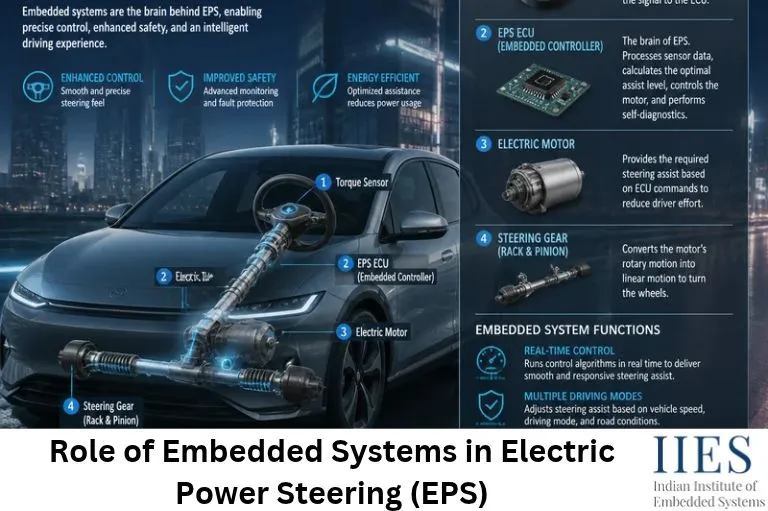
What Is Electric Power Steering (EPS)?
Electric Power Steering (EPS) is an electronically controlled steering assistance system that helps drivers turn the vehicle’s steering wheel with less physical effort.
Unlike hydraulic power steering, which uses a hydraulic pump and fluid pressure, EPS uses an electric motor to generate the required steering assistance.
The system continuously monitors parameters such as:
- Steering wheel torque
- Steering angle
- Vehicle speed
- Motor position
- Motor current
Based on this information, the EPS control unit determines how much assistance the electric motor should provide.
For example, when a vehicle moves at a low speed, such as during parking, the system provides greater steering assistance. At higher speeds, steering assistance is reduced to improve vehicle stability and driver control.
How Does an Electric Power Steering System Work?
The electric power steering working principle depends on communication between sensors, the ECU, and the electric motor.
When the driver turns the steering wheel, sensors detect the applied force and steering movement. These signals are sent to the Electronic Control Unit, which processes the information using embedded software.
The ECU then controls the electric motor to provide the required steering assistance.
The basic working process involves the following steps:
Driver Steering Input
When the driver rotates the steering wheel, the torque sensor detects the force applied by the driver. The steering angle sensor can also measure the direction and angle of rotation.
Sensor Data Collection
The sensors continuously collect information about steering torque, steering angle, and vehicle speed. This information helps the system understand the driver’s steering requirements.
ECU Data Processing
The EPS control unit receives sensor signals and processes them using a programmed control algorithm. It calculates the required steering assistance based on driving conditions.
Electric Motor Control
The ECU sends control signals to the motor driver, which regulates the electric motor’s operation. The motor generates the required assistance to reduce the driver’s steering effort.
Continuous Monitoring
The embedded controller continuously monitors system performance and checks for abnormal conditions. If a fault is detected, the system can activate warning indicators and apply an appropriate fail-safe strategy.

Role of Embedded Systems in Electric Power Steering
Embedded systems in electric power steering are responsible for coordinating the different electronic components and ensuring accurate steering assistance.
Let’s understand the major roles of embedded technology in EPS.
Microcontroller-Based Control
A microcontroller acts as the processing unit of the electric power steering system.
It receives sensor signals, executes control algorithms, and generates commands for the electric motor.
Automotive-grade microcontrollers are designed to handle real-time operations and safety-related tasks.
For example, an embedded controller continuously processes steering torque and vehicle speed information to calculate the appropriate motor assistance.
Sensor Data Processing
Sensors are essential components of an electric power steering system.
The embedded controller processes information from different sensors to understand the driver’s steering input and vehicle operating conditions.
Important sensors include:
- Torque Sensor: Measures the force applied by the driver to the steering wheel.
- Steering Angle Sensor: Detects the steering wheel’s rotational angle and direction.
- Vehicle Speed Sensor: Provides vehicle speed information to adjust steering assistance.
- Motor Position Sensor: Monitors the electric motor’s position and movement.
- Current Sensor: Measures motor current to support motor control and fault detection.
Accurate sensor processing helps the system provide smooth and responsive steering assistance.
Real-Time Motor Control
One of the most important functions of embedded systems in automotive steering is controlling the electric motor.
The ECU calculates the required assistance and sends commands to the motor control circuit.
Depending on the EPS design, the system may use a Brushless DC (BLDC) motor or another suitable electric motor.
Embedded software controls parameters such as:
- Motor speed
- Motor torque
- Motor direction
- Motor current
- Motor response
Advanced motor control techniques, such as Field-Oriented Control (FOC), can be used to achieve smooth and efficient motor operation.
Vehicle Speed-Based Steering Assistance
The amount of steering assistance required changes depending on vehicle speed.
At low speeds, drivers need more assistance to turn the steering wheel easily. At high speeds, excessive steering assistance can reduce steering feel and stability.
The EPS ECU uses vehicle speed information to adjust motor assistance.
For example:
| Driving Condition | Steering Assistance |
| Parking | High assistance |
| City driving | Moderate assistance |
| Highway driving | Lower assistance |
This intelligent adjustment is possible through embedded control algorithms.
CAN Communication in Electric Power Steering
Modern vehicles contain multiple Electronic Control Units that communicate with each other.
CAN (Controller Area Network) is widely used in automotive applications to exchange information between different vehicle control modules.
In an electric power steering system, CAN communication can help the EPS ECU receive vehicle speed information and exchange relevant diagnostic or operating data with other vehicle systems.
For example, the EPS ECU may receive vehicle speed information from another control unit through the CAN network.
Embedded software manages this communication and processes the received data according to system requirements.
Fault Detection and Functional Safety
Steering is a safety-critical function in automobiles. Therefore, electric power steering systems require continuous monitoring and fault detection.
The embedded controller monitors sensor signals, motor current, voltage levels, communication status, and other operating parameters.
If an abnormal condition occurs, the system can:
- Detect sensor failures.
- Identify motor-related faults.
- Monitor communication errors.
- Activate warning indicators.
- Reduce or disable steering assistance when necessary.
Automotive functional safety standards such as ISO 26262 provide guidance for developing safety-related electronic systems.
Major Components of an Electric Power Steering System
An electric power steering system consists of several hardware and software components that work together.
| Component | Function |
| Microcontroller | Processes sensor data and executes control algorithms |
| Torque Sensor | Measures driver-applied steering force |
| Steering Angle Sensor | Detects steering wheel angle |
| Vehicle Speed Sensor | Provides vehicle speed information |
| Electric Motor | Generates steering assistance |
| Motor Driver | Controls motor operation |
| ECU | Coordinates the EPS control functions |
| CAN Transceiver | Enables communication over the CAN network |
| Embedded Software | Manages system operation, monitoring, and control |
The combination of these components makes EPS an important application of automotive embedded systems.
Different Types of Electric Power Steering Systems
Electric power steering systems are classified based on the location of the electric motor and the mechanism used to provide steering assistance.
Column-Assisted Electric Power Steering (C-EPS)
In Column-Assisted EPS, the electric motor is mounted on the steering column.
The motor provides assistance directly through the steering column mechanism.
This configuration is commonly used in smaller passenger vehicles because of its compact design.
Pinion-Assisted Electric Power Steering (P-EPS)
In Pinion-Assisted EPS, the electric motor provides assistance through the steering pinion.
The motor helps reduce the effort required to rotate the steering mechanism.
It is suitable for certain passenger vehicle applications.
Rack-Assisted Electric Power Steering (R-EPS)
In Rack-Assisted EPS, the electric motor provides assistance directly to the steering rack.
This configuration can deliver higher steering assistance and is used in vehicles requiring greater steering forces.
Different EPS architectures use different motor mounting and assistance mechanisms.

Advantages of Embedded Systems in Electric Power Steering
The integration of embedded technology provides several advantages over traditional hydraulic steering systems.
Improved Fuel Efficiency
EPS operates using an electric motor rather than a continuously driven hydraulic pump. This can reduce engine load and improve vehicle efficiency.
Better Steering Control
Embedded control algorithms continuously adjust steering assistance according to driving conditions.
Reduced Maintenance
EPS eliminates several hydraulic components, such as steering fluid, hoses, and hydraulic pumps.
Compact Design
Electronic components and electric motors allow manufacturers to develop compact steering assistance systems.
Integration with Advanced Driver Assistance Systems (ADAS)
EPS can support advanced vehicle functions such as Lane Keeping Assist and automated parking when integrated with suitable sensors, controllers, and vehicle software.
Improved Diagnostics
Embedded controllers can monitor system parameters, detect faults, and store diagnostic information for maintenance.
Role of EPS in Electric Vehicles and Autonomous Driving
Electric power steering is particularly important in electric vehicles because it operates independently of an engine-driven hydraulic pump.
Since EVs already depend heavily on electronic control systems, EPS can be integrated with other vehicle control units to support efficient vehicle operation.
In autonomous and advanced driver assistance applications, electric power steering can also receive steering commands from vehicle automation controllers.
For example, during Lane Keeping Assist, the vehicle’s ADAS controller can request a steering adjustment through the EPS system, depending on the vehicle architecture and safety design.
This integration makes embedded software, real-time processing, communication protocols, and motor control essential areas of automotive engineering.
Practical Example: How an Embedded Controller Operates an EPS Motor
Consider a vehicle moving at 30 km/h. The driver turns the steering wheel to the right while navigating a curve.
The following process takes place:
- The torque sensor detects the driver’s applied force.
- The steering angle sensor identifies the direction and angle of rotation.
- The vehicle speed information is received by the EPS ECU.
- The microcontroller processes the sensor information.
- The control algorithm calculates the required steering assistance.
- The motor driver supplies the necessary current to the electric motor.
- The motor generates assistance to support the driver’s steering action.
- The controller continuously monitors the motor and sensor feedback.
This entire process takes place continuously and requires accurate real-time embedded control.
For engineering students, this example demonstrates how microcontrollers, sensors, motor drivers, embedded C programming, and automotive communication protocols work together in a practical automotive application.
Skills Required to Develop Automotive Embedded Systems
Developing an electric power steering system requires knowledge of both hardware and software.
Some important technical skills include:
- Embedded C programming
- Microcontroller architecture
- Digital and analog electronics
- Sensor interfacing
- ADC and PWM configuration
- DC and BLDC motor control
- CAN communication protocol
- Real-time operating systems (RTOS)
- ECU development and testing
- Automotive functional safety fundamentals
These skills are useful for engineers interested in automotive embedded development, ECU programming, automotive electronics, and vehicle control systems.
Career Opportunities in Automotive Embedded Systems
The increasing use of electronic control units in modern vehicles is creating opportunities for engineers with automotive embedded systems knowledge.
Some relevant job roles include:
| Job Role | Major Responsibilities |
| Embedded Software Engineer | Develops embedded software for automotive controllers |
| Automotive Embedded Engineer | Works on vehicle electronic systems |
| ECU Developer | Develops and tests electronic control unit software |
| Firmware Engineer | Develops low-level microcontroller firmware |
| Automotive Testing Engineer | Performs ECU validation and functional testing |
| Motor Control Engineer | Develops electric motor control algorithms |
Knowledge of embedded C, microcontrollers, CAN communication, sensors, and automotive electronics can help engineering graduates prepare for these technical roles.
Conclusion
Electric Power Steering is an important example of how embedded technology is transforming the automotive industry.
From processing steering sensor signals to controlling electric motors and communicating with other vehicle ECUs, embedded systems in electric power steering perform several critical functions.
Microcontrollers, embedded C programming, motor control, CAN communication, and real-time processing are the technologies that make modern EPS systems intelligent and responsive.
For electronics and engineering graduates interested in automotive technology, understanding EPS provides practical insight into how embedded systems are used in real-world vehicle applications.
Learning these technologies through practical projects and hands-on training can help students build the technical foundation required for careers in automotive embedded systems.