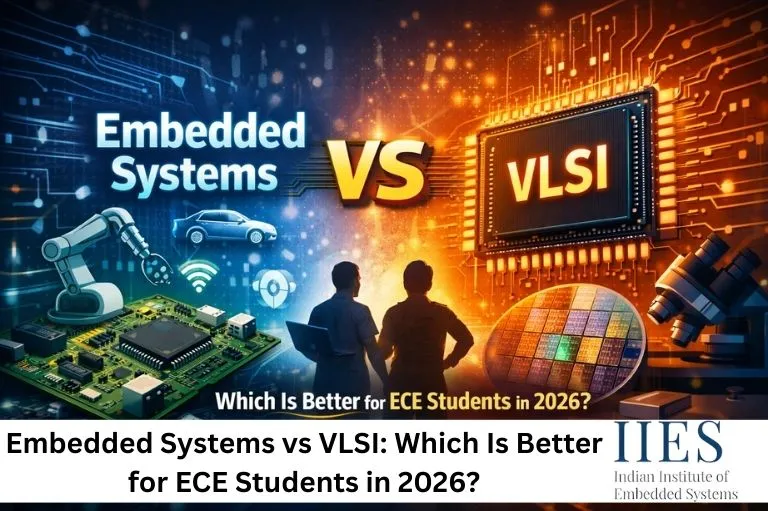
What Is Embedded Systems?
Embedded Systems focuses on designing and programming microcontroller-based systems that control hardware devices in real time.
Embedded engineers work on:
- Automotive electronics (ECU systems)
- IoT devices
- Industrial automation
- Medical equipment
- Consumer electronics
- Robotics and smart devices
Core Skills Required:
- Embedded C and C++
- Microcontroller programming (ARM Cortex, STM32, PIC)
- RTOS concepts (FreeRTOS)
- Device drivers
- Communication protocols (UART, SPI, I2C, CAN)
- Basic electronics and circuit debugging
Embedded systems engineers work on both hardware and software, making it a practical and application-driven field.

What Is VLSI?
VLSI (Very Large Scale Integration) deals with designing and verifying integrated circuits (ICs) and semiconductor chips.
VLSI engineers work in:
- ASIC design
- FPGA implementation
- RTL coding
- Verification (UVM-based environments)
- Static timing analysis
- Physical design
- Semiconductor fabrication support
Core Skills Required:
- Digital electronics
- Verilog / VHDL
- RTL design
- ASIC vs FPGA flow
- EDA tools (Cadence, Synopsys, Mentor Graphics)
- Timing closure and synthesis
VLSI is more theory-heavy and tool-oriented compared to embedded systems.
Embedded Systems vs VLSI: Key Differences
| Feature | Embedded Systems | VLSI |
|---|
| Main Focus | Programming & device control | Chip & IC design |
| Work Type | Hardware + Software | Mostly hardware design |
| Programming Languages | C, C++, Embedded C | Verilog, VHDL |
| Tools | Keil, STM32Cube, MPLAB | Cadence, Synopsys |
| Industry | Automotive, IoT, Automation | Semiconductor industry |
| Job Volume in India | High | Moderate to limited |
| Learning Curve | Moderate | High |
| Entry Barrier | Lower | Higher |
Salary Comparison in India (2026)
Embedded Systems Salary (Freshers)
- ₹2.5 LPA – ₹5 LPA (Entry level)
- ₹6–10 LPA with 3–5 years experience
- Higher in automotive and product companies
VLSI Salary (Freshers)
- ₹3 LPA – ₹7 LPA in design & verification roles
- ₹8–15 LPA for skilled engineers in top semiconductor firms
- Higher salaries but fewer openings
Note: Salaries depend heavily on skills, internship experience, and company type (service vs product).
Job Opportunities in India
Embedded Systems Job Roles
- Embedded Engineer
- Firmware Developer
- IoT Developer
- Automation Engineer
- R&D Engineer
- Device Driver Developer
Embedded roles are widely available in Bangalore, Chennai, Pune, Hyderabad, and Noida due to strong automotive and IoT industries.
VLSI Job Roles
- RTL Design Engineer
- Verification Engineer
- Physical Design Engineer
- DFT Engineer
- FPGA Engineer
VLSI jobs are concentrated in semiconductor hubs such as Bangalore and Hyderabad. Entry opportunities are fewer but specialized.

Learning Difficulty Comparison
Embedded Systems
- Beginner friendly
- Project-based learning
- Faster job readiness
- Requires practical debugging skills
- Suitable for students with average mathematics background
VLSI
- Requires strong digital electronics fundamentals
- Heavy theory and timing analysis
- Long learning curve
- Tool dependency
- Strong competition for core roles
For most fresh graduates, embedded systems offers a smoother transition into industry.
Industry Trends (2026–2030 Outlook)
Embedded Systems Future Scope
- Rapid growth in electric vehicles (EVs)
- Expansion of IoT and smart devices
- Industrial automation demand
- Robotics and AI hardware integration
- Increasing demand for firmware engineers
India’s automotive electronics and smart device ecosystem is expanding steadily, creating consistent demand for embedded engineers.
VLSI Future Scope
- Government semiconductor initiatives
- New chip manufacturing plants in India
- Growth in ASIC design outsourcing
- Expansion of fabless semiconductor startups
The semiconductor sector is growing, but core VLSI roles remain competitive and skill-intensive.
Pros and Cons
Embedded Systems
Pros:
- More job openings
- Faster employability
- Hands-on projects
- Easier entry for freshers
- Strong demand across multiple industries
Cons:
- Lower starting salary compared to top VLSI roles
- Hardware debugging can be challenging
- Some service-based jobs offer moderate pay
VLSI
Pros:
- High salary potential
- Specialized semiconductor career
- Opportunity to work in global chip companies
- Strong long-term growth in core design roles
Cons:
- Fewer entry-level openings
- Requires strong academic fundamentals
- Often prefers M.Tech/MS graduates
- Longer preparation time
Who Should Choose Embedded Systems?
Choose Embedded Systems if you:
- Enjoy coding and hardware interaction
- Want quicker job placement
- Prefer practical learning
- Are comfortable with C programming
- Want broader job opportunities in India
Who Should Choose VLSI?
Choose VLSI if you:
- Strong in digital electronics
- Interested in chip architecture and design
- Comfortable with theory-heavy subjects
- Ready for long preparation time
- Aim for semiconductor product companies
Is Embedded Systems Better Than VLSI?
For most ECE students in India, Embedded Systems is the better starting career because:
- Higher job availability
- Faster industry entry
- Lower academic barrier
- Wider application industries
However, for students targeting high-end semiconductor design careers and willing to invest more time in mastering digital design, VLSI offers higher long-term earning potential.
There is no universal “best” field — the right choice depends on your strengths and goals.
Final Verdict
| Category | Better Option |
|---|
| Easy Learning | Embedded |
| Job Availability | Embedded |
| High Salary Potential | VLSI |
| Beginner Friendly | Embedded |
| Semiconductor Core Career | VLSI |
Overall Recommendation:
For the majority of ECE students in India in 2026, Embedded Systems offers better initial career stability and faster employability. VLSI is ideal for academically strong students targeting specialized semiconductor roles.