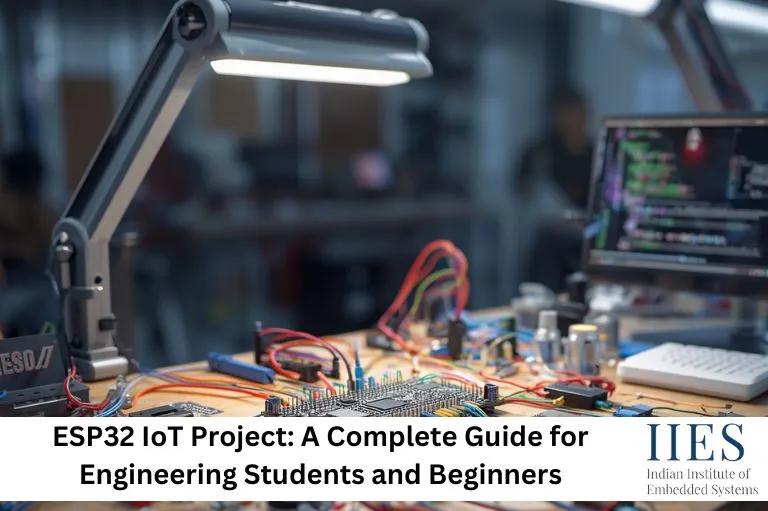
What is ESP32?
ESP32 is a low-power microcontroller developed for wireless IoT applications. It comes with integrated Wi-Fi and Bluetooth Low Energy (BLE), making it ideal for connected embedded systems. Unlike traditional microcontrollers that require external communication modules, ESP32 offers everything on a single development board.
Some of its key features include:
- Dual-core processor for efficient multitasking.
- Built-in Wi-Fi and Bluetooth connectivity.
- Multiple GPIO pins for sensor integration.
- Support for Arduino IDE and ESP-IDF programming.
- Low power consumption for battery-operated devices.
- Support for cloud-based monitoring systems.
Because of these capabilities, ESP32 has become one of the most popular choices for embedded IoT solutions and wireless sensor networks.

Why is ESP32 Popular for IoT Development?
ESP32 simplifies IoT development by combining processing power, wireless communication, and ease of programming. Students can quickly prototype projects without investing in expensive hardware.
Advantages of Using ESP32
- Supports Wi-Fi-enabled embedded systems.
- Ideal for IoT data acquisition systems.
- Suitable for industrial IoT applications.
- Enables cloud connectivity for remote monitoring.
- Compatible with numerous sensors and actuators.
- Supports real-time embedded applications.
- Perfect for smart device and automation projects.
Its versatility makes it useful for both academic projects and commercial IoT applications.
Setting Up Arduino IDE for ESP32
One of the easiest ways to begin ESP32 programming is by using Arduino IDE. It provides a beginner-friendly development environment and supports numerous ESP32 libraries.
Basic Setup Process
- Install Arduino IDE on your system.
- Add ESP32 board support using the Board Manager.
- Connect the ESP32 development board using a USB cable.
- Select the appropriate COM port.
- Upload a simple LED blinking program.
- Verify successful communication between the board and the IDE.
For advanced applications, developers can also use ESP-IDF programming, which offers greater control over hardware resources and system-level functionalities.
Components Required for ESP32 IoT Projects
Before building your first project, you may need:
- ESP32 development board
- Breadboard
- Jumper wires
- LEDs
- Temperature and humidity sensors
- Motion sensors
- OLED or LCD displays
- Wi-Fi connectivity
- Power supply module
- Relay modules
- Soil moisture sensors
- Gas sensors
- Cloud platforms for data storage
These components can be used across multiple ESP32 prototype projects and mini project ideas.
Top ESP32 IoT Project Ideas
1. Smart Home Automation System
Build a smart home solution that allows users to control lights, fans, and appliances remotely using Wi-Fi.
Features
- Mobile-based control
- Voice assistant integration
- Energy monitoring systems
- Real-time device management
- Cloud-based monitoring support
2. Environmental Monitoring System
Monitor environmental conditions such as:
- Temperature
- Humidity
- Air quality
- Atmospheric pressure
The collected information can be stored using cloud connectivity solutions for real-time data monitoring.
3. Smart Agriculture Monitoring
Agriculture is increasingly adopting IoT technologies for automation and precision farming.
An ESP32-based agriculture system can monitor:
- Soil moisture
- Temperature levels
- Water requirements
- Environmental conditions
Benefits include:
- Improved crop management
- Reduced water consumption
- Automated irrigation systems
- Remote monitoring capabilities
4. IoT-Based Energy Monitoring System
This project helps monitor electricity consumption in homes and industries.
It includes:
- Real-time power monitoring
- Cloud-based dashboards
- Usage analysis
- Wireless communication technologies
- Remote notifications
Energy monitoring projects are highly relevant in industrial IoT applications and smart cities.
ESP32 Cloud Connectivity for IoT Applications
Cloud integration is one of the major strengths of ESP32 IoT development.
Cloud platforms help in:
- Data collection
- Remote monitoring
- Device management
- Data visualization
- Real-time notifications
Cloud-based monitoring systems allow users to access sensor data from anywhere using smartphones or web applications.
Some commonly implemented applications include:
- Weather monitoring systems
- Smart agriculture projects
- Healthcare monitoring devices
- Smart home applications
- Industrial automation systems
ESP32 Sensor Integration
Sensor integration is fundamental to every IoT project.
ESP32 supports various sensors such as:
- Temperature sensors
- Gas sensors
- Motion sensors
- Light sensors
- Soil moisture sensors
- Water level sensors
- Ultrasonic sensors
- Pressure sensors
By combining sensors with cloud connectivity, developers can build intelligent connected embedded systems for real-world applications.
MQTT Communication Protocol in ESP32 IoT Projects
MQTT (Message Queuing Telemetry Transport) is one of the most widely used communication protocols in IoT systems. It is lightweight, fast, and ideal for devices that operate with limited power and bandwidth.
When developing ESP32 IoT projects, MQTT enables seamless communication between devices, cloud platforms, and mobile applications.
Benefits of MQTT Protocol
- Low power consumption.
- Fast data transmission.
- Supports real-time data monitoring.
- Suitable for cloud-based monitoring systems.
- Reliable communication for connected embedded systems.
- Works efficiently with wireless sensor networks.
MQTT is commonly used in:
- Smart home automation systems.
- Industrial IoT applications.
- Smart agriculture monitoring.
- Healthcare monitoring systems.
- Energy monitoring systems.
ESP-IDF Programming for Advanced Applications
While Arduino IDE is beginner-friendly, ESP-IDF (Espressif IoT Development Framework) provides advanced capabilities for professional IoT development.
Why Use ESP-IDF?
- Better memory management.
- Multi-threading support.
- Advanced networking capabilities.
- Enhanced security features.
- Improved hardware-level control.
- Optimized performance for real-time embedded applications.
ESP-IDF is particularly useful when building:
- Industrial automation systems.
- Low-power IoT devices.
- High-performance embedded applications.
- Cloud-connected devices.
- Large-scale IoT deployments.
Students interested in embedded systems programming can start with Arduino IDE and gradually transition to ESP-IDF as they gain experience.

Industrial IoT Applications Using ESP32
Industrial IoT (IIoT) is revolutionizing manufacturing and automation. ESP32 offers cost-effective solutions for developing industrial monitoring and control systems.
Common Industrial Applications
- Machine health monitoring.
- Industrial temperature monitoring.
- Predictive maintenance systems.
- Smart inventory management.
- Factory automation.
- Energy consumption analysis.
- Wireless sensor networks.
Benefits of ESP32 in Industry
- Real-time monitoring capabilities.
- Remote device management.
- Low deployment costs.
- Cloud integration support.
- Reliable wireless communication.
- Easy sensor integration.
These features make ESP32 suitable for both educational projects and commercial implementations.
Low-Power IoT Devices Using ESP32
Power consumption is an important consideration in IoT systems. ESP32 provides multiple power-saving modes that significantly extend battery life.
Power Optimization Techniques
- Deep sleep mode.
- Light sleep mode.
- Optimized Wi-Fi usage.
- Efficient sensor scheduling.
- Event-based communication.
Low-power designs are commonly used in:
- Smart wearables.
- Healthcare monitoring devices.
- Environmental monitoring systems.
- Agriculture monitoring applications.
- Portable IoT products.
Building power-efficient projects also helps students understand real-world embedded hardware design principles.
Best Practices for ESP32 IoT Development
When building ESP32 projects, consider the following practices:
Use Appropriate Communication Technologies
- Wi-Fi
- Bluetooth Low Energy (BLE)
- MQTT
- HTTP Protocol
- WebSocket Communication
Focus on Security
Always implement:
- Secure authentication.
- Encrypted communication.
- Access control mechanisms.
- Secure cloud integration.
Optimize Hardware Design
- Select suitable sensors.
- Ensure stable power management.
- Use proper PCB layouts for advanced projects.
- Minimize power consumption wherever possible.
Improve System Reliability
- Handle communication failures gracefully.
- Implement error detection mechanisms.
- Use watchdog timers when required.
- Validate sensor data before processing.
Following these practices can significantly improve the performance and scalability of ESP32-based IoT systems.
Career Benefits of Learning ESP32 IoT Projects
Developing ESP32 projects provides valuable hands-on experience in multiple domains.
Students can gain practical knowledge of:
- Embedded systems programming.
- IoT communication technologies.
- Cloud-based monitoring systems.
- Wireless sensor networks.
- Industrial automation.
- Real-time embedded applications.
- Sensor integration techniques.
- Edge computing in IoT.
These skills are highly valued across industries such as:
- Consumer electronics.
- Automotive systems.
- Healthcare technology.
- Smart manufacturing.
- Robotics.
- Agriculture technology.
- Industrial automation.
- Smart city solutions.
Building multiple ESP32 mini projects can significantly strengthen your portfolio and improve your placement opportunities in embedded systems and IoT domains
Emerging Applications of ESP32 in IoT Development
Modern ESP32 connected devices are enabling smarter and more efficient IoT solutions across industries. Students can explore various ESP32 embedded projects that combine sensor integration, wireless communication, and cloud technologies. Innovative applications such as ESP32 networking projects and ESP32 web server applications allow developers to build real-time dashboards and remote monitoring solutions. Understanding IoT system architecture is equally important when designing scalable applications that connect sensors, cloud platforms, and end users. Working on ESP32 innovation projects also helps learners gain practical experience in developing next-generation connected systems for industrial and consumer applications..
Conclusion
ESP32 has become one of the most versatile platforms for IoT development due to its powerful processing capabilities, built-in wireless communication, and extensive ecosystem support. Whether you are building a smart home automation system, an environmental monitoring device, or an industrial IoT application, ESP32 provides the tools needed to transform ideas into real-world solutions.
For engineering students, working on ESP32 IoT projects offers far more than technical knowledge. It develops problem-solving abilities, strengthens embedded systems programming skills, and provides practical experience with cloud connectivity, wireless communication technologies, and sensor integration. As industries continue to adopt connected embedded systems and edge computing solutions, expertise in ESP32 and IoT development can open doors to exciting career opportunities in embedded systems and automation engineering.