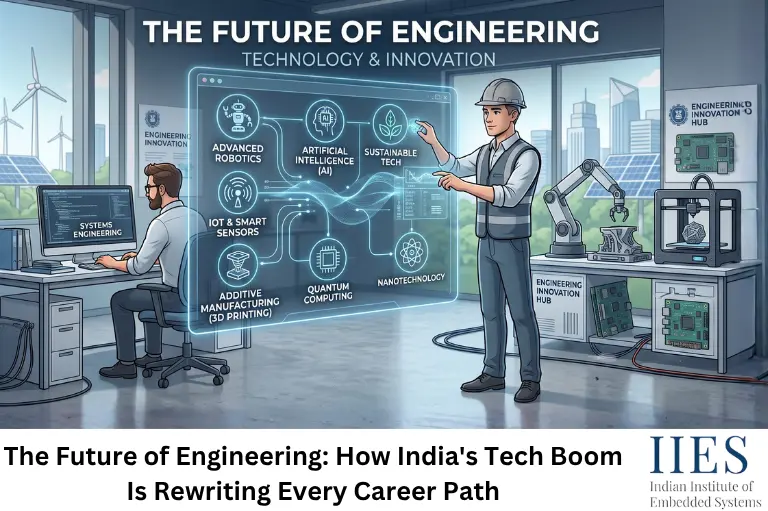
Why the Future of Engineering Looks Nothing Like Its Past
Three forces are rewriting engineering at the same time:
- Software is eating hardware. Every physical system, a car, a solar inverter, a factory robot, now ships with firmware, sensors, and a connectivity layer.
- The climate and energy transition is non-negotiable. Governments and companies are engineering their way to net-zero, not just talking about it.
- Geopolitics is reshaping where things get built. Global supply chains are diversifying away from single-country dependence, and India is positioning itself as a serious manufacturing and design alternative.
Here’s a number worth sitting with if you’re worried about “AI taking engineering jobs”: the World Economic Forum’s Future of Jobs research projects around 92 million jobs displaced globally by 2030, but roughly 170 million new ones created in the same window. That’s a net gain of about 78 million jobs, concentrated heavily in technology, data, AI, and green-energy engineering roles.
The jobs aren’t disappearing. They’re changing shape, and nowhere is that reshaping more visible right now than in India.

India’s Infrastructure Boom: The Engineering Opportunity of a Generation
Under the PM Gati Shakti National Master Plan, India is coordinating road, rail, port, and airport development on a single digital platform spanning more than 1,700 data layers across 57 ministries. Investment bank estimates put cumulative infrastructure spending under this push at roughly $1.3–1.45 trillion over the plan’s multi-year horizon, with hundreds of major projects already evaluated and sanctioned.
What this means for engineers:
- Civil, structural, and transportation engineers are needed for sheer physical scale, highways, dedicated freight corridors, and metro expansions across dozens of cities.
- Automation and controls engineers are needed for the “smart” layer: traffic management systems, digital twins of infrastructure assets, and sensor networks that monitor bridges and rail lines in real time.
The Semiconductor Angle
The India Semiconductor Mission is arguably the sharpest edge of this boom for embedded systems and hardware engineers specifically. By mid-2026, more than a dozen chip manufacturing and packaging projects had been approved, backed by a cumulative investment north of ₹1.6 lakh crore. The Tata Electronics–PSMC fab at Dholera, targeting 50,000 wafer starts a month, is on track for its first silicon by the end of 2026, while facilities from Micron, CG Semi, and Kaynes are already in commercial production. Semicon 2.0, approved in July 2026 with an outlay of roughly ₹1.27 lakh crore, extends this push into design, equipment, materials, and workforce training.
If you’re an embedded systems or electronics engineer, this is the single most consequential trend on this list: India is finally building the chip supply chain that its own electronics and IoT industries depend on.
The Electric Revolution: Engineering the Shift to E-Mobility
India crossed roughly 2.45 million EV sales in FY2025–26, a 25% jump year-on-year, pushing overall EV penetration to about 8.5% of all vehicle sales. The government’s stated 2030 target is bold: 30% of private cars, 70% of commercial vehicles, 40% of buses, and 80% of two- and three-wheelers running electric.
That target can’t be hit with battery packs alone. It needs engineers who can build:
- Battery Management Systems (BMS) – real-time embedded firmware that keeps a battery pack safe, balanced, and efficient
- Motor control and power electronics – the systems converting stored energy into smooth, efficient motion
- Charging infrastructure – from home chargers to fast-charging networks, each with its own embedded control and payment systems
Notice something: almost every one of those bullet points is fundamentally an embedded C/C++ problem wearing an automotive costume. The “electric revolution” isn’t just an automotive story – it’s an embedded systems story first.
Green Future, Renewable Energy Engineering: Powering a Net-Zero India
India’s installed renewable energy capacity has nearly quadrupled, from about 76 GW in 2014 to roughly 288.6 GW as of mid-2026, with solar alone accounting for over 162 GW. The national target is 500 GW of non-fossil capacity by 2030, on the way to a broader net-zero commitment by 2070.
Reaching 500 GW isn’t just about installing more panels and turbines. It needs:
- Grid and transmission engineers to move power from sun-rich, wind-rich regions to where demand actually is
- Embedded and control engineers building the SCADA systems and inverter firmware that keep solar and wind plants stable and grid-compliant
- Energy storage engineers – “storing sunlight for the night” is now the binding constraint on the entire renewable transition, not panel manufacturing
If you’re chasing a “green” engineering career, the honest advice is: don’t just study solar panels. Study the control systems and storage technology around them — that’s where the harder, better-paying problems live.
According to the India Skills Report 2026, AI and ML-related job roles have grown by around 600%, one of the sharpest jumps of any engineering category. India already holds close to 16% of the world’s AI talent pool, a figure projected to grow toward 1.25 million professionals by 2027.
But here’s what most “learn AI” advice misses: AI isn’t only a cloud-and-data-center story anymore. A growing share of it is moving onto the device itself, TinyML and edge AI running inference directly on microcontrollers, letting a doorbell camera, a wearable, or an industrial sensor make decisions without ever touching the cloud.
If your background is embedded systems, that’s your real on-ramp into AI, not switching careers to “become a data scientist,” but learning to deploy lightweight models on constrained hardware.
Robotics and Automation: From Factory Floors to Last-Mile Delivery
India’s robotics and automation market is still small by global standards, but it’s growing faster than almost anywhere else in Asia, even as the country continues to have one of the lowest robot-density figures in the region. That gap between “low adoption today” and “fast growth rate” is exactly where career opportunity lives, with automotive and electronics manufacturing leading adoption right now, pushed along by rising wages and the government’s “Make in India” precision-manufacturing goals.
Engineers building this future need:
- Motion control and actuator firmware
- Computer vision for quality inspection and navigation
- Real-time operating systems for safety-critical coordination
Quantum Computing: Engineering at the Edge of Physics
This is the newest, strangest, and arguably most exciting field on this list. India’s National Quantum Mission, a ₹6,003 crore, eight-year program has already achieved a 1,000-km secure quantum communication milestone, less than two years after its 2023 launch, and the government reports the mission had already delivered more than half of its targeted outcomes within just three years.
You don’t need a physics PhD to get into this field early. What helps instead:
- Strong fundamentals in linear algebra and probability
- Comfort with at least one quantum programming framework (Qiskit is the most accessible starting point)
- Genuine interest in a field where “textbook answers” barely exist yet
Quantum engineering roles are scarce today but so were “machine learning engineer” roles in 2012. Early movers in nascent fields often end up defining the field’s best practices rather than just following them.
Cybersecurity Engineering: Guarding the Digital Backbone
Every trend above EVs, IoT, robotics, quantum networks, AI expands the digital attack surface. The global cybersecurity workforce gap now sits at roughly 4.8 million unfilled roles, per ISC2’s workforce research, with the Asia-Pacific region alone accounting for around 3.4 million of that gap.
For engineers with a hardware or embedded background, the most underrated entry point isn’t “generic cybersecurity” it’s:
- OT/ICS security – protecting the industrial control systems running factories, power grids, and water treatment plants
- Embedded security – secure boot, hardware security modules, and firmware signing for connected devices
- Automotive and EV cybersecurity – a connected car is a rolling network of ECUs, and every one is a potential entry point
Biotechnology and Bioengineering: Where Circuits Meet Cells
India’s bioeconomy has grown from around $10 billion in 2014 to roughly $190 billion-plus by 2026, now approaching 5% of GDP, with more than 11,800 active biotech startups. The government’s BioE3 policy (Biotechnology for Economy, Environment, and Employment), approved in August 2024, is specifically designed to turn India into a global biomanufacturing hub.
Bioengineering isn’t just for biology graduates anymore. It increasingly needs:
- Biomedical device engineers building diagnostic and monitoring hardware
- Bioinformatics engineers processing genomic and biological data at scale
- Wearable health-tech engineers combining biosensors, embedded firmware, and connectivity to track everything from glucose to heart rhythm
If you already know embedded systems and IoT, medical device engineering is one of the most direct, and most meaningful, pivots available to you.
The Internet of Things (IoT): The Connective Tissue Behind Everything on This List
Here’s the thread tying this entire article together: almost none of the trends above work without IoT underneath them.
- EVs use IoT for telematics and remote diagnostics
- Renewable grids use IoT sensors for real-time monitoring
- Robots rely on IoT connectivity for fleet coordination
- Biotech wearables are, functionally, IoT devices
- Even quantum networks need classical IoT-style infrastructure to manage and monitor them
Estimates vary by research firm, but most agree the global IoT market is on track to multiply several times over by the early 2030s, crossing well into trillion-dollar territory — and India’s IoT market is forecast to grow faster than the global average.
This is why embedded systems and IoT aren’t a “niche” specialization anymore. They’re the substrate every other trend in this article runs on.

Career Opportunities in Emerging Engineering Fields: India and the World
Here’s the encouraging news buried in all this disruption: India’s engineering employability is actually improving. The India Skills Report 2026 puts overall graduate employability at 56.35% (up from 54.81% the year before), with engineering (BE/BTech) graduates specifically at 70.15% and computer science/IT graduates at 78–80%.
Field | India Outlook | Global Outlook | Core Skills to Build |
AI/ML Engineering | ~600% job growth (India Skills Report 2026) | Talent pool projected to hit 1.25M by 2027 | Python, ML frameworks, edge/TinyML deployment |
Embedded Systems & IoT | Backed by Semicon 2.0 and India’s IoT market growth | Foundational layer under nearly every field below | C/C++, RTOS, microcontrollers, protocols |
Renewable Energy Engineering | 500 GW non-fossil target by 2030 | Global renewable investment accelerating sharply | Power electronics, SCADA, grid systems |
Cybersecurity Engineering | Part of a ~3.4M-role Asia-Pacific gap | ~4.8M-role global gap (ISC2) | OT/ICS security, embedded security, cloud security |
Robotics & Automation | Fast-growing off a small base | Steady global growth, led by Asia-Pacific | Motion control, computer vision, RTOS |
Quantum Computing | ₹6,003 crore National Quantum Mission | Still nascent, early-mover advantage available | Linear algebra, Qiskit, quantum networking basics |
Biotech/Bioengineering | $190B+ bioeconomy, BioE3 policy | Rising demand for medical device engineers | Biosensors, embedded firmware, bioinformatics |
Global Capability Centres: The India-to-World Bridge
Beyond India’s domestic market, Global Capability Centres (GCCs), India-based engineering and R&D hubs for multinational companies, have quietly become one of the country’s biggest white-collar employers, giving Indian engineers direct access to global-scale problems without leaving the country. Add a gig and freelance engineering workforce projected to reach 23.5 million people by 2030, and the line between “career opportunities in India” and “career opportunities globally” is basically disappearing.
The Future of Engineering Careers: What Will Actually Set You Apart
Across every field above, three qualities separate engineers who thrive from engineers who stagnate:
- T-shaped skills – deep expertise in one core discipline, paired with working fluency across software, AI, and systems thinking
- Proof over paper – a portfolio of real, working projects consistently outperforms a transcript full of grades when it comes to getting hired
- Comfort with ambiguity – half the fields on this list (quantum computing, edge AI, biomanufacturing) don’t have settled “textbook” answers yet; the engineers who win here are the ones comfortable figuring it out as they go
The WEF’s own skills research backs this up: the fastest-growing skill categories through 2030 combine technical ability with distinctly human skills collaboration, critical thinking, and adaptability. AI can write code. It’s much worse at judgment, context, and knowing which problem is actually worth solving.
How to Start Preparing Today
You don’t need to wait for a “quantum engineering degree” to exist. Start here:
- Get fluent in C/C++ and Python – one gives you control over hardware, the other gives you speed with data and AI
- Build with real hardware – an Arduino or Raspberry Pi project teaches you more in a weekend than a semester of theory alone
- Pick one emerging field and go deep – don’t try to learn AI, quantum, and biotech all at once; pick the one that overlaps with what already excites you
- Build a public portfolio – recruiters increasingly screen GitHub profiles and project demos before resumes
- Find structured, project-based mentorship – self-teaching works, but a good mentor shortens your learning curve dramatically, especially in hardware-adjacent fields where mistakes are slow and expensive to debug
If the hardware side of this future, embedded systems, IoT, and the electronics underneath AI, EVs, and robotics, is what excites you most, that’s exactly the skill set about to be in short supply.
Key Takeaways
- Engineering’s biggest career growth is happening at the intersections AI + hardware, biology + electronics, energy + software not inside old single-discipline silos
- India’s mission-scale programs (Gati Shakti, the Semiconductor Mission, the National Quantum Mission, BioE3, the 500 GW renewable target) are creating engineering demand at a national-policy scale, not just a company-by-company one
- Embedded systems and IoT are the connective tissue underneath nearly every other trend in this article
- AI is a net job creator globally (+78 million by 2030, per WEF research), but only for engineers who adapt their skills alongside it
- A portfolio of real projects, not a single credential, is what’s actually opening doors in 2026
Future Engineering Trends to Watch
Several technologies deserve close attention over the next decade.
AI will increasingly become a general engineering tool.
Edge AI
More intelligent processing will move directly onto devices and machines.
Autonomous Systems
Vehicles, robots, drones, and industrial systems will become more capable of operating with limited human intervention.
Electrification
Transportation and industrial systems will continue shifting toward electric technologies.
Renewable Energy
Solar, wind, storage, smart grids, and new energy technologies will reshape power engineering.
Quantum Technologies
Quantum computing, sensing, and communication could create entirely new engineering disciplines.
Advanced Semiconductors
AI, automotive electronics, robotics, and data centers will continue increasing demand for advanced chips.
Bioengineering
Biology and engineering will increasingly converge in healthcare, manufacturing, food, agriculture, and energy.
Cybersecurity
Every connected engineering system will need stronger security.
Digital Twins
Engineers will increasingly use virtual models to monitor, simulate, and optimize real-world systems.
What Is the Best Engineering Career for the Future?
There is no single engineering career that will be the best for everyone.
A better question is:
Which field matches your interests while also giving you access to growing technologies?
For example:
- Like programming and electronics? → Embedded Systems, IoT, Edge AI
- Like mathematics and computers? → AI, ML, Data Engineering
- Like machines and automation? → Robotics and Controls
- Like automobiles? → EV and Automotive Engineering
- Like circuits and chips? → VLSI and Semiconductor Engineering
- Like energy and sustainability? → Renewable Energy and Power Engineering
- Like security and computers? → Cybersecurity
- Like biology and technology? → Bioengineering and Biotechnology
- Like buildings and infrastructure? → Civil, Smart Infrastructure and Environmental Engineering
The strongest career strategy is usually to build one deep specialization plus several complementary skills.
Conclusion
The future of engineering is not about replacing traditional engineering with technology.
It is about combining traditional engineering knowledge with new technology.
A successful engineer of the future may be someone who understands a physical system and also knows how to program it, connect it, analyze its data, secure it, and improve it using AI.
That is why engineering remains one of the most adaptable career paths.
The tools will change.
The technologies will change.
But the ability to solve real-world problems using engineering principles will continue to matter.
The engineers who keep learning, building, experimenting, and adapting will be in the strongest position to shape the next generation of technology.