What Is a Pointer?
- A pointer is a variable that stores the memory address of another variable or function instead of storing a value.
- Picture a variable as a house and a pointer as the written address of that house. The address is not the house, but it lets you walk there and change what is inside.
- Two operators do the work:
& gives the address of a variable, and * follows an address to the value stored there (dereferencing). - The pointer’s type tells the compiler how many bytes to read and how far to step, so
p + 1 moves forward by sizeof(*p) bytes. - The size of the pointer itself depends on the platform, not on the data it points to.
#include

int main(void)
{
    int temperature = 36;
    int *ptr = &temperature;        // ptr stores the ADDRESS of temperature

    printf("Value of temperature  : %d\n", temperature);
    printf("Address of temperature: %p\n", (void *)&temperature);
    printf("ptr holds             : %p\n", (void *)ptr);
    printf("Value through ptr     : %d\n", *ptr);

    return 0;
}
Output (the address will differ on your machine):
Value of temperature  : 36
Address of temperature: 0x7ffd5c3a1a4c
ptr holds             : 0x7ffd5c3a1a4c
Value through ptr     : 36
Pointer Size on Common Platforms
| Platform | Pointer size |
|---|
| 8051 (Keil C51), generic pointer | 3 bytes |
| AVR (ATmega328P), data pointer | 2 bytes |
| ARM Cortex-M (32-bit) | 4 bytes |
| 64-bit PC (x86-64, ARM64) | 8 bytes |
Pro tip: print sizeof(void *) on your own target. It takes ten seconds and removes guesswork.

The Pointer Family Tree: Types of Pointers at a Glance
Underneath, every pointer is just an address. The “type” comes from the rules wrapped around it. Strictly speaking, the C standard defines pointer types by what they point to (int *, void *, function pointers). Names like wild and dangling describe a pointer’s state, and near, far and huge were compiler extensions. Everyone calls them all “types”, so we will too.
| Family | Pointer types | The question it answers |
|---|
| State | Null, wild, dangling | Is this address safe to use right now? |
| Target | Void, double, function, array, structure, complex | What lives at this address? |
| Access rules | Const, volatile, restrict | What am I allowed to do through it? |
| Memory model | Near, far, huge, 8051 memory-specific | Which memory space does it reach? |
| Ownership (C++) | unique_ptr, shared_ptr, weak_ptr | Who cleans up the object? |
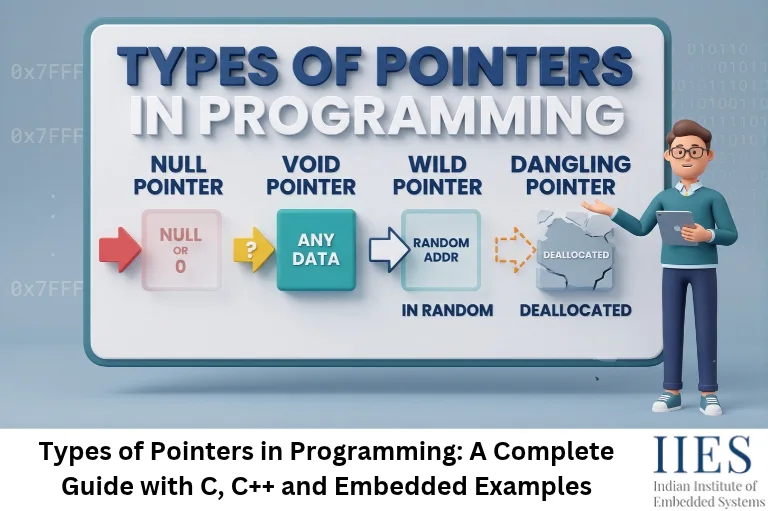
Types of Pointers Based on State: Null, Wild and Dangling
1. Null Pointer
- A null pointer is a pointer that intentionally points to nothing. It is the safe “empty” value.
- It is written as
NULL in C and nullptr in C++11 and later (C23 adds nullptr too). - Typical jobs: initializing pointers, reporting failure (
malloc returns NULL when memory runs out), and marking the end of a linked list.
#include
#include

int main(void)
{
    int *buffer = malloc(100 * sizeof(int));

    if (buffer == NULL)            // always check before using
    {
        printf("Allocation failed\n");
        return 1;
    }

    buffer[0] = 7;
    free(buffer);
    buffer = NULL;                 // no longer dangling
    return 0;
}
- Why prefer
nullptr in C++: NULL is just the integer 0, so f(NULL) can call the wrong overload. nullptr has its own type and always means “pointer”. - Embedded note: On many Cortex-M devices, address
0x00000000 is mapped to flash or the vector table, so reading through a NULL pointer may not crash. It quietly returns data. Check for NULL explicitly, and if your core has an MPU, mark address 0 as no-access so the bug fails loudly.
2. Wild Pointer
- A wild pointer is a pointer that was declared but never initialized, so it holds whatever garbage was in that memory.
- Dereferencing it is undefined behavior: a crash, silent corruption, or “works fine on my desk”.
- Why it hides: global and static pointers start as
NULL, but local pointers do not, so the bug shows up only inside functions.
void wild_demo(void)
{
    int *ptr;               // BAD: uninitialized, holds a garbage address
    *ptr = 25;              // undefined behavior

    int value = 25;
    int *safe  = &value;    // GOOD: points to a real object
    int *empty = NULL;      // GOOD: deliberately points to nothing
}
- Embedded note: On a microcontroller, peripherals share the address space with RAM. A wild write can land on a peripheral register, disable a clock or flip a GPIO, and the symptom looks like a hardware fault.
- Prevent it: initialize at declaration, compile with
-Wall -Wextra, and run a static analyzer such as cppcheck or clang-tidy.
3. Dangling Pointer
- A dangling pointer is a pointer that used to be valid but now points to memory that has been freed or has gone out of scope.
- Three classic causes: using memory after
free(), returning the address of a local variable, and keeping a pointer to a variable whose block has ended.
int *read_sensor_bad(void)
{
    int reading = 512;
    return &reading;        // BAD: 'reading' disappears when the function returns
}

void read_sensor_good(int *out)
{
    *out = 512;             // GOOD: the caller owns the storage
}
int *p = malloc(sizeof(int));
*p = 100;
free(p);        // memory goes back to the heap
p = NULL;       // p no longer dangles
- RTOS note: Pushing a pointer to a local variable into a queue is a favorite way to create a dangling pointer. The receiving task may read it after the sender’s stack frame is gone. Send by value, or use a statically allocated or pooled buffer.
Null vs Wild vs Dangling: Quick Comparison
| | Null | Wild | Dangling |
|---|
| Initialized? | Yes, to nothing | No | Yes, but the object is gone |
| Safe to test? | Yes: if (p != NULL) | No, the value is garbage | No, it looks valid |
| Typical cause | Deliberate | Missing initialization | free(), scope exit, returned locals |
| Fix | Check before use | Initialize at declaration | Set to NULL after free(), never return locals |
Types of Pointers Based on Target: Void, Double, Function and More
4. Void Pointer (Generic Pointer)
- A void pointer (
void *) can hold the address of any data type, because it carries no type information. - You cannot dereference it directly. Cast it to a concrete type first.
- Standard C does not allow arithmetic on
void *. GCC permits it as an extension (treating the size as 1), but that is not portable. - In C,
void * converts to other object pointers implicitly. In C++ you need an explicit cast. - It powers
malloc, memcpy and qsort, and RTOS APIs such as FreeRTOS task parameters.
#include

void swap_any(void *a, void *b, size_t size)
{
    unsigned char *pa = a;           // view both objects as raw bytes
    unsigned char *pb = b;

    while (size--)
    {
        unsigned char tmp = *pa;
        *pa++ = *pb++;
        *pb++ = tmp;
    }
}
int x = 10, y = 20;
swap_any(&x, &y, sizeof x);          // x = 20, y = 10

float a = 1.5f, b = 2.5f;
swap_any(&a, &b, sizeof a);          // same function, different type
- Watch out: casting to the wrong type compiles fine and returns garbage. Casting a
uint8_t * to uint32_t * at an odd address can trigger a HardFault on Cortex-M0/M0+, which cannot do unaligned word access. - Deep dive: [link to your void pointers in C post]
5. Pointer to Pointer (Double Pointer)
- A pointer to pointer stores the address of another pointer, declared with two stars:
int **pp. - Mental model:
pp → p → value. Here *pp is the pointer and **pp is the value. - You need it to change a caller’s pointer inside a function, to handle
char **argv and arrays of strings, to build dynamic 2D arrays, and to update a linked list’s head.
#include
#include

int allocate_buffer(int **out, size_t count)
{
    *out = malloc(count * sizeof(int));     // changes the CALLER's pointer
    return (*out != NULL) ? 0 : -1;
}

int main(void)
{
    int *samples = NULL;

    if (allocate_buffer(&samples, 5) == 0)
    {
        samples[0] = 100;
        printf("First sample: %d\n", samples[0]);   // First sample: 100
        free(samples);
        samples = NULL;
    }
    return 0;
}
- Embedded note: many safety standards, including MISRA C, restrict or ban
malloc and free. The double-pointer pattern still matters for linked structures built from static pools.

6. Function Pointer
- A function pointer stores the address of a function, so you can call it indirectly and choose behavior at runtime.
- Syntax:
return_type (*name)(parameter_types). The parentheses matter: int (*fp)(int) is a pointer to a function, while int *fp(int) is a function returning int *. - The standard library uses them too:
qsort() takes a comparison function pointer. - In firmware you will meet them in interrupt vector tables, timer and UART callbacks, state machines, driver abstraction layers, and bootloaders that jump to an application’s reset handler.
#include

void led_on(void)  { printf("LED ON\n");  }
void led_off(void) { printf("LED OFF\n"); }

int main(void)
{
    void (*action)(void);     // pointer to a function: no arguments, returns nothing

    action = led_on;
    action();                 // LED ON

    action = led_off;
    action();                 // LED OFF
    return 0;
}
Output:
LED ON
LED OFF
A tidy state machine with a function pointer table:
typedef void (*state_fn_t)(void);

void state_idle(void)    { /* wait for a trigger  */ }
void state_measure(void) { /* read the sensor      */ }
void state_report(void)  { /* send data over UART  */ }

state_fn_t state_table[] = { state_idle, state_measure, state_report };

state_table[current_state]();     // jump straight to the right handler
7. Array Pointers and Arrays of Pointers
- An array pointer points to an array, while an array of pointers is an array whose elements are pointers. The square brackets bind tighter than the star, so the parentheses decide which one you get.
| Declaration | Meaning |
|---|
int *p = arr; | Points to the first element (the array “decays”) |
int (*p)[5] = &arr; | Points to the whole array of 5 ints |
int *p[5]; | An array of 5 int pointers |
int arr[5] = {10, 20, 30, 40, 50};

int *p1      = arr;       // points to arr[0]
int (*p2)[5] = &arr;      // points to the WHOLE array

printf("%d\n", *(p1 + 2));    // 30, same as arr[2]
printf("%d\n", (*p2)[4]);     // 50

const char *menu[] = { "Temperature", "Humidity", "Pressure" };   // great for LCD menus
Remember: arr[i] is just shorthand for *(arr + i).
8. Structure Pointer
- A structure pointer stores the address of a
struct and reaches members with the arrow operator ->. - Passing a pointer (4 bytes on Cortex-M) instead of copying a large struct saves stack space and CPU cycles.
- You will see it in HAL handles, driver contexts and linked-list nodes.
#include

typedef struct
{
    uint16_t id;
    float    value;
} Sensor_t;

void sensor_update(Sensor_t *s, float new_value)
{
    s->value = new_value;          // same as (*s).value = new_value;
}

int main(void)
{
    Sensor_t temp = { 101, 25.5f };
    sensor_update(&temp, 26.1f);
    return 0;
}
- Bonus pattern, the opaque pointer: the header declares
typedef struct Sensor Sensor; and the struct’s fields live only in the .c file. Callers hold a pointer but cannot touch the internals, which gives you encapsulation in plain C.
9. Complex Pointers (and How to Read Them)
- Complex pointers are declarations that combine
*, [] and (), such as an array of function pointers. - Reading rule: start at the name, move right, then left, and resolve parentheses first.
int (*fp[3])(char);        // fp is an array of 3 pointers to functions taking char and returning int
char *(*handler)(int);     // handler is a pointer to a function taking int and returning char *
- Tame them: use
typedef, or paste the declaration into the cdecl tool.
Types of Pointers Based on Access Rules: const, volatile and restrict
10. Constant Pointers (the Four const Combinations)
| Declaration | Read as | Change the value? | Change the address? |
|---|
int *p | pointer to int | Yes | Yes |
const int *p | pointer to const int | No | Yes |
int *const p | const pointer to int | Yes | No |
const int *const p | const pointer to const int | No | No |
Trick: read the declaration from right to left.
int a = 10, b = 20;

const int *p1 = &a;        // pointer to constant
// *p1 = 15;               // error: read-only through p1
p1 = &b;                   // OK

int *const p2 = &a;        // constant pointer
*p2 = 15;                  // OK
// p2 = &b;                // error: p2 is fixed

const int *const p3 = &a;  // neither can change
- Embedded use:
const lookup tables and strings usually stay in flash on ARM toolchains, which saves scarce RAM. Marking parameters like const uint8_t *data also documents that a function will not modify your buffer.
11. Volatile Pointers
- Volatile tells the compiler a value can change outside normal program flow (hardware, an ISR, DMA), so every access must really happen.
- Without it, the optimizer may read a register once and loop forever, or delete “pointless” repeated writes.
| Declaration | Meaning | Typical use |
|---|
volatile uint32_t *p | Pointer to volatile data | Hardware registers (most common) |
uint32_t *volatile p | The pointer itself is volatile | A pointer modified inside an ISR |
const volatile uint32_t *p | Pointer to read-only volatile data | Status registers you read but never write |
#include

#define GPIOA_ODR  (*(volatile uint32_t *)0x40020014U)   // STM32F4-style output data register

GPIOA_ODR |=  (1U << 5);     // PA5 high
GPIOA_ODR &= ~(1U << 5);     // PA5 low
- Always confirm the address in your chip’s reference manual.
- Common trap:
volatile does not make an access atomic and does not replace a critical section for data shared between an ISR and main().
12. Restrict Pointers (C99)
- A restrict pointer is a promise to the compiler that, during its lifetime, the object it points to is accessed only through that pointer (or pointers derived from it).
- That promise lets the compiler keep values in registers and vectorize loops.
memcpy takes restrict parameters (no overlap allowed), while memmove does not.- Break the promise by passing overlapping buffers and you get undefined behavior. C++ has no standard
restrict, though compilers offer __restrict.
void add_arrays(int *restrict out, const int *restrict a, const int *restrict b, size_t n)
{
    for (size_t i = 0; i < n; i++)
        out[i] = a[i] + b[i];
}
Types of Pointers Based on Memory Model: Near, Far, Huge and 8051 Pointers
13. Near, Far and Huge Pointers
- These come from 16-bit x86 real mode (think DOS and Turbo C), where memory was split into 64 KB segments.
| Pointer | Size | What it holds | Catch |
|---|
| Near | 2 bytes | Offset inside the current segment | Cannot leave the segment |
| Far | 4 bytes | Segment:offset | Not normalized, so arithmetic wraps inside a segment |
| Huge | 4 bytes | Normalized segment:offset | Crosses segments, but slower |
- Two far pointers aimed at the same physical address can compare unequal, because one address has many segment:offset spellings. Huge pointers are normalized, so they compare reliably.
- Modern 32-bit and 64-bit compilers use flat memory, so these keywords are no longer meaningful there. They still appear in exams and interviews, and the idea lives on in embedded compilers.
14. 8051 Memory-Specific Pointers (Keil C51)
- A memory-specific pointer names its memory space in the declaration, so the compiler stores only the address (1 or 2 bytes).
- A generic pointer also stores a memory-type byte (3 bytes in total), so it reaches any space but costs more RAM and runs slower.
| Declaration | Points to | Pointer size |
|---|
char data *p | Internal direct RAM | 1 byte |
char idata *p | Internal indirect RAM | 1 byte |
char pdata *p | Paged external RAM | 1 byte |
char xdata *p | External RAM | 2 bytes |
char code *p | Program (code) memory | 2 bytes |
char *p (generic) | Any of the above | 3 bytes |
unsigned char xdata *ext_ptr;     // 2 bytes: external RAM
unsigned char code  *rom_ptr;     // 2 bytes: constants and tables in code memory
unsigned char *generic_ptr;       // 3 bytes: works anywhere, but slower
- Rule of thumb: internal RAM is only 128 or 256 bytes on classic parts, so use memory-specific pointers whenever you know where the data lives. SDCC offers the same idea with
__xdata, __code and friends. - Same story on classic AVR (ATmega328P): flash data needs
PROGMEM and pgm_read_byte(), because an ordinary pointer reads RAM.
Types of Pointers in C++: Smart Pointers and the this Pointer
15. Smart Pointers
- A smart pointer is a C++ class that wraps a raw pointer and frees the object automatically (RAII), which removes most leaks and dangling pointers.
| Smart pointer | Ownership | Overhead | Use when |
|---|
std::unique_ptr | Single owner, move-only | Typically the size of a raw pointer | Default choice for owning an object |
std::shared_ptr | Shared, reference counted | Control block plus counting | Several owners truly share the lifetime |
std::weak_ptr | Non-owning observer of a shared_ptr | Small | Breaking reference cycles, caches, observers |
#include
#include

struct Sensor
{
    Sensor()  { std::cout << "Sensor created\n"; }
    ~Sensor() { std::cout << "Sensor destroyed\n"; }
};

int main()
{
    auto owner  = std::make_unique();    // sole owner (C++14)
    auto shared = std::make_shared();    // reference count = 1
    auto copy   = shared;                        // reference count = 2
    std::weak_ptr watcher = shared;      // observes, does not own

    std::cout << "use_count = " << shared.use_count() << '\n';
    return 0;                                    // everything is cleaned up automatically
}
Output:
Sensor created
Sensor created
use_count = 2
Sensor destroyed
Sensor destroyed
- Embedded note:
unique_ptr with a custom deleter is a clean way to wrap locks and peripheral handles. shared_ptr is rarely worth its cost on small MCUs, and heap use may be restricted by your coding standard. - Avoid
std::auto_ptr. It was deprecated in C++11 and removed in C++17. - Deep dive: [link to your C++ smart pointers post]
16. The this Pointer
- The
this pointer is a hidden pointer passed to every non-static member function. It points to the object the function was called on. - Use it to resolve name clashes, to return
*this for method chaining, and to hand the current object to other functions.
class Led
{
    int pin;
public:
    Led& setPin(int pin)
    {
        this->pin = pin;     // 'this' resolves the clash with the parameter name
        return *this;        // allows led.setPin(5).setPin(6)
    }
};
Pointer vs Reference in C++
| | Pointer | Reference |
|---|
| Can be null | Yes | No, it must bind to an object |
| Can be reassigned | Yes | No |
| Dereference needed | *p | No |
| Best for | Optional objects, arrays, hardware addresses | Required parameters, operator overloading |
Pointers in Other Programming Languages
| Language | Pointer support | Notes |
|---|
| C / C++ | Full: arithmetic, casting, function pointers | Maximum power, maximum responsibility |
| Rust | References (&T, &mut T), raw pointers (*const T, *mut T), Box, Rc, Arc | The borrow checker rejects dangling references at compile time; raw pointers need unsafe |
| Go | Pointers exist, no pointer arithmetic | Garbage collected |
| C# | Pointers only inside unsafe code | Mostly references |
| Java / Python | No explicit pointers, only object references | null and None play the role of a null pointer |
Which Pointer Type Should You Use?
| If you need to… | Use |
|---|
| Mark “no object yet” or signal failure | Null pointer (NULL / nullptr) |
| Accept any data type in a generic API | void * plus a size parameter |
| Let a function change the caller’s pointer | Pointer to pointer |
| Choose behavior at runtime (callbacks, state machines) | Function pointer |
| Read data without modifying it | Pointer to const |
| Talk to a hardware register | Pointer to volatile (const volatile if read-only) |
| Pass a big struct cheaply | Structure pointer (const if read-only) |
| Own heap memory in C++ | std::unique_ptr |
| Share ownership in C++ | std::shared_ptr, with weak_ptr to break cycles |
| Save RAM on an 8051 | Memory-specific pointers (xdata, code, idata) |
Common Pointer Mistakes and How to Avoid Them
- Dereferencing before initializing: initialize every pointer at declaration.
- Ignoring
malloc‘s return value: always compare with NULL. - Using memory after
free(): set the pointer to NULL immediately. - Returning the address of a local variable: return by value, pass an output pointer, or use caller-owned storage.
- Casting
void * to the wrong type: keep a type tag or size next to every generic pointer. - Walking past the end of an array: pointing one element past the end is legal, but dereferencing it is not.
- Misaligned access: a
uint8_t * cast to uint32_t * can fault on Cortex-M0/M0+. - Casting away
const or volatile: it silences the compiler, not the bug. - Trusting
sizeof on an array parameter: inside a function it returns the pointer’s size, not the array’s. - Mixing allocators in C++: pair
new with delete, new[] with delete[], and malloc with free.
Pointer Debugging Toolkit
- Compile with
-Wall -Wextra and treat pointer warnings as errors. - Run
cppcheck or clang-tidy for static analysis. - Build your driver logic for a PC and run it under AddressSanitizer (
-fsanitize=address) or Valgrind. - In GDB, use
print *ptr and x/8xb ptr to inspect memory. - On Cortex-M, read the fault status registers in your HardFault handler. BFAR or MMFAR holds the offending address when the matching valid bit in CFSR is set.
- If your core has an MPU, make address 0 inaccessible to catch null dereferences early.
Advantages and Disadvantages of Pointers
Advantages
- Direct hardware access through memory-mapped I/O
- Efficient passing of large data without copying
- Dynamic structures such as linked lists, trees and graphs
- Callbacks and runtime behavior through function pointers
- Output parameters, so a function can hand back more than one result
Disadvantages
- Undefined behavior on misuse: crashes, corruption, security holes
- Memory leaks when ownership is unclear
- Harder debugging, since aliasing makes code difficult to reason about
- Platform-specific sizes and alignment rules
Try It Yourself: Four Hands-On Challenges
- Print
sizeof(void *) and sizeof(int *) on your PC and on your target board, then compare. - Write a function that returns the address of a local variable, read the compiler warning, then fix it two different ways.
- Build a function pointer table that runs a different LED pattern for each index.
- Use a
volatile pointer to toggle a GPIO pin without any HAL call.
Key Takeaways
- Every pointer is an address. The “type” is the set of rules around it.
- Initialize on declaration, check for
NULL, and clear pointers after free(). - Use
const to protect data and volatile to talk to hardware. - Use
void * for generic APIs and function pointers for callbacks and state machines. - In C++, prefer
unique_ptr over raw owning pointers. - On embedded targets, know your memory spaces, alignment rules and what address 0 really does.

Conclusion
Pointers stop being scary when you ask the same four questions every time:
- Is this address valid right now? (state)
- What lives there, and how many bytes is it? (target)
- What am I allowed to do through it? (const, volatile, restrict)
- Which memory does it reach, and who frees it? (memory model, ownership)
Answer those and you can read almost any pointer declaration, spot most pointer bugs before they ship, and write firmware that behaves on the bench and in the field.