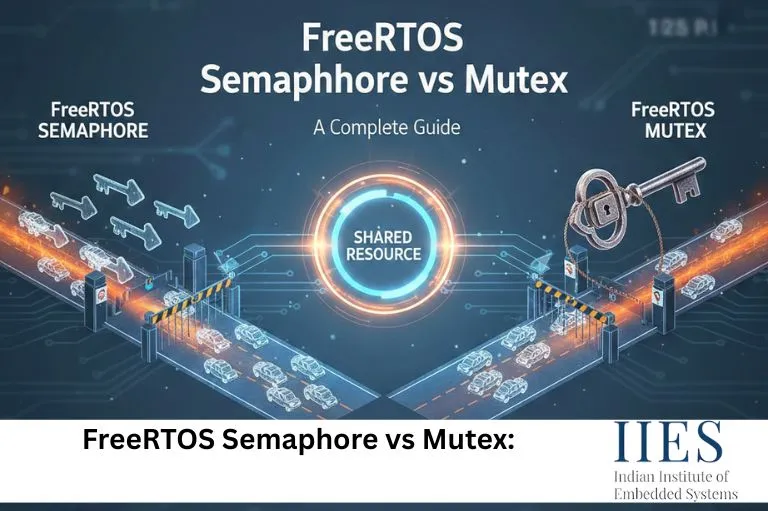
What Is Synchronization in FreeRTOS?
Synchronization is the process of coordinating tasks so they can safely access shared resources without interfering with each other.
Without synchronization:
- Two tasks may modify the same variable simultaneously
- A low-priority task can block a high-priority task
- ESP32 applications may freeze or behave unpredictably
FreeRTOS provides several synchronization tools, but semaphores and mutexes are the most commonly used and most often confused.
Understanding Semaphores in FreeRTOS
A semaphore is primarily used for signaling between tasks or between an interrupt and a task.
Think of a semaphore as a notification mechanism:
- One task (or ISR) signals that an event has occurred
- Another task waits for that signal and then continues execution
Semaphores are not designed to protect shared data.

Types of Semaphores in FreeRTOS
1. Binary Semaphore
- Has two states: available or unavailable
- Commonly used for event signaling
Typical ESP32 use cases:
- Button press detection
- Sensor data ready notification
- ISR-to-task communication
2. Counting Semaphore
- Can count multiple available resources
- Useful when several identical resources exist
Example:
- Managing access to a limited number of buffers or connections
When to Use a Semaphore
Use a semaphore when:
- Tasks need to signal events
- An interrupt service routine (ISR) needs to notify a task
- Tasks must wait for external events (sensor ready, data received)
Understanding Mutex in FreeRTOS
A mutex (mutual exclusion) ensures that only one task can access a shared resource at a time.
When a task locks a mutex:
- Other tasks must wait until it is released
- Data corruption is prevented
- System stability is maintained
Mutexes are specifically designed for resource protection, not signaling.
Why Mutex Is Different from Semaphore
The most important difference is priority inheritance.
Priority Inheritance Explained
In real-time systems, a low-priority task holding a resource can block a high-priority task. This problem is known as priority inversion.
Mutexes solve this by:
- Temporarily boosting the priority of the task holding the mutex
- Allowing it to release the resource faster
Semaphores do not support priority inheritance, which makes them unsafe for protecting shared resources in real-time applications.

When to Use a Mutex
Use a mutex when:
- Multiple tasks share the same resource
- Data integrity is critical
- Priority inversion must be avoided
Common ESP32 examples:
- Protecting global variables
- Accessing SPI, I2C, or UART peripherals
- Updating displays
- Managing file systems or shared memory
FreeRTOS Semaphore vs Mutex: Comparison Table
| Feature | Semaphore | Mutex |
|---|
| Purpose | Signaling & synchronization | Resource protection |
| Ownership | No ownership | Has ownership |
| Who can release | Any task or ISR | Only the owner task |
| Priority inheritance | ❌ Not supported | ✅ Supported |
| Best use case | Event signaling | Shared resource access |
ESP32 Practical Example
Semaphore:
A GPIO interrupt signals a task when a button is pressed.
Mutex:
Multiple tasks access a shared buffer used by Wi-Fi and sensor tasks.
Using a semaphore for shared data in this case may cause corruption, while a mutex prevents it.
When to Use Semaphore vs Mutex (Decision Guide)
Use a semaphore when:
- You need event notification
- Tasks must wait for signals
- Communication is one-way
Use a mutex when:
- Tasks share data or peripherals
- Data consistency matters
- Priority inversion is a concern
Correct selection greatly improves ESP32 system reliability.
Common Mistakes to Avoid
Many beginners misuse synchronization tools. Common mistakes include:
- Using semaphores instead of mutexes for data protection
- Forgetting to release mutexes or semaphores
- Using delays instead of proper synchronization
- Ignoring priority inversion issues
These mistakes can lead to deadlocks, performance degradation, and crashes.
Best Practices for FreeRTOS Synchronization
- Keep critical sections short
- Always release synchronization objects
- Prefer mutexes for shared resources
- Use semaphores only for signaling
- Avoid blocking high-priority tasks unnecessarily
Following these best practices ensures efficient and stable ESP32 applications.
Conclusion
Understanding the difference between FreeRTOS semaphore and mutex is essential for building reliable ESP32 applications.
- Semaphores are ideal for task signaling and event handling
- Mutexes are designed for shared resource protection with priority inheritance
By choosing the correct synchronization method and following best practices, developers can build stable, efficient, and scalable real-time systems using FreeRTOS on ESP32.