Stacks are not just an academic concept. They are deeply integrated into how programs execute.
When a function is called in C, it gets added to a call stack. Each function call pushes a frame onto the stack, and when the function finishes, it is popped off. This is how recursion works internally.
Stacks are also essential for:
- Expression evaluation (infix to postfix conversion)
- Backtracking algorithms (like DFS)
- Undo/redo systems
- Memory management in low-level programming
If you understand stacks well, you also understand how programs execute under the hood.

What is Stack?
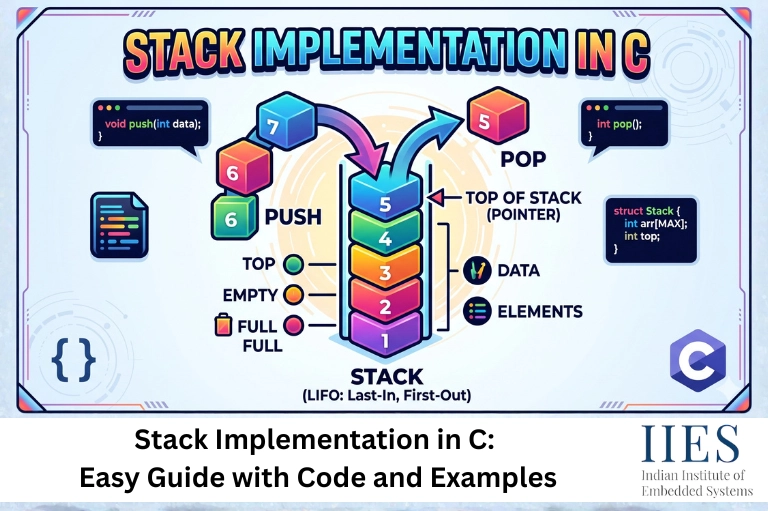
A stack in C programming is a linear data structure that follows the Last-In, First-Out (LIFO) principle.
This means:
- The last element added is the first one removed
- All operations happen at one end, called the top
A simple real-world analogy is a stack of plates. You can only add or remove plates from the top.
Explain the Operations Performed on Stack
To fully understand stack operations in C, you need to know the core functions that define its behavior.
Push Operation
Adds an element to the top of the stack.
- Before inserting, you must check for overflow
- Then increment the top pointer and store the value
Pop Operation
Removes the top element from the stack.
- Always check for underflow before removing
- Return the element and decrement the top
Peek Operation
Returns the top element without removing it.
- Useful for inspection without modifying the stack
Auxiliary Operations
- isEmpty(): Checks if the stack has no elements
- isFull(): Checks if the stack has reached its maximum capacity
These operations form the backbone of any stack implementation.
Implementing Stack as an Array in C
The simplest and most widely used method is stack implementation using array in C.
Concept
- Use a fixed-size array to store elements
- Maintain a variable top to track the current index
Code Example
#include

#define MAX 100

int stack[MAX];

int top = -1;

void push(int value) {

   if (top == MAX - 1) {

       printf("Stack Overflow\n");

       return;

   }

   stack[++top] = value;

}

int pop() {

   if (top == -1) {

       printf("Stack Underflow\n");

       return -1;

   }

   return stack[top--];

}

int peek() {

   if (top == -1) {

       printf("Stack is empty\n");

       return -1;

   }

   return stack[top];

}
How to Implement Stack in C Step by Step
To build a stack from scratch, follow this structured approach:
Step 1: Define Maximum Size
Decide the capacity of your stack.
Step 2: Declare Array and Top Variable
Initialize top = -1 to indicate an empty stack.
Step 3: Implement Push Logic
- Check if stack is full
- Increment top
- Insert value
Step 4: Implement Pop Logic
- Check if stack is empty
- Return top element
- Decrement top
Step 5: Add Peek and Utility Functions
Optional but useful for debugging and real-world applications.
Stack Program in C Using Switch Case
In real applications or academic settings, a menu-driven approach is often used.
#include

#define MAX 5

int stack[MAX], top = -1;

void push() {

   int x;

   scanf("%d", &x);

   if (top == MAX - 1)

       printf("Overflow\n");

   else

       stack[++top] = x;

}

void pop() {

   if (top == -1)

       printf("Underflow\n");

   else

       printf("%d\n", stack[top--]);

}

void display() {

   if (top == -1) {

       printf("Empty\n");

       return;

   }

   for (int i = top; i >= 0; i--)

       printf("%d ", stack[i]);

}

int main() {

   int choice;

   while (1) {

       scanf("%d", &choice);

       switch (choice) {

           case 1: push(); break;

           case 2: pop(); break;

           case 3: display(); break;

           case 4: return 0;

       }

   }

}
This structure is useful for testing all stack operations in C interactively.
Stack Using Linked List in C
For more flexibility, you can implement stack using linked list in C.
Why Use Linked List?
- No fixed size limitation
- Memory is allocated dynamically
- Better for large or unpredictable data
Structure Definition
struct Node {

   int data;

   struct Node* next;

};
Push Operation
struct Node* push(struct Node* top, int value) {

   struct Node* newNode = (struct Node*)malloc(sizeof(struct Node));

   newNode->data = value;

   newNode->next = top;

   return newNode;

}

Pop Operation

struct Node* pop(struct Node* top) {

   if (top == NULL) {

       printf("Underflow\n");

       return NULL;

   }

   struct Node* temp = top;

   top = top->next;

   free(temp);

   return top;

}
Array Implementation vs Linked List Implementation
Feature | Array Implementation of Stack in C | Stack Using Linked List in C |
Memory | Fixed | Dynamic |
Performance | Faster | Slight overhead |
Overflow | Possible | Only when memory is full |
Complexity | Simple | Slightly complex |
Flexibility | Limited | High |
Common Edge Cases in Stack Implementation
When working on stack implementation in C, handling edge cases correctly is what separates a working program from a reliable one. Ignoring these scenarios can lead to crashes, undefined behavior, or memory issues.
1. Popping from an Empty Stack (Underflow)
One of the most common mistakes is trying to perform a pop operation when the stack is empty.
What happens:
- Accessing invalid memory
- Unexpected output or program crash
Best practice:
Always check:
if (top == -1) {

   printf("Stack Underflow\n");

}
2. Pushing Beyond Stack Limit (Overflow)
In array implementation of stack in C, the stack has a fixed size. Trying to push beyond this limit causes overflow.
What happens:
- Data overwrite
- Logical errors in program
Best practice:
if (top == MAX - 1) {

   printf("Stack Overflow\n");

}
3. Memory Allocation Failure (Linked List Stack)
In stack using linked list in C, memory is allocated dynamically. If memory allocation fails, the program may crash.
What happens:
- malloc() returns NULL
- Program becomes unstable
Best practice:
struct Node* newNode = (struct Node*)malloc(sizeof(struct Node));

if (newNode == NULL) {

   printf("Memory allocation failed\n");

}

4. Incorrect Top Pointer Handling
Improper updates to the top variable can break the entire stack logic.
Common issues:
- Incrementing/decrementing in wrong order
- Skipping updates
Tip:
Always follow:
- Push → increment then insert
- Pop → return then decrement
5. Ignoring Edge Cases in Display or Peek
Functions like peek() or display() should also handle empty stack conditions.
Example:
if (top == -1) {

   printf("Stack is empty\n");

}
Optimization Tips for Stack Implementation in C
While learning stack implementation in C, most examples focus on correctness. However, in real-world applications, optimizing your stack can significantly improve performance, memory usage, and scalability.
1. Use Dynamic Resizing Instead of Fixed Arrays
In standard stack implementation using array in C, the stack size is fixed. This can lead to overflow even when memory is available.
Better approach:
Use dynamic resizing with realloc() to expand the stack when needed.
Benefit:
- Prevents unnecessary overflow
- Makes your implementation scalable
2. Avoid Unnecessary Memory Allocation
In stack using linked list in C, memory is allocated for every push operation. Excessive allocation can slow down performance.
Best practice:
- Allocate only when needed
- Free memory immediately after pop
Why it matters:
Efficient memory handling reduces fragmentation and improves speed.
3. Minimize Function Call Overhead
Frequent function calls (push/pop) can add overhead in performance-critical programs.
Optimization tip:
- Use inline functions for small operations where appropriate
inline void push(int value) {

   // optimized push logic

}
Benefit:
4. Use Pointer-Based Access for Faster Operations
Instead of repeatedly accessing array indices, you can use pointers to track the top.
Benefit:
- Slight performance improvement
- Cleaner logic in advanced implementations
5. Reduce Redundant Condition Checks
Avoid checking conditions multiple times unnecessarily inside loops or functions.
Example:
Check overflow/underflow once at the beginning instead of repeating.
6. Choose the Right Implementation Based on Use Case
- Use array implementation of stack in C when size is predictable and performance is critical
- Use linked list stack when size is dynamic and flexibility is required
Making the right choice itself is an optimization.
Real-World Applications of Stack
Stacks are used extensively in real-world systems:
- Function call stack in C runtime
- Expression evaluation (postfix, prefix)
- Undo/Redo features in editors
- Browser navigation history
- Backtracking algorithms
Mini Example: Expression Evaluation
Stacks help convert infix expressions like:
A + B * C
into postfix:
A B C * +
This simplifies computation for compilers and calculators.
Common Mistakes to Avoid
Even simple structures like stacks can cause bugs if not handled carefully.
- Not checking overflow or underflow
- Incorrect initialization of top
- Memory leaks in linked list implementation
- Ignoring edge cases like empty stack operations
- Mixing stack logic with unrelated program logic
Best Practices for Stack Implementation
- Keep push and pop functions independent
- Always validate conditions before operations
- Use clear naming conventions
- Add debugging output during development
- Use linked list implementation for scalable systems
Future Relevance of Stack
Stacks remain relevant even in modern computing:
- Used in compilers and interpreters
- Important in recursion-heavy algorithms
- Core to embedded systems programming
- Used in AI algorithms involving backtracking
- Essential for memory-efficient system design
As long as programs rely on execution flow and memory control, stacks will remain fundamental.
Conclusion
Learning stack implementation in C gives you a deeper understanding of how programs manage data and execution flow. Whether you use array implementation of stack in C or stack using linked list in C, the key is to master the underlying logic and operations.
Once you are comfortable with stacks, you can move on to more advanced data structures and algorithms with confidence. Start small, practice consistently, and build real programs that use stacks in meaningful ways.