What is IoT?
The Internet of Things (IoT) refers to a network of physical devices embedded with sensors, processors, software, and communication technologies that enable them to collect, exchange, and process data.
These devices communicate through various networking technologies such as Wi-Fi, Bluetooth, Zigbee, LoRaWAN, and cellular networks.
Common examples of IoT devices include:
- Smart thermostats
- Smart watches
- Connected vehicles
- Industrial sensors
- Smart agricultural monitoring systems
- Healthcare monitoring devices
The primary objective of IoT is to connect physical objects and generate meaningful data that can improve decision-making, automation, efficiency, and user experience.

Key Components of IoT
Devices and Sensors
Sensors collect real-time information such as temperature, humidity, pressure, motion, location, and environmental conditions.
Connectivity
Communication networks enable devices to exchange information with other devices, cloud platforms, and applications.
Data Processing
Collected data is processed either in cloud servers or edge computing devices to generate useful insights.
Applications
The processed information is used in various sectors including healthcare, manufacturing, agriculture, transportation, and smart cities.
What is WoT?
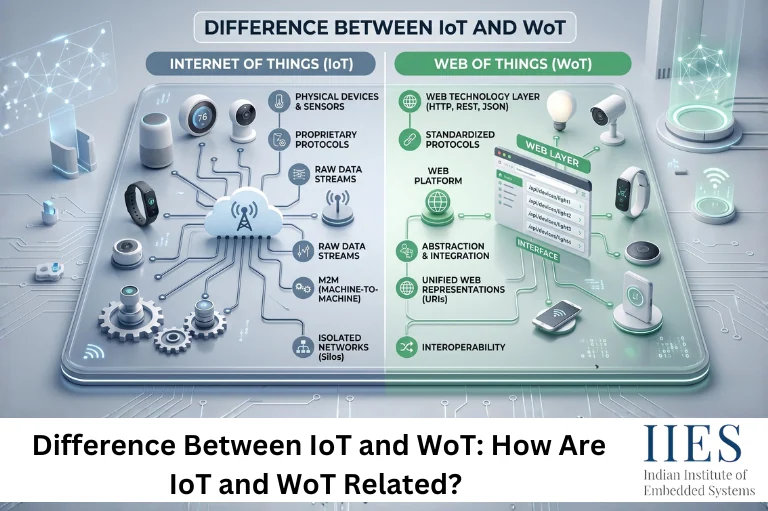
The Web of Things (WoT) is an approach that builds on IoT by applying web standards and technologies to connected devices.
Instead of treating devices as isolated systems with proprietary interfaces, WoT makes them accessible through common web technologies such as:
- HTTP
- REST APIs
- JSON
- WebSockets
- Semantic Web technologies
The goal of WoT is to simplify device integration and improve interoperability across different platforms and manufacturers.
Through WoT, devices can be accessed and controlled similarly to web applications, making development faster and more standardized.
Key Components of WoT
Thing Description (TD)
WoT uses standardized descriptions that define device properties, actions, events, and communication methods.
Semantic Interoperability
Devices can understand and interact with one another regardless of vendor-specific implementations.
Web APIs
Developers can access device functionalities using familiar web-based programming methods.
Standardized Communication
WoT promotes consistent communication models that simplify integration across systems.
How Are IoT and WoT Related?
A common question among technology professionals is: How are IoT and WoT related?
The answer is simple: WoT builds on top of IoT.
IoT provides the infrastructure needed for connecting devices, collecting data, and enabling communication. WoT adds a web-based layer that standardizes how devices are described, discovered, and accessed.
Without IoT, there would be no connected devices for WoT to manage. Without WoT, integrating devices from different vendors would often require custom development and proprietary solutions.
In other words:
- IoT creates the connected ecosystem.
- WoT makes the ecosystem easier to access and manage.
When discussing IoT and WoT together, it is helpful to think of IoT as the foundation and WoT as the bridge that connects devices to the web.

Advantages of IoT and WoT
While IoT and WoT serve different purposes, both technologies offer significant benefits for organizations and developers. Understanding these advantages helps explain why they are increasingly adopted together in modern connected systems.
Advantages of IoT
- Real-time monitoring of devices and environments
- Automation of repetitive tasks
- Predictive maintenance capabilities
- Improved operational efficiency
- Reduced operational costs
Advantages of WoT
- Simplified device integration
- Standardized communication methods
- Enhanced interoperability between platforms
- Faster application development
- Reduced dependency on specific vendors
Difference Between IoT and WoT
The following table summarizes the key difference between IoT and WoT.
Feature | IoT | WoT |
Full Form | Internet of Things | Web of Things |
Primary Focus | Device connectivity and data exchange | Web-based access and interoperability |
Purpose | Connect physical devices | Standardize device interaction |
Communication | Various networking protocols | Web technologies and standards |
Device Access | Often vendor-specific | Uniform web-based interfaces |
Interoperability | Limited in heterogeneous environments | High interoperability |
Development Approach | Hardware and connectivity focused | Application and web integration focused |
Standards Used | MQTT, Zigbee, Bluetooth, LoRaWAN | HTTP, REST, JSON, Web APIs |
Main Objective | Connect devices | Make devices accessible through the web |
Complexity | Higher integration effort | Simplified integration and development |
Real-World Examples of IoT and WoT
Smart Home Systems
In a smart home, IoT devices such as smart lights, cameras, and thermostats collect and exchange data.
WoT allows these devices to be controlled through a standardized web interface or mobile application regardless of the manufacturer.
Industrial Automation
Industrial IoT sensors monitor machine performance, vibration, and temperature.
WoT enables these devices to expose their data through web APIs, making integration with enterprise applications much easier.
Smart Cities
IoT devices gather traffic, pollution, and energy consumption data.
WoT provides a unified framework for accessing information from different city infrastructure systems.
Challenges of IoT and WoT
Despite their numerous advantages, both IoT and WoT face several technical and operational challenges. Organizations implementing connected systems must address these issues to ensure reliable, secure, and scalable deployments.
IoT Challenges | WoT Challenges |
Security vulnerabilities in connected devices | Adoption of common standards across vendors |
Device compatibility issues | Integration with legacy IoT systems |
Data privacy concerns | Semantic modeling complexity |
Scalability challenges with large device networks | Additional implementation effort |
Network reliability and connectivity issues | Web-based security risks |
Addressing these challenges is essential for building robust and future-ready connected ecosystems. As technologies mature, industry standards and best practices continue to improve the reliability and interoperability of both IoT and WoT solutions.
Benefits of Combining IoT and WoT
Organizations increasingly adopt both technologies because they offer several advantages:
- Improved interoperability
- Faster application development
- Easier device integration
- Reduced development costs
- Better scalability
- Enhanced user experience
- Simplified maintenance
The combination of IoT and WoT enables businesses to build flexible and future-ready connected ecosystems.
Future of IoT and WoT
As billions of connected devices continue to come online, interoperability will become even more important. Future smart environments will involve devices from numerous manufacturers operating together seamlessly.
The Web of Things is expected to play a critical role in achieving this goal by providing universal standards for device discovery, communication, and control.
Emerging technologies such as artificial intelligence, edge computing, digital twins, and Industry 4.0 will further strengthen the relationship between IoT and WoT, enabling more intelligent and autonomous systems.

Conclusion
Understanding the difference between IoT and WoT is essential for anyone working with connected technologies. While IoT focuses on connecting physical devices and enabling data exchange, WoT extends these capabilities by applying web standards that improve interoperability and accessibility.
When explaining how IoT and WoT are related, it is best to view IoT as the infrastructure layer and WoT as the web-enabled layer that simplifies interaction between devices and applications. Together, IoT and WoT create a powerful ecosystem that supports smarter homes, industries, cities, and future digital innovations.
As connected technologies continue to evolve, the integration of IoT and WoT will become increasingly important in building scalable, interoperable, and intelligent systems.