What Are Embedded Systems?
An embedded system is a combination of hardware and software designed to perform a dedicated function within a larger product or system.
Unlike a general-purpose computer that can run many different applications, an embedded system is usually optimized for a particular task.
A typical embedded system may contain:
- Microcontroller or microprocessor
- Sensors
- Actuators
- Memory
- Communication interfaces
- Embedded software or firmware
- Power management components
For example, a temperature-control system in a manufacturing plant can continuously measure temperature using a sensor, process the readings using a microcontroller, and control a cooling system when the temperature crosses a defined limit.
This ability to sense, process, decide, and control makes embedded technology highly useful for industrial automation.

What Is Industrial Automation?
Industrial automation refers to the use of control systems, computers, machines, sensors, and software to operate industrial processes with reduced manual intervention.
It is commonly used in:
- Manufacturing plants
- Automotive factories
- Electronics production
- Food-processing facilities
- Chemical plants
- Power systems
- Warehouses
- Robotics
- Packaging systems
Industrial automation can improve consistency, productivity, safety, and process monitoring.
Different technologies can work together in an automated factory, including PLCs, embedded controllers, sensors, actuators, SCADA systems, industrial networks, robots, and industrial IoT devices.
How Embedded Systems Are Used in Industrial Automation
The role of embedded systems in industrial automation is not limited to one particular machine. They can be found at different levels of an automated system.
An embedded controller may collect information from sensors, execute control logic, operate actuators, communicate with other devices, and continuously monitor equipment.
A simplified automation process can be represented as:
Sensor → Embedded Controller → Decision/Control Logic → Actuator → Machine
For example, consider an automated conveyor system.
A sensor detects an object on the conveyor. The embedded controller receives the sensor signal and determines whether the object should be moved, stopped, or redirected. It then sends a control signal to the motor or actuator.
This process can happen repeatedly and within very short time intervals.

1. Sensor Monitoring and Data Collection
Sensors are an important part of industrial automation because machines need information about their environment and operating conditions.
Embedded systems can collect data from sensors such as:
- Temperature sensors
- Pressure sensors
- Proximity sensors
- Light sensors
- Vibration sensors
- Humidity sensors
- Position sensors
- Current and voltage sensors
For example, a vibration sensor installed on an industrial motor can provide information about abnormal vibration.
An embedded controller can continuously process these readings and identify conditions that may require maintenance.
This is one reason embedded systems for industrial automation are useful for equipment monitoring and predictive maintenance.
2. Motor and Machine Control
Many industrial machines depend on motors for movement.
Embedded controllers can be used to control:
- Motor speed
- Direction
- Position
- Start and stop operations
- Acceleration and deceleration
For example, an automated conveyor may need to increase its speed when production demand rises and slow down when a sensor detects an obstruction.
The embedded controller can receive sensor information and generate appropriate control signals.
Motor control is particularly important in robotics, CNC machines, conveyor systems, pumps, fans, and automated production equipment.
3. Real-Time Control
One of the most important characteristics of industrial automation is the ability to respond within predictable time limits.
A system controlling a machine cannot always wait several seconds to process an event. Some operations require rapid and deterministic responses.
This is where real-time embedded systems become important.
For example, if a safety sensor detects a dangerous condition, the controller may need to immediately stop a motor or machine.
The embedded software continuously executes control logic and responds to inputs according to the timing requirements of the application.
Real-time control is therefore a major reason embedded controllers are widely used in industrial environments.
4. Robotics and Automated Machines
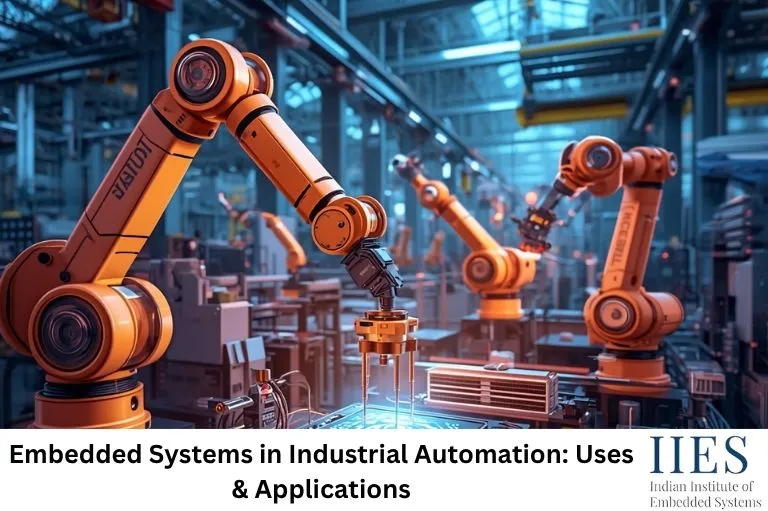
Industrial robots use embedded computing and control systems to perform precise movements.
Robotic systems can be used for:
- Welding
- Assembly
- Pick-and-place operations
- Painting
- Packaging
- Inspection
- Material handling
Embedded controllers process signals from sensors and control motors and actuators that move the robot.
For example, a robotic arm used in an assembly line may need to detect the position of a component, move to a specific location, pick up the component, and place it accurately.
The controller must coordinate multiple operations while maintaining timing and positional accuracy.
5. Safety and Monitoring Systems
Industrial environments can involve high temperatures, moving machinery, high voltages, pressure, and other hazards.
Embedded systems can support safety monitoring by continuously checking important parameters.
For example, an embedded controller could monitor:
Temperature → Pressure → Motor Current → Machine Status
If a monitored value exceeds a predefined limit, the system can trigger an alarm or initiate a predefined protective action.
However, safety-critical industrial systems require appropriate hardware, software, redundancy, validation, and safety standards. A basic microcontroller project should not automatically be considered an industrial safety system.
6. Industrial Communication
Modern factories contain many machines and controllers that need to exchange information.
Embedded systems can communicate using different interfaces and industrial communication protocols.
Examples include:
- UART
- SPI
- I2C
- CAN
- Modbus
- Ethernet-based industrial communication
- Other fieldbus and industrial Ethernet technologies
For example, an embedded controller may collect information from sensors and send processed data to another controller or monitoring system.
Understanding communication protocols is therefore an important skill for students interested in industrial embedded systems.
7. PLC and Embedded Systems Working Together
Programmable Logic Controllers (PLCs) are widely used in industrial automation. Embedded controllers and PLCs can serve different roles depending on the application.
A PLC is designed specifically for industrial control and is typically programmed for automation logic, while an embedded controller can be designed into a dedicated machine or product with application-specific hardware and software.
In a real industrial system, these technologies can work together.
For example:
Sensors → Embedded Controller → PLC → Industrial Network → SCADA
An embedded controller may handle specialized machine-level processing while a PLC manages broader automation logic.
Therefore, PLC and embedded systems should not necessarily be viewed as competing technologies. Their roles depend on the architecture and requirements of the automation system.
8. Industrial IoT and Smart Manufacturing
The combination of embedded systems and connectivity has led to the growth of Industrial Internet of Things (IIoT).
IIoT devices can collect data from machines and send it to local or cloud-based systems for monitoring and analysis.
For example, an embedded device attached to an industrial motor could collect:
- Temperature
- Vibration
- Current
- Operating hours
- Motor status
This information can then be transmitted through an industrial network or gateway.
Engineers can use this data to identify abnormal conditions, monitor equipment performance, and support predictive maintenance.
This connection between embedded technology, networking, data analysis, and Industry 4.0 is creating new opportunities for embedded engineers.
9. Automated Quality Inspection
Embedded systems can also support automated inspection systems.
A production line may use sensors, cameras, or other measurement devices to check whether a product meets predefined requirements.
For example, an automated system could check:
- Product dimensions
- Component presence
- Position
- Surface defects
- Packaging conditions
The embedded controller can coordinate sensors, trigger measurements, process basic signals, and communicate inspection results to other automation systems.
More advanced inspection systems may combine embedded computing with machine vision and AI.
10. Energy and Power Monitoring
Factories consume significant amounts of electrical energy, making energy monitoring another useful application. Embedded systems can measure parameters such as:
- Voltage
- Current
- Power
- Energy consumption
- Power factor
The collected information can help identify inefficient machines or unusual power consumption.
When connected to industrial networks, these measurements can also become part of a larger energy-management system.
Embedded Systems vs. Traditional Industrial Control
Traditional industrial automation often relies heavily on PLCs and dedicated control hardware. Modern systems increasingly combine PLCs, embedded controllers, industrial computers, networking, and IoT technologies.
The appropriate technology depends on the application.
For example:
Requirement | Possible Technology |
Machine control | PLC or embedded controller |
Dedicated product control | Microcontroller-based embedded system |
High-level monitoring | Industrial PC/SCADA |
Sensor data collection | Embedded device |
Connected machine monitoring | IIoT device |
Robotic control | Embedded/industrial controller |
Process visualization | HMI/SCADA |
There is no single controller that is best for every industrial application.
Example: Embedded System in an Automated Conveyor
Consider a simple automated conveyor system used in a factory.
A proximity sensor detects when an object reaches a specific position.
The embedded controller receives the sensor signal and processes it. If an object is detected, the controller can instruct the motor driver to stop the conveyor.
The system can then activate another actuator to move the object to a different section.
The basic sequence is:
Object Detection → Sensor Signal → Embedded Controller → Control Decision → Motor/Actuator
Additional sensors can be added to monitor motor temperature, conveyor speed, or object position.
This simple example demonstrates how concepts learned in embedded systems courses are applied to real industrial automation.
Why Embedded Systems Are Important for Industry 4.0
Industry 4.0 focuses on connected, intelligent, and data-driven industrial systems.
Embedded systems contribute to this environment by providing computing capabilities close to machines and sensors.
Instead of simply collecting data manually, connected embedded devices can continuously monitor equipment and communicate information.
This enables technologies such as:
- Smart factories
- Industrial IoT
- Predictive maintenance
- Edge computing
- Machine monitoring
- Automated quality control
- Connected robotics
- Data-driven manufacturing
Edge computing is particularly useful when some data needs to be processed close to the machine instead of sending every piece of raw data to a remote server.
Skills Needed to Work With Embedded Systems in Industrial Automation
Students interested in industrial automation should build a combination of hardware and software skills.
Important areas include:
Embedded C
C remains an important programming language for microcontroller-based embedded development.
Students should understand:
- Variables and data types
- Pointers
- Structures
- Bit manipulation
- Memory
- Functions
- Interrupts
- Peripheral programming
Microcontrollers
A strong understanding of microcontrollers helps students understand how embedded controllers interact with real hardware.
Common areas include:
- GPIO
- Timers
- PWM
- ADC
- UART
- SPI
- I2C
- Interrupts
Sensors and Actuators
Students should understand how sensors generate signals and how controllers interact with actuators.
Communication Protocols
Knowledge of protocols such as CAN, Modbus, UART, SPI, and I2C can be valuable depending on the target industry and application.
Real-Time Concepts
Understanding timing, interrupts, scheduling, and real-time operating systems can help when working on systems that require predictable responses.
Industrial Automation Concepts
It is also useful to understand PLCs, HMIs, SCADA, industrial networking, and basic automation architecture.
Career Opportunities in Embedded and Industrial Automation
The increasing use of automation creates opportunities across embedded systems, industrial electronics, robotics, and connected manufacturing.
Depending on their skills, engineers can work in roles such as:
- Embedded Systems Engineer
- Firmware Engineer
- Embedded Software Engineer
- Industrial Automation Engineer
- Control Systems Engineer
- Robotics Engineer
- IoT Engineer
- Embedded IoT Engineer
- Automation Software Engineer
The exact requirements vary between companies. Some roles may focus heavily on embedded C and microcontrollers, while others may require PLC programming, industrial communication, Linux, networking, or IoT technologies.
Conclusion
Embedded systems in industrial automation provide the computing and control capabilities needed for modern machines to sense conditions, process information, control equipment, and communicate with other systems. They are used in motor control, robotics, sensor monitoring, machine safety, industrial communication, quality inspection, energy monitoring, and Industrial IoT applications. For students, learning embedded C, microcontrollers, sensors, communication protocols, real-time concepts, and basic industrial automation can provide a strong foundation for working with modern automated systems. As factories become more connected through IIoT and Industry 4.0, the ability to combine embedded systems with networking, data processing, and automation technologies is becoming increasingly valuable.