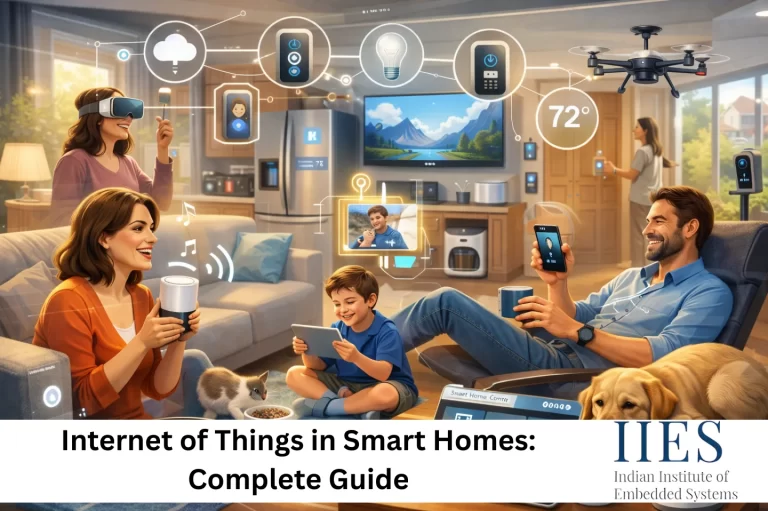
Understanding the Internet of Things in Smart Homes
The Internet of Things (IoT) refers to a network of connected devices embedded with sensors, software, and internet connectivity. These devices collect and exchange data in real time, enabling automation and remote control.
In residential spaces, IoT connects lighting systems, home automation systems, climate control, appliances, and security tools into one unified ecosystem. Instead of functioning independently, devices work together to improve comfort, safety, and efficiency.
For example, when you leave home, your system may automatically:
- Turn off lights
- Adjust temperature settings
- Lock doors
- Activate security cameras
This level of coordination is known as IoT home automation, and it forms the foundation of every smart home.

Core Technologies Powering Smart Homes
Behind every smart home is a combination of hardware, connectivity, and intelligent software. These components allow devices to sense their environment, process information, and take action.
Technology | Role in Smart Homes | Example |
Sensors | Detect activity and conditions | Motion, temperature, humidity |
IoT devices | Execute tasks | Smart locks, cameras, bulbs |
Connectivity | Enables communication | Wi-Fi, Zigbee, Bluetooth |
Cloud computing | Stores and processes data | Mobile apps, dashboards |
AI & neural networks | Learn behavior patterns | Predictive automation |
Together, these technologies create energy efficient smart homes that adapt to the people living inside them.
How IoT Home Automation Improves Daily Life
One of the most noticeable advantages of IoT is convenience. Smart homes reduce manual effort by automating repetitive tasks. Instead of constantly adjusting settings, systems learn routines and operate automatically.
Imagine waking up to gradual lighting, comfortable room temperature, and your coffee brewing on schedule. During the day, appliances power down when not in use. At night, security systems activate automatically.
These subtle improvements create a smoother lifestyle without constant interaction. Over time, automation becomes almost invisible, yet incredibly valuable.
Typical home automation systems may include:
- Voice-controlled assistants
- Scheduled lighting and curtains
- Smart thermostats
- Remote appliance management
The result is a home that feels responsive rather than static.
Benefits of IoT in Smart Homes
The growing popularity of connected living is driven by real, measurable advantages. The benefits of IoT in smart homes extend beyond comfort and into energy savings, safety, and sustainability.
First, automation reduces wasted time and effort. Tasks that once required attention now happen automatically. Second, real-time monitoring gives homeowners better visibility into their environment. Third, intelligent systems optimize energy use, which lowers monthly expenses. Finally, security improves through constant surveillance and instant alerts.
These benefits combine to create homes that are smarter, safer, and more efficient than traditional setups.
Energy Efficient Smart Homes and Smart Resource Management
Energy efficiency is one of the strongest reasons homeowners adopt IoT technology. Traditional homes often waste electricity because lights, heating, and appliances run longer than necessary. Smart systems analyze occupancy and behavior, ensuring energy is used only when needed.
Feature | Traditional Setup | Smart IoT Setup |
Lights | Manual switching | Motion-based control |
AC/Heating | Fixed schedule | Adaptive learning |
Monitoring | Monthly bill only | Real-time analytics |
Appliances | Always on standby | Smart power saving |
By reducing unnecessary consumption, energy efficient smart homes help families cut costs while supporting environmental sustainability.

IoT Devices for Home Security and Peace of Mind
Security has become a top priority for homeowners, and IoT devices for home security have significantly improved protection levels. Instead of relying solely on alarms, connected systems provide continuous monitoring and remote control.
Smart cameras stream live footage to mobile phones. Doorbells offer two-way communication. Locks can be controlled from anywhere. Motion sensors trigger instant notifications.
These tools allow homeowners to stay informed and react quickly, whether they are at work, traveling, or simply in another room. More importantly, they create peace of mind by keeping families and property safe.
The Role of AI, Neural Networks, and Intelligent Learning
Modern smart homes are no longer rule-based systems. They increasingly rely on artificial intelligence and neural networks to analyze behavior and make smarter decisions.
AI studies patterns such as when you wake up, how long you stay home, and what temperature you prefer. Over time, the system predicts these needs automatically. This predictive intelligence reduces the need for manual programming.
In many ways, smart homes now function similarly to AI language models like digital assistants, which understand context rather than just commands. Instead of simply responding to “turn on lights,” systems learn when lights should turn on naturally.
This deeper intelligence makes automation more human-centered and intuitive.
Why Semantic Search and Entities Matter for Smart Homes
Search engines today use advanced technologies like BERT, entity-based search, and Knowledge Graphs to understand meaning rather than just keywords. Instead of matching exact phrases, Google recognizes relationships between entities such as:
- Internet of Things
- Smart home technology
- Connected devices
- Home automation systems
- Security sensors
- Energy management
By understanding these connections, search engines deliver more accurate results. This is why comprehensive, context-rich content about the Internet of Things in smart homes performs better than simple keyword repetition. It demonstrates expertise and topical authority.
Challenges and Considerations
Despite its advantages, adopting IoT technology requires planning. Security risks, compatibility issues, and upfront costs must be considered carefully. Strong passwords, encrypted networks, and regular software updates are essential for protecting data.
Choosing devices within the same ecosystem and ensuring reliable internet connectivity also improves performance. With proper planning, most challenges can be easily managed.
The Future of Smart Living
The future of smart homes looks increasingly autonomous. Faster connectivity, improved sensors, and more advanced AI will make homes capable of predicting needs even more accurately. Systems may soon manage energy distribution, monitor health conditions, and integrate directly with smart cities.
As costs decrease and technology becomes more accessible, IoT-powered homes will likely become the global standard.

Conclusion
The Internet of Things in smart homes represents a major step forward in residential technology. By connecting devices, enabling IoT home automation, improving home security, and supporting energy efficient smart homes, IoT creates environments that are both intelligent and practical.
Combined with artificial intelligence, neural networks, and modern data systems, smart homes are evolving into spaces that understand and adapt to human life. For homeowners seeking comfort, safety, and efficiency, investing in IoT is no longer optional, it’s the future of modern living. Institutions such as IIES Bangalore, known for offering some of the best embedded courses in Bangalore, are also preparing the next generation of engineers with hands-on training in IoT, embedded systems, and smart home technologies, helping bridge the gap between innovation and real-world applications.
.