What Is a Recursive Function in C?
In simple terms, recursion in C programming is a technique where a function calls itself to solve a problem. This concept is best understood when learning recursive functions in C, because the same logic is repeated on smaller inputs until a solution is reached.
A recursive function in C is a function that calls itself either directly or indirectly to solve a problem. Instead of solving the entire problem at once, the function solves a smaller version of the same problem and relies on repeated function calls until a terminating condition is reached.
Recursion is commonly used for problems that naturally follow a repetitive or hierarchical structure, such as mathematical calculations, tree traversal, searching algorithms, and divide-and-conquer problems.

Two Essential Components of Recursion
Every recursive function in C must have two mandatory components. Without these, recursion will either fail or run infinitely.
1. Base Case
The base case is the condition that stops further recursive calls. It represents the simplest form of the problem that can be solved directly.
Without a base case, the function will keep calling itself endlessly, leading to stack overflow.
2. Recursive Case
The recursive case is where the function calls itself with a modified argument. Each call should move the program closer to the base case.
A well-designed recursive case ensures that recursion eventually terminates.
Simple Real-Life Analogies to Understand Recursion
Tracing Your Ancestry
Imagine tracing your family history:
- You start with yourself
- Then look at your parents
- Then your grandparents
- And so on
Base Case: You reach the earliest known ancestor.
Recursive Case: For the current person, trace their parents.
This mirrors how a recursive function keeps calling itself until the base condition is met.
Cutting a Pizza
Consider cutting a pizza into smaller slices:
- You cut a large slice into smaller ones
- Each slice is cut again until it’s small enough to eat
Base Case: The slice is small enough.
Recursive Case: Divide the slice further.
How Recursion Works Internally in C
When a recursive function is called, C uses the function call stack:
- Each function call gets its own stack frame
- Local variables and return addresses are stored
- Once the base case is reached, functions return one by one
Understanding stack behavior is especially important in embedded systems, where memory is limited and uncontrolled recursion can cause system failure.

Example 1: Sum of N Natural Numbers Using Recursion
#include

int sum(int n)
{
    if (n == 1) // Base case
        return 1;
    else // Recursive case
        return n + sum(n - 1);
}

int main()
{
    int result = sum(5);
    printf("Sum = %d", result);
    return 0;
}
Explanation:
- sum(5) returns 5 + sum(4)
- sum(4) returns 4 + sum(3)
- This continues until sum(1)
- Final result is 15
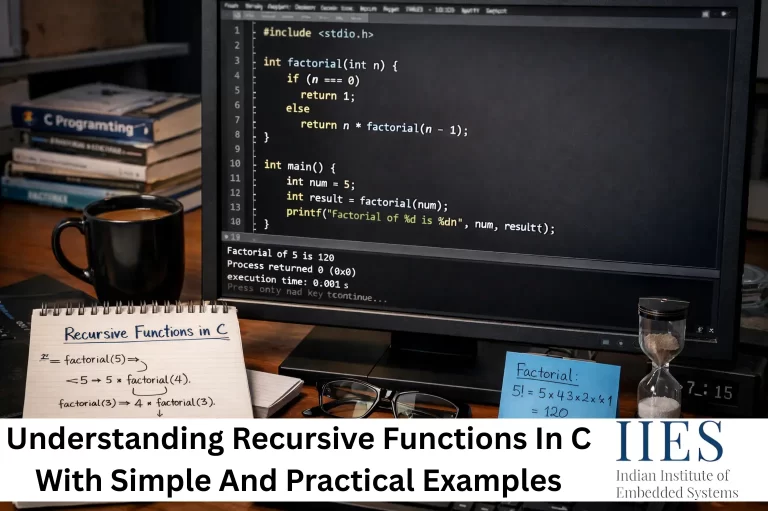
Example 2: Product of N Natural Numbers (Factorial)
#include

int factorial(int n)
{
    if (n == 1) // Base case
        return 1;
    else // Recursive case
        return n * factorial(n - 1);
}

int main()
{
    int result = factorial(5);
    printf("Factorial = %d", result);
    return 0;
}
Explanation:
- This program calculates 5! = 5 × 4 × 3 × 2 × 1
- Recursion reduces the problem step by step until the base case is reached
Example 3: Fibonacci Series Using Recursion
#include

int fibonacci(int n)
{
    if (n == 0) // Base case
        return 0;
    else if (n == 1) // Base case
        return 1;
    else // Recursive case
        return fibonacci(n - 1) + fibonacci(n - 2);
}

int main()
{
    int result = fibonacci(5);
    printf("Fibonacci = %d", result);
    return 0;
}
Explanation:
- Each function call breaks the problem into two smaller sub-problems
- This example demonstrates how recursion can grow rapidly in complexity
Advantages of Using Recursive Functions in C
- Makes code more readable and logical
- Ideal for problems with repetitive structure
- Reduces complex looping logic
- Useful for tree, graph, and divide-and-conquer algorithms
Limitations of Recursion (Important for Embedded Systems)
- Higher memory usage due to stack frames
- Risk of stack overflow
- Slower compared to iterative solutions
- Not recommended for memory-constrained embedded applications
At IIES, students are taught when to use recursion and when to avoid it, especially in real-time and embedded systems programming.
Recursion vs Iteration in C
| Feature | Recursion | Iteration |
|---|
| Code readability | High | Moderate |
| Memory usage | High | Low |
| Execution speed | Slower | Faster |
| Embedded suitability | Limited | Preferred |
Best Practices for Writing Recursive Functions
- Always define a clear base case
- Ensure progress toward the base case
- Avoid deep recursion in embedded systems
- Test with small inputs first
- Prefer iteration for performance-critical code