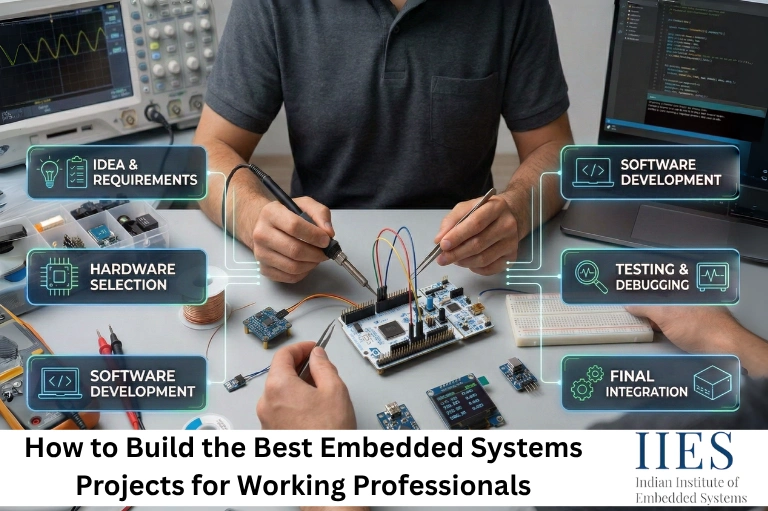
Why Working Professionals Should Focus on Embedded Projects
Many working professionals struggle to transition from theoretical knowledge to real embedded systems development. The challenge is not learning concepts, but applying them in real-world projects.
For working professionals, building embedded systems projects offers several advantages:
- Practical exposure to real-world systems
- Stronger understanding of hardware-software interaction
- Improved debugging and optimization skills
- Better job opportunities in IoT, automotive, and robotics
Unlike theoretical learning, hands-on project development builds confidence and problem-solving ability.
Embedded Systems Development Process
The embedded systems development process refers to a structured approach used to design, build, test, and deploy embedded solutions. It ensures that systems are reliable, efficient, and aligned with real-world requirements.
In professional environments, this process is not treated as isolated steps but as a continuous lifecycle. It typically includes requirement analysis, system design, hardware selection, firmware development, testing, debugging, and optimization.
The complete step-by-step lifecycle is explained below.

Embedded Systems Development Lifecycle (Step-by-Step)
Building reliable embedded systems requires following a structured and industry-aligned lifecycle. This approach helps professionals reduce errors, improve efficiency, and develop production-ready systems.
1. Problem Definition & Requirement Analysis
Every project begins with a clear understanding of the problem. Define system objectives, inputs/outputs, and constraints such as cost, power, and performance.
Example: A smart irrigation system that monitors soil moisture and automates watering.
2. System Architecture & Design
Design the system structure before implementation:
- Create block diagrams
- Define data flow
- Select communication protocols (UART, SPI, I2C)
3. Hardware Selection & Setup
Choose suitable components:
- Microcontroller (ESP32, STM32, Arduino)
- Sensors and actuators
- Power supply and interfacing circuits
4. Firmware Development
Develop embedded software using structured programming:
- Use Embedded C/C++
- Implement control logic
- Optimize memory and power usage
5. Module-Level Testing
Test individual components before full integration:
- Validate sensor data
- Verify communication interfaces
- Check output responses
6. Debugging & Issue Resolution
Identify and fix system issues:
- Use UART logs
- Apply debugging tools (JTAG/SWD)
- Analyze signals using oscilloscopes or logic analyzers
7. System Integration
Combine hardware and software modules:
- Ensure all components work together
- Validate complete system functionality
8. Optimization & Performance Tuning
Improve system efficiency:
- Reduce memory usage
- Enhance execution speed
- Minimize power consumption
9. Final Deployment
Prepare the system for real-world use:
- Generate firmware (HEX/Binary)
- Flash to microcontroller
- Perform final validation
Practical Insight
In real-world embedded projects, development is often iterative. Engineers frequently move between testing, debugging, and optimization to achieve a stable and efficient system.
Embedded Systems Design Process
The embedded systems design process focuses on planning system architecture and ensuring proper hardware-software integration. It plays a key role in meeting performance, power, and cost requirements.
This process includes defining system architecture, selecting components, designing interfaces, and preparing the system for firmware development and integration.
In practice, the design process is an essential part of the overall embedded systems development lifecycle described above.
Embedded Software Development Best Practices
To build the best embedded systems projects, following embedded software development best practices is essential.
Key Best Practices
- Modular Programming
Break your code into reusable modules for better maintainability. - Coding Standards
Follow structured guidelines such as MISRA C to improve code reliability. - Memory Optimization
Efficient memory usage is critical in embedded systems with limited resources. - Power Optimization
Optimize battery usage, especially in IoT and portable devices. - Version Control
Use Git to track changes and collaborate efficiently. - Documentation
Maintain proper documentation for future updates and debugging.
Optimization plays a critical role when building reliable embedded systems. Unlike general-purpose computing, embedded devices operate with limited memory, processing power, and energy constraints. Poor optimization can lead to system instability, slow performance, or even complete failure.
Key Reasons to Focus on Optimization
- Memory Constraints → Embedded systems often have very limited RAM and storage
- Performance Efficiency → Inefficient code can slow down system response time
- Power Consumption → Poor optimization can drain battery-operated devices quickly
- System Stability → Excess resource usage may cause crashes or unexpected behavior
Simple Code Example
// Inefficient memory usage

int buffer[1000];

// Optimized memory usage

int buffer[100];
In this example, allocating unnecessary memory wastes valuable resources. Optimizing such areas ensures better system performance and reliability.
Best Practices for Optimization
- Use only required memory and avoid over-allocation
- Optimize loops and conditional statements
- Remove unused variables and code
- Use efficient data structures
- Monitor performance during development
Practical Insight
Even small optimizations can significantly improve embedded system performance, especially in real-time and low-power applications. Professionals who prioritize optimization build systems that are not only functional but also efficient and production-ready.

Building Embedded Systems: Practical Workflow
For working professionals with limited time, efficiency is key when building embedded systems.
Recommended Workflow
- Start with a simple prototype
- Test individual components (sensor, microcontroller, communication)
- Integrate modules step-by-step
- Perform system-level testing
This incremental approach reduces errors and simplifies debugging.
Embedded Systems Debugging Techniques
Debugging plays a critical role in the success of any embedded project.
Basic Debugging in Embedded System
- Serial communication logs (UART)
- LED indicators for system status
Advanced Debugging Techniques
- Breakpoints and step execution
- Memory and register inspection
- Real-time debugging tools
Developing strong embedded systems debugging techniques helps professionals solve complex issues efficiently.
Debugging Tools and Techniques
Choosing the right debugging tools and techniques significantly improves development productivity.
Tool | Purpose |
Multimeter | Check voltage and continuity |
Oscilloscope | Analyze signal waveforms |
Logic Analyzer | Debug communication protocols |
JTAG/SWD Debugger | Advanced firmware debugging |
What is Debugger in Embedded System?
A debugger is a tool that allows developers to:
- Pause execution
- Inspect variables
- Step through code
- Identify logical and hardware-related issues
How to Debug Embedded Systems Effectively
Understanding how to debug embedded systems is essential for building reliable projects.
Step-by-Step Debugging Approach
- Reproduce the issue consistently
- Isolate the faulty module
- Analyze signals using tools
- Fix the issue and test again
A systematic approach prevents wasted time and improves accuracy.
Build Process in Embedded System
The build process in embedded system converts your code into executable firmware.
Build Process Steps
- Writing source code
- Compiling
- Linking
- Generating binary/HEX file
- Flashing firmware to microcontroller
Example Build Command
arm-none-eabi-gcc main.c -o output.elf
Understanding the build process of embedded system helps in resolving compilation and linking errors efficiently.
Levels of Abstraction in Embedded Systems Design Process
Embedded systems operate across multiple layers, known as levels of abstraction in embedded systems design process.
Abstraction Layers
- Hardware Level
- Register Level
- Driver Level
- Application Level
Properly managing these layers improves system scalability, portability, and maintainability.
Embedded System Design Examples
Here are some practical embedded system design examples that professionals can build:
- IoT-based smart home automation
- Industrial motor speed control system
- Wearable health monitoring device
- Smart energy meter
These projects reflect real-world applications and enhance portfolio strength.
Common Challenges in Embedded Systems Development
Challenge | Solution |
Hardware integration issues | Verify connections and protocols |
Memory limitations | Optimize code and data structures |
Communication failures | Use logic analyzers |
Power instability | Monitor voltage and current |
Emerging Trends in Embedded Systems
The future of embedded systems is evolving with technologies such as:
- AI-enabled embedded devices
- Edge computing systems
- Low-power IoT architectures
- Integration with machine learning models
Professionals who adapt to these trends will stay ahead in the industry.

Conclusion
Building the best embedded systems projects requires more than just selecting ideas—it involves mastering the embedded systems development process, design methodology, and debugging techniques.
By following:
- Structured development workflows
- Embedded software development best practices
- Efficient debugging strategies
working professionals can build industry-ready projects that enhance both technical expertise and career growth.