What Is a Data Type in C++?
Every variable in C++ needs a data type, there’s no way around it. C++ is a statically typed language, meaning the compiler must know, before your program ever runs, exactly what kind of data each variable will hold.
A data type tells the compiler three things:
- How much memory to reserve for the variable
- What kind of values it can legally store
- What operations are valid on it, can you add two of them, compare them, index into them?
Think of a data type as a container spec. A char is a small teacup, perfect for a single character, wasteful for anything bigger. A double is more like a bucket, built to hold large, precise decimal values. Pick the wrong container, and you either waste resources or lose data you needed to keep.
This “container spec” idea matters more in C++ than in most beginner-friendly languages, because C++ hands you direct control over memory, and expects you to use it responsibly.

Why Data Types Matter (Especially in Embedded Systems)
On a server with 16GB of RAM, using an int instead of a short barely registers. On a microcontroller, it can be the difference between code that fits and code that doesn’t.
- Memory is finite. An 8-bit microcontroller might have as little as 2KB of RAM total. Every byte saved by choosing
uint8_t over int is a byte available elsewhere. - Hardware registers expect exact widths. Memory-mapped peripheral registers are often exactly 8, 16, or 32 bits wide. The wrong-sized type can corrupt adjacent memory or misread hardware state.
- Portability depends on it. Code that assumes
int is always 4 bytes will misbehave on a platform where it’s 2 bytes. - Performance is affected. Some processors handle certain data widths faster than others, so a mismatch can slow down time-critical code.
This is exactly why fixed-width types like uint8_t, int16_t, and uint32_t exist — more on those shortly.
Classification of Data Types in C++
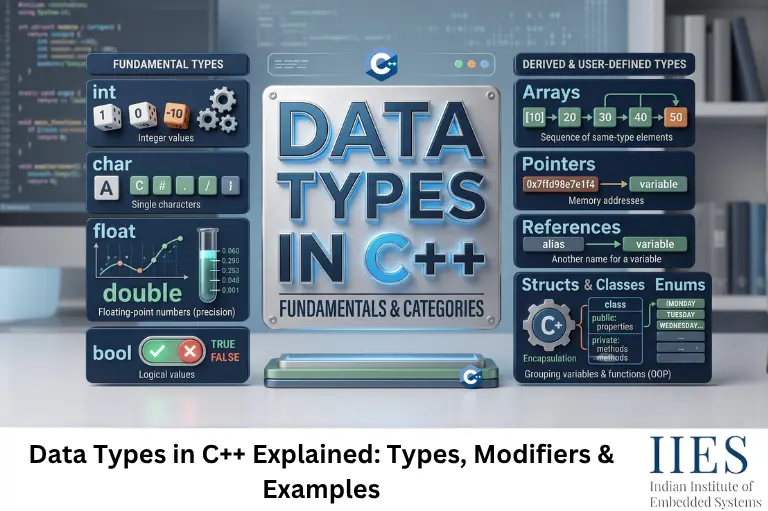
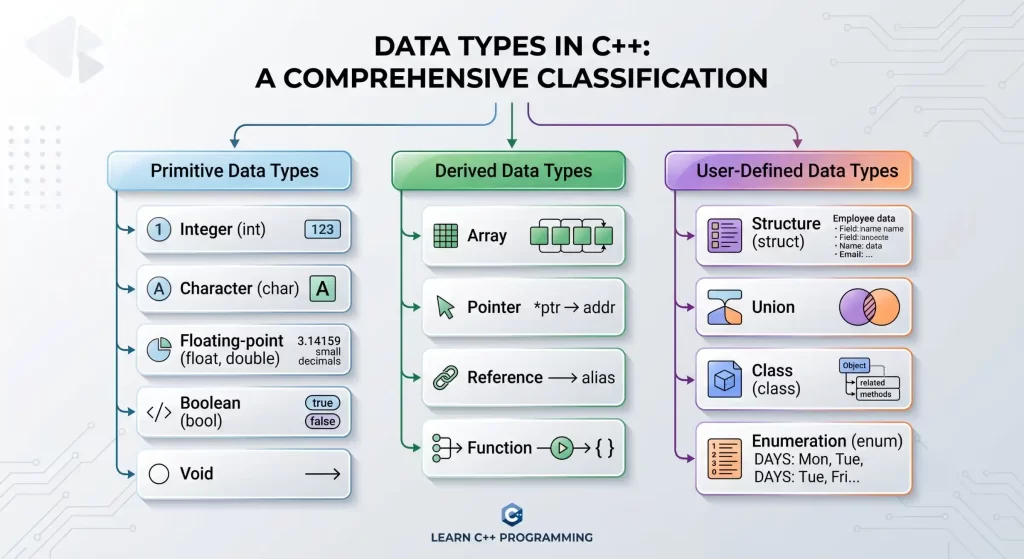
C++ organizes its data types into three main categories:
- Primitive (Built-in) Data Types — the fundamental types baked directly into the language:
int, char, float, double, bool, void, wchar_t - Derived Data Types, types built from primitive types: arrays, pointers, references, and functions
- User-Defined Data Types, custom types you create yourself:
struct, union, class, and enum
Let’s go through each category, starting with the building blocks.
Primitive Data Types in C++
Primitive data types, also called fundamental or built-in types, are the ones the compiler understands natively, with no extra code required.
| Data Type | Keyword | Typical Size | Typical Range | Example |
|---|
| Integer | int | 4 bytes | -2,147,483,648 to 2,147,483,647 | int age = 21; |
| Character | char | 1 byte | -128 to 127 | char grade = 'A'; |
| Floating-point | float | 4 bytes | ~1.2E-38 to 3.4E+38 | float pi = 3.14f; |
| Double | double | 8 bytes | ~2.3E-308 to 1.7E+308 | double gpa = 8.91; |
| Boolean | bool | 1 byte | true or false | bool isOn = true; |
| Void | void | no value stored | N/A | void showMenu(); |
| Wide Character | wchar_t | 2 or 4 bytes | Platform-dependent | wchar_t symbol = L'∑'; |
Sizes above are typical on modern 32-bit/64-bit systems. C++ guarantees only a minimum size for most of these, not an exact one, always confirm with sizeof() on your target compiler and hardware.
See It for Yourself
Don’t take these numbers on faith, check them directly:
cpp
#include
using namespace std;

int main() {
    cout << "int: "    << sizeof(int)    << " bytes" << endl;
    cout << "char: "   << sizeof(char)   << " byte"  << endl;
    cout << "float: "  << sizeof(float)  << " bytes" << endl;
    cout << "double: " << sizeof(double) << " bytes" << endl;
    cout << "bool: "   << sizeof(bool)   << " byte"  << endl;
    return 0;
}
Here’s a fact that catches a lot of learners off guard: on an 8-bit AVR microcontroller, like the one powering an Arduino Uno, int is only 2 bytes, not 4. Run the same code on your laptop and on that board, and you’ll get different answers. This is exactly why embedded engineers lean on fixed-width types instead of assuming.
Two modern additions worth knowing:
char16_t and char32_t (added in C++11), for UTF-16 and UTF-32 characterschar8_t (added in C++20), for UTF-8 encoded characters
Derived Data Types in C++
Derived data types are built using primitive types as their foundation. They don’t introduce a new “kind” of data, they change how that data is organized or accessed.
Arrays – a fixed-size collection of elements of the same type, stored in contiguous memory.
cpp
int marks[5] = {90, 85, 88, 76, 95};
Pointers – a variable that stores the memory address of another variable, instead of a value itself.
cpp
int score = 95;
int* scorePtr = &score;   // scorePtr holds the address of 'score'
References – an alias for an existing variable. Unlike a pointer, a reference can’t be null and can’t later be reassigned to refer to something else. This one is unique to C++, C doesn’t have it.
cpp
int total = 100;
int& totalRef = total;    // totalRef IS total, just under another name
Functions – a function has a type too, determined by its return type and parameter list. This becomes visible the moment you work with function pointers or callbacks.
cpp
int add(int a, int b) { return a + b; }
int (*funcPtr)(int, int) = add;   // funcPtr's type matches add's signature
Derived types are where C++ starts feeling powerful — arrays and pointers alone unlock dynamic memory management and low-level hardware access that primitive types can’t offer on their own.
User-Defined Data Types in C++ (A Quick Look)
Beyond primitive and derived types, C++ lets you define entirely new types tailored to your problem:
struct – groups related variables of different types under one name (e.g., a SensorReading with a timestamp, temperature, and humidity)union – similar to a struct, but all members share the same memory location, which is handy in memory-constrained embedded workclass – like a struct, but with access control and support for methods, constructors, and OOP principlesenum / enum class – assigns readable names to a set of integer constants, e.g., enum State { IDLE, RUNNING, ERROR };
User-defined types are broad enough to deserve their own deep-dives. For now, just know they sit at the top of the hierarchy, built entirely from the primitive and derived types below them.
C++ Type Modifiers
Type modifiers adjust a primitive type’s size or range without inventing a new type from scratch. C++ has four of them:
| Modifier | What It Does |
|---|
signed | Allows both positive and negative values (the default for most integer types) |
unsigned | Allows only zero and positive values, doubling the positive range in exchange for losing negatives |
short | Reduces the memory allocated, shrinking the range |
long | Increases the memory allocated, expanding the range |
Modifiers apply to int, char, and double, with some restrictions, you can’t have an unsigned float, for instance.
cpp
short int smallValue = 100;
unsigned int positiveOnly = 4000000000;
long int largeValue = 9999999999L;
unsigned long long int hugeValue = 18000000000000000000ULL;
Why this matters practically: if a variable will only ever hold values from 0–255, like a sensor’s raw 8-bit reading, unsigned char is a far better fit than int. It uses a quarter of the memory and documents your intent at the same time.
C++ Modified Data Types List
Here’s the full reference table combining base types with modifiers, the one worth bookmarking:
| Modified Data Type | Typical Size | Typical Range |
|---|
short int | 2 bytes | -32,768 to 32,767 |
unsigned short int | 2 bytes | 0 to 65,535 |
int | 4 bytes | -2,147,483,648 to 2,147,483,647 |
unsigned int | 4 bytes | 0 to 4,294,967,295 |
long int | 4 or 8 bytes* | Platform-dependent |
unsigned long int | 4 or 8 bytes* | Platform-dependent |
long long int | 8 bytes | -9.2 × 10¹⁸ to 9.2 × 10¹⁸ |
unsigned long long int | 8 bytes | 0 to 1.8 × 10¹⁹ |
signed char | 1 byte | -128 to 127 |
unsigned char | 1 byte | 0 to 255 |
long double | 8, 12, or 16 bytes* | Platform-dependent |
*long and long double sizes vary noticeably by platform. On 64-bit Linux/macOS, long is typically 8 bytes; on 64-bit Windows, it’s typically still 4 bytes. This mismatch is a classic source of “works on my machine” bugs when code moves between operating systems.
When exact size matters, and in embedded work it usually does, skip the guesswork and reach for the fixed-width types in
cpp
#include

uint8_t  statusFlag  = 1;           // exactly 1 byte, always
int16_t  temperature = -15;         // exactly 2 bytes, always
uint32_t timestamp   = 1699999999;  // exactly 4 bytes, always
These guarantee identical width on every compiler and architecture, no surprises when moving from a desktop test build to a target microcontroller.

Type Conversion in C++ (Why It Ties In Here)
Since C++ lets you mix data types in one expression, it needs rules for converting between them:
- Implicit conversion happens automatically, an
int gets silently promoted to a double in a mixed calculation, for instance. - Explicit conversion (casting) is done deliberately, using
static_cast(value) – the modern, preferred approach, or the older C-style (type)value.
cpp
double price = 499.99;
int roundedDown = static_cast(price);   // becomes 499 — the decimal is dropped, not rounded
Watch for narrowing conversions — moving from a bigger or more precise type into a smaller one. These compile without complaint but can silently lose data: a double truncated to int drops its decimal, and a long squeezed into a short can wrap around into a completely different number.
Advantages of Data Types in C++
- Memory efficiency – allocate exactly the memory a value needs, nothing more, which matters most on RAM-limited devices
- Type safety – the compiler catches mismatches before your program ever runs, not after it crashes in the field
- Improved readability –
bool isConnected communicates intent far better than a vague int - Performance optimization – correctly sized types make better use of CPU registers and cache lines
- Portability, with the right types – fixed-width types like
uint16_t behave identically across compilers and architectures - A foundation for OOP – user-defined types (
class, struct) let you model real-world entities, the basis of object-oriented design in C++
Disadvantages of Data Types in C++
- Platform dependency – the standard fixes only a minimum size for types like
int and long, so identical code can behave differently across systems - Silent narrowing conversions – C++ often allows assigning a
double to an int, or a long to a short, without a compiler error, quietly dropping data - Overflow and underflow risk – exceed an unsigned type’s range and it wraps around silently; exceed a signed type’s range and you hit undefined behavior. Neither raises an error by default
- A learning curve for beginners – seven primitive types, four modifiers, and several derived and user-defined types make “which type should I use here” a genuinely common early stumbling block
- Extra headers for guarantees – the base language doesn’t promise exact widths;
Quick Reference Cheat Sheet
| Type | Size | Signed Range | Unsigned Range |
|---|
char | 1 byte | -128 to 127 | 0 to 255 |
short | 2 bytes | -32,768 to 32,767 | 0 to 65,535 |
int | 4 bytes | -2.1B to 2.1B | 0 to 4.2B |
long | 4/8 bytes | Platform-dependent | Platform-dependent |
long long | 8 bytes | ±9.2 × 10¹⁸ | 0 to 1.8 × 10¹⁹ |
float | 4 bytes | ~7 digits precision | — |
double | 8 bytes | ~15 digits precision | — |
Best Practices for Choosing the Right Data Type
- Match the type to the range you actually need – don’t default to
int out of habit when uint8_t or short would do - Use
uint8_t, int16_t, uint32_t, and friends - Prefer
bool over int for flags – it documents intent and typically costs less memory - Use
const for values that shouldn’t change, and volatile for memory-mapped hardware registers that can change outside your program’s control - Never assume a size – verify it with
sizeof() on your actual target compiler and hardware - Use
size_t for array indices and sizes, not int, it’s unsigned and matches your platform’s addressable memory range
Key Points to Remember
- Data types in C++ language define the kind of values an entity can represent.
- C++ has fundamental, derived, enumeration, and class-related types.
- Common fundamental types include int, char, bool, float, double, and void.
- Arrays, pointers, references, and functions are commonly discussed as derived types.
- enum and enum class provide named enumerated values.
- Classes and structures allow programmers to create custom types.
- signed, unsigned, short, long, and long long modify or specify integer types.
- Type size can vary by implementation, so portable code should avoid unsupported assumptions.
- Fixed-width integer types are useful when an exact integer width is required.
- Selecting the right type improves readability, reliability, memory usage, and portability.
- In embedded systems, data type selection can be especially important because memory and hardware constraints matter.
Final Takeaway
A strong understanding of data types in C++ language provides the foundation for writing better C++ programs. The choice of data type affects how information is represented, how operations behave, how much storage is needed, and how portable the program is.
For beginners, start with the fundamental types such as int, float, double, char, and bool. Once these are clear, move to arrays, pointers, references, enumerations, structures, and classes.
For embedded systems and IoT development, go one step further by understanding value ranges, exact-width integer types, memory usage, signedness, precision, and platform-specific behavior. These concepts become increasingly important when C++ interacts directly with hardware.