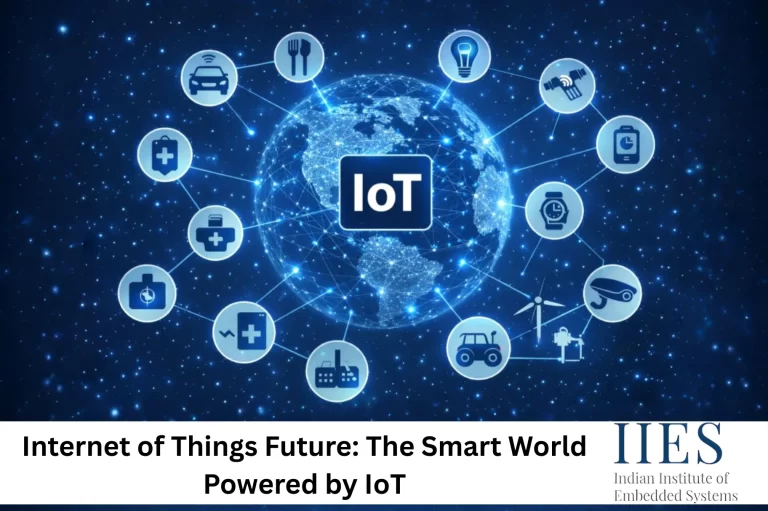
Understanding the Internet of Things and Its Applications
At its core, the Internet of Things is a network of physical devices embedded with sensors, software, and internet connectivity that allows them to gather information, communicate with each other, and respond intelligently. These devices observe their surroundings, send data for processing, and automatically perform actions based on insights.
Behind every smart device, there is a simple but powerful workflow that makes automation possible:
Sensors → Data Collection → Processing (Cloud or Edge) → Action or Automation
This continuous feedback loop enables devices to analyze information in real time, learn from patterns, and improve performance over time. For example, a smart thermostat senses room temperature, processes the data through cloud or edge computing, and then adjusts cooling automatically. Similarly, industrial sensors can detect abnormal machine behavior and trigger maintenance alerts before failures occur.
Because of this intelligent cycle, IoT systems move beyond basic connectivity and become predictive, adaptive, and efficient, powering everything from smart homes to advanced industrial systems.

IoT by the Numbers: Real Stats & Market Growth
To grasp the scale and impact of IoT, industry research provides powerful insights:
- In 2024, there were roughly 18.5 billion connected IoT devices worldwide, and this number is expected to grow to about 21 billion in 2025, with projections targeting nearly 39 billion by 2030. (Source: IoT Analytics)
- The global IoT market is projected to reach approximately USD 2.65 trillion by 2030, reflecting widespread deployment across industries. (Source: Grand View Research)
- The IoT devices market – covering sensors, connectivity modules, and processing hardware – was valued at around USD 70.3 billion in 2024, and could grow to over USD 180 billion by 2030. (Source: Grand View Research)
- In healthcare, the IoT in healthcare market was worth about USD 369.6 billion in 2024, with expectations to exceed USD 1.17 trillion by 2033 due to remote monitoring and digital health growth. (Source: IMARC Group)
- The IoT security market, an essential segment focused on protecting devices and networks, was estimated at about USD 35.5 billion in 2024, with forecasts nearing USD 142 billion by 2030. (Source: Grand View Research)
It is a rapidly expanding technology ecosystem with deep implications across business, government, and consumer sectors.
Example:
Sector | IoT Impact |
Smart Homes | Automation, energy savings |
Healthcare | Remote monitoring, wearables |
Industry | Predictive maintenance |
Cities | Traffic + energy optimization |
Smart Home Automation Using IoT
One of the most tangible experiences of IoT for everyday users is inside their homes. Through smart home automation using IoT, devices like lights, thermostats, security systems, and voice assistants work together to make daily life more convenient and efficient.
Instead of manually operating appliances, homeowners can now automate routines, such as:
- Lights that adjust based on occupancy
- Thermostats that learn temperature preferences
- Door locks that secure automatically at night
- Voice-controlled speakers that manage multiple devices
These conveniences also translate into measurable benefits: reduced energy consumption, improved safety, and a more personalized user experience. As adoption continues to grow, smart homes are becoming standard in both urban and suburban settings.
IoT in Healthcare: Enhancing Care and Outcomes
The role of IoT in healthcare has expanded quickly, especially with increased emphasis on remote and preventive care. IoT in healthcare devices provide continuous monitoring of vital signs and patient conditions, enabling physicians to make informed decisions faster.
Wearable medical devices and connected monitoring systems allow:
- Real-time tracking of heart rate, glucose levels, oxygen saturation
- Early diagnosis through continuous data feeds
- Remote patient monitoring that reduces hospital visits
- Personalized health alerts and treatment reminders
The benefits of IoT in healthcare are substantial. Patients receive more responsive care, while healthcare providers improve efficiency and outcomes. For elderly or chronically ill patients, these technologies are not conveniences – they are lifelines that help prevent emergencies and hospital readmissions.

Industrial Transformation with IoT
While consumer IoT often gets the spotlight, Industrial IoT (IIoT) drives enormous economic value behind the scenes. Many businesses use connected systems to automate processes, optimize production, and reduce operating costs.
In manufacturing and supply chains, IoT enables:
- Real-time monitoring of machinery
- Predictive maintenance to avoid equipment failures
- Automated logistics tracking
- Smart inventory management
These applications enhance productivity and prevent downtime, making organizations more resilient and competitive. As industries adopt IoT at scale, the ability to analyze data in real time becomes a strategic advantage rather than a luxury.
Smart Cities IoT: Creating Sustainable Urban Systems
As urban populations increase, cities face challenges related to traffic congestion, energy demand, public safety, and environmental sustainability. Smart cities IoT solutions use connected systems to address these challenges intelligently.
Examples include:
- Traffic signals that adapt to congestion patterns
- Smart streetlights that dim when not needed
- Sensors that track air quality and pollution
- Smart waste bins that notify collection services
These innovations improve quality of life, reduce operational costs, and make cities more environmentally friendly. IoT is helping city planners move from reactive problem-solving to proactive urban management.
Impact of 5G on IoT
The rollout of 5G networks is a major catalyst for IoT growth. With higher speeds, ultra-low latency, and support for massive device connectivity, 5G enables new classes of IoT applications that were previously impractical.
For example:
- Autonomous vehicles that require real-time data sharing
- Smart factories with hundreds of connected machines
- Remote medical procedures that demand immediate responsiveness
Without 5G, many of these solutions would struggle to deliver reliable performance. The integration of 5G accelerates the future of connected devices, unlocking new dimensions of automation and intelligence.
IoT Advantages and Challenges
The benefits of IoT are clear – increased automation, real-time decision support, cost savings, and personalized experiences across domains. However, adoption also brings certain risks and responsibilities.
One of the most pressing concerns involves IoT security and privacy issues. As more devices collect sensitive data, protecting personal and corporate information becomes critical. Cybersecurity must be built into system design from the beginning, including:
- Strong authentication methods
- Data encryption
- Regular firmware and software updates
By proactively addressing these challenges, organizations can secure IoT systems while unlocking their full potential.
AI, Neural Networks, and the Next IoT Phase
Looking ahead, IoT will increasingly rely on artificial intelligence, neural networks, and advanced analytics to interpret vast amounts of data. These systems enable devices to not just collect information but to understand, predict, and adapt.
For instance:
- AI models analyze traffic patterns to optimize city routes
- Neural networks detect health anomalies before symptoms surface
- Machine learning refines industrial processes for greater efficiency
IoT data also fuels advanced search technology through entity-based search and knowledge graphs, helping platforms better understand the relationships between devices, locations, and user behaviors. In this way, IoT contributes not just to automation but to contextual intelligence that powers the digital world.
Conclusion
The Internet of Things future is transforming life across personal, professional, and societal domains. From smarter homes and connected healthcare to efficient industries and sustainable cities, IoT drives real, measurable benefits that extend far beyond convenience. Although challenges like security and privacy must be carefully managed, the overall impact of IoT – fueled by AI, 5G, and edge computing – points to a future where technology anticipates our needs, systems optimize themselves, and data becomes a fundamental asset for progress. At IIES Bangalore, we actively train students and professionals in these emerging technologies, preparing them to build and innovate within this connected world. The IoT revolution is not coming – it is already here.