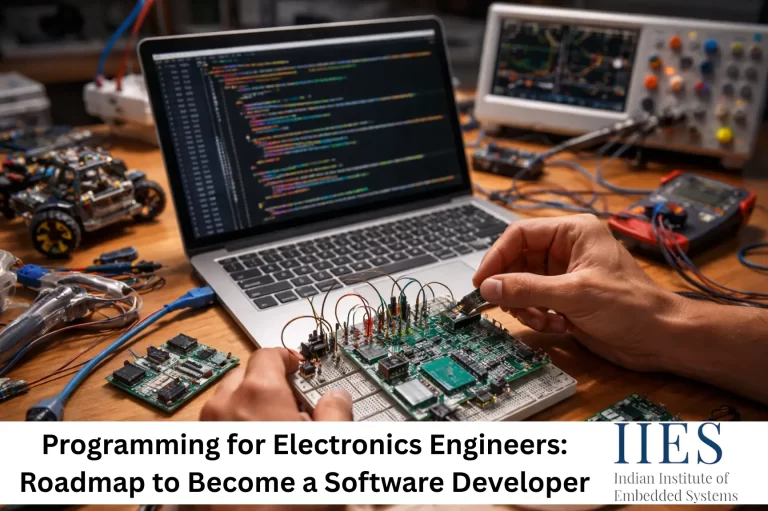
Can Electronics Engineers Become Software Developers?
Electronics engineers already think like programmers.
When you debug a faulty PCB, analyze signals on an oscilloscope, or troubleshoot a microcontroller issue, you follow a logical sequence: observe, test, isolate, and fix. This is the same thinking process used when debugging software.
The difference is only in tools.
Instead of wires and components, you work with code, functions, and algorithms.
This is why many companies actively hire electronics graduates for development roles. They bring something unique – a deep understanding of how hardware, memory, timing, and processors behave. That system-level knowledge helps them write more efficient and reliable software.
So yes, an electronics engineer becoming a software engineer is not only possible – it’s increasingly common.

Why Programming for Electronics Engineers Matters Today
Modern devices are essentially computers in disguise. A washing machine runs firmware. A car contains millions of lines of embedded code. Even medical devices depend on real-time software for safety.
Without programming, electronics knowledge remains incomplete.
Learning software allows engineers to control hardware directly, automate processes, and design complete end-to-end solutions rather than just isolated circuits. Instead of relying on separate teams, you become capable of building intelligent systems independently.
This is exactly why industries now prefer engineers who understand both hardware and software integration.
Embedded Systems Programming: The Natural Starting Point
For most professionals, embedded systems programming is the smoothest entry into software development.
Here, code interacts directly with hardware – registers, timers, GPIO pins, interrupts, and memory. These are concepts electronics engineers already understand from microcontrollers and digital systems.
Consider a simple STM32 example:
#include "stm32f4xx.h"


int main(void)

{
    RCC->AHB1ENR |= (1 << 0);

    GPIOA->MODER |= (1 << 10);

    while(1)

    {
        GPIOA->ODR ^= (1 << 5);

        for(int i=0;i<500000;i++);

    }

}
This small program toggles an LED. It is software, but deeply connected to hardware behavior. For electronics engineers, this feels natural and intuitive.
That’s why firmware development, RTOS programming, and IoT device coding are often the first steps into software careers.
Best Programming Languages for Electronics Engineers
Choosing the right tools makes the journey easier. You don’t need to learn every language – just a few powerful ones.
| Language | Where It Helps Most |
| C / C++ | Embedded systems, firmware |
| Python | Automation, AI, scripting |
| JavaScript | Web dashboards, IoT apps |
| MATLAB | Signal processing, simulations |
| Java | Android & enterprise systems |
Mastering C/C++ and Python alone opens most career paths.

Software Engineering for Electronics Students: Skills You Must Learn
While electronics provides a strong foundation, professional software engineering introduces new practices. Writing production-level code requires structure, maintainability, and teamwork.
Students transitioning into software engineering for electronics backgrounds should gradually learn:
- Data structures and algorithms
- Git and version control
- Object-oriented programming
- Testing and debugging practices
- Clean architecture design
These skills ensure your code scales properly and works well in team environments.
The good news is that once you understand these concepts, you can apply them anywhere – embedded systems, cloud applications, or AI tools.
A Practical Roadmap for Electronics Engineer to Software Developer
A clear roadmap prevents confusion. Start with strong programming fundamentals in C or C++. Then learn Python for automation and scripting. Build small projects like sensor data loggers or IoT dashboards. Publish your work on GitHub to demonstrate real skills.
Next, strengthen computer science basics such as algorithms and system design. Finally, choose a specialization like embedded systems, web development, or artificial intelligence.
This structured approach makes the transition smoother and faster.
Real Industry Demand and Opportunities
The demand for hybrid engineers is rising rapidly.
Billions of IoT devices are deployed worldwide. Cars contain dozens of embedded controllers. Robotics and automation are expanding across industries. All of these require engineers who understand both circuits and code.
Companies in automotive, healthcare, consumer electronics, semiconductor, and startup ecosystems actively seek professionals with embedded systems programming and software expertise.
Because this combination is rare, salaries and career growth tend to be higher compared to traditional single-domain roles.
From Electronics Engineer Becoming Software Engineer: The Big Picture
When electronics engineers learn programming, they don’t abandon their field. They multiply their opportunities. They can design smarter devices, develop better firmware, optimize performance, and even move into high-growth areas like AI systems, robotics, and cloud-connected platforms. Instead of being limited to hardware design, they become complete system engineers. This versatility is what the industry values most.
Final Thoughts
So, can electronics engineers become software developers? Absolutely.
Programming for electronics engineers is one of the smartest career investments today. Your hardware knowledge already gives you an edge. By learning coding, software architecture, and modern development practices, you unlock opportunities across embedded systems, IoT, automation, and full-scale software engineering.
With consistent practice and real projects, the transition becomes natural.
If you want structured guidance, hands-on training, and industry-focused learning in embedded systems and software technologies, you can explore programs at IIES Bangalore to accelerate your growth.
The future belongs to engineers who understand both hardware and software. And electronics engineers are perfectly positioned to lead that future.