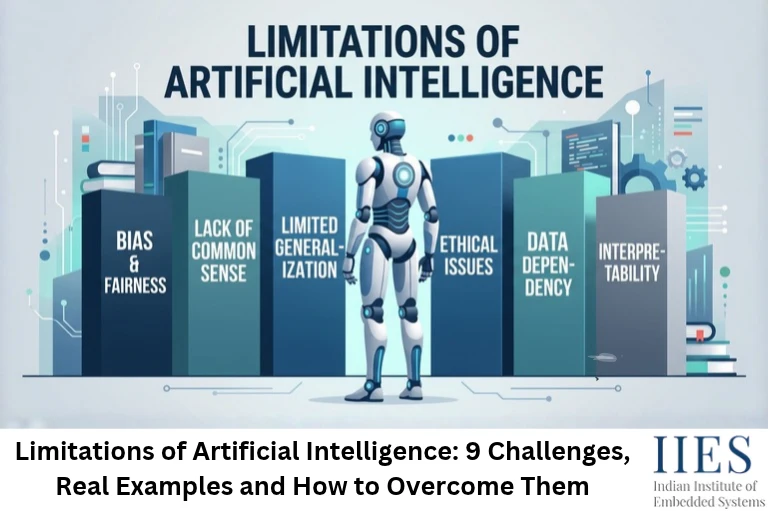
The main limitations of artificial intelligence are dependence on large, good-quality data; bias inherited from that data; no genuine understanding or common sense; poor performance in situations it was not trained for; hallucinations in generative models; black-box decision making; high compute and energy cost; security weaknesses; and open ethical and accountability questions. Most can be reduced with better data, human oversight, explainability tools, grounding, efficient models and regulation, but none is fully solved today.AI can flag suspicious patterns in medical scans, translate between dozens of languages and write working code. The same technology can also invent a court case that never existed, turn down a good job applicant for reasons nobody can explain, or misread a stop sign that has a few stickers on it.
That is why understanding the limitations of artificial intelligence matters. It is not about doubting the technology. It is about knowing where to trust it, where to double-check it, and where a human must stay in charge.
In this guide you will get:
AI vs human intelligence at a glance
| Capability | AI today | Humans |
| Spotting patterns in huge datasets | Excellent | Limited by speed and fatigue |
| Consistency on repetitive work | Excellent | Varies |
| Common sense and context | Weak | Strong |
| Adapting to brand-new situations | Weak | Strong |
| Explaining a decision | Often weak | Usually possible |
| Judgment, values and accountability | None of its own | Strong |
typedef enum { ACT_NORMAL, ACT_WARN, ACT_SAFE_STOP } action_t;
#define VIB_HARD_LIMIT_G 8.0f /* physical limit, never negotiable */
#define CONF_MIN 0.80f /* below this, ignore the model */
#define ANOMALY_THRESHOLD 0.90f
action_t decide_action(float vibration_g, float anomaly_prob, float confidence)
{
/* 1. Deterministic rule always wins */
if (vibration_g > VIB_HARD_LIMIT_G) {
return ACT_SAFE_STOP;
}
/* 2. Model unsure (maybe unseen conditions): fall back, do not guess */
if (confidence < CONF_MIN) {
return ACT_WARN;
}
/* 3. Trust the model only inside the safety envelope */
if (anomaly_prob > ANOMALY_THRESHOLD) {
return ACT_WARN;
}
return ACT_NORMAL;
}
How this code protects you
| Limitation | Practical fix | What to explore |
| Data dependency and bias | Diverse, well-documented datasets; bias audits; testing across groups | Data augmentation, synthetic data, fairness metrics, datasheets and model cards |
| No real understanding | Ground models in trusted knowledge; combine learning with rules | Retrieval-augmented generation (RAG), knowledge graphs, neuro-symbolic AI |
| Poor generalization | Train on varied conditions; monitor for drift after deployment | Transfer learning, domain adaptation, continual learning |
| Hallucinations | Answer from retrieved sources with citations; allow “I don’t know”; human review for high stakes | RAG, tool use, verification steps, uncertainty-aware evaluation |
| Black box | Use explanation tools; prefer interpretable models in high-stakes areas | SHAP, LIME, saliency maps |
| Limited creativity | Keep humans in charge of direction and judgment | Human-AI co-creation workflows |
| Compute and energy | Make models smaller and smarter | Quantization, pruning, distillation, small models, edge NPUs |
| Security and privacy | Red-team, validate inputs, limit what AI can access | Adversarial training, federated learning, differential privacy, prompt-injection defenses |
| Ethics and accountability | Human oversight, audit trails, governance frameworks | NIST AI RMF, ISO/IEC 42001, regulation |
The main limitations are dependence on large, good-quality data, bias inherited from that data, no real understanding or common sense, poor performance in unfamiliar situations, hallucinations, black-box decision making, high compute and energy cost, security weaknesses, and open ethical and accountability questions.
It depends on the use case, but the root limitation is that AI learns statistical patterns rather than understanding the world. In practice that shows up as unreliability outside familiar data: bias, hallucinations and brittle behaviour.
Partly. Efficiency, bias testing, grounding and security are engineering problems that keep improving. True common sense, causal reasoning and value alignment remain open research problems, so progress is likely to be gradual.
The main ones are tiny memory, hard real-time deadlines, tight power budgets, noisy sensors, difficulty verifying neural networks for safety-critical use, and the need for safe over-the-air updates. Quantization, pruning and guardrail logic help.
It can be. AI learns from historical data, so if the data under-represents groups or reflects past unfairness, the model can repeat it. Diverse data, bias audits and testing across groups help reduce it.
Indian Institute of Embedded Systems – IIES