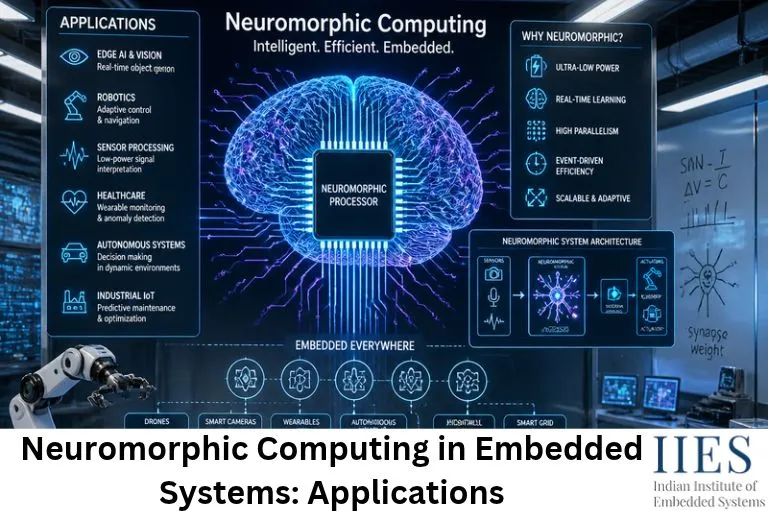
What Is Neuromorphic Computing?
Neuromorphic computing is a computing paradigm that attempts to reproduce certain principles of biological neural networks using electronic circuits and specialized hardware.
The human brain contains billions of neurons connected through synapses. These neurons communicate using electrical signals called spikes. Neuromorphic computing takes inspiration from this mechanism to design hardware and algorithms capable of processing information efficiently. Unlike traditional computing architectures, which generally separate memory and processing units, neuromorphic systems can combine computation and memory-like functions within interconnected processing elements. This approach can reduce unnecessary data movement and support event-driven computation.
For example, consider a smart security camera. A traditional camera system may continuously process incoming video frames to identify movement. A neuromorphic vision system can instead process changes in visual information, allowing it to focus on meaningful events rather than repeatedly analyzing unchanged scenes.
This makes neuromorphic computing particularly interesting for applications where low latency, low power consumption, and real-time decision-making are important.
How Does Neuromorphic Computing Work?
Neuromorphic computing works by using artificial neurons and synapses to imitate selected information-processing mechanisms found in biological brains.
Its operation generally involves the following components:
Artificial Neurons
Artificial neurons receive input signals, process them, and generate output signals when certain conditions are satisfied. In spiking neural networks, a neuron accumulates incoming signals over time. When its internal membrane potential reaches a particular threshold, it generates a spike that is transmitted to other connected neurons.
Artificial Synapses
Synapses represent the connections between neurons. In neuromorphic systems, artificial synapses control how signals are transmitted between processing elements. Their connection strengths, known as weights, influence how information is processed and can be adjusted during learning or training, depending on the architecture and learning method.
Spiking Neural Networks (SNN)
Spiking Neural Networks are one of the important computational models used in neuromorphic computing. Unlike conventional artificial neural networks, which typically communicate using numerical activation values at each processing step, SNNs communicate through discrete spikes. These spikes carry information through their timing and frequency.
For example, a sensor detecting sudden movement can generate an event. An SNN can process this event and activate a response without requiring continuous processing of unchanged input data.
Event-Based Processing
Event-based computing processes information when meaningful changes or events occur. This is particularly useful in applications involving cameras, motion sensors, robotics, and other real-time systems.
For instance, an event-based vision sensor can detect changes in brightness at individual pixels rather than capturing complete image frames at fixed intervals. The processing hardware can then respond to these changes as they occur.
Neuromorphic Hardware
Neuromorphic hardware consists of specialized chips and electronic circuits designed to implement brain-inspired computing models. Examples include Intel Loihi 2, IBM’s TrueNorth research chip, and SpiNNaker systems. These platforms demonstrate different approaches to implementing neural networks and event-driven computation in hardware.

Neuromorphic Computing vs Traditional Computing
Understanding the difference between traditional and neuromorphic computing helps engineering students see why this technology is important for future embedded systems applications.
| Parameter | Traditional Computing | Neuromorphic Computing |
| Computing approach | Conventional instruction-based processing | Brain-inspired processing |
| Architecture | CPU, memory, and processing units | Artificial neurons and synapses |
| Information processing | Usually clock-driven | Often event-driven |
| Data communication | Conventional digital data | Can use spike-based communication |
| Power consumption | Depends on workload and architecture | Can be highly energy-efficient for suitable workloads |
| Processing | General-purpose and specialized processing | Specialized neural and event-based processing |
| Applications | Computers, controllers, and conventional embedded devices | Robotics, event-based vision, and intelligent sensing |
Neuromorphic computing does not replace traditional computing in every application. Conventional microcontrollers, CPUs, and GPUs remain more suitable for many control, communication, and general-purpose tasks.
Neuromorphic hardware is particularly promising when applications involve sparse events, neural computation, and energy-efficient intelligent processing.
Applications of Neuromorphic Computing in Embedded Systems
Neuromorphic computing has potential applications across several embedded technology domains. Its ability to process events and recognize patterns makes it useful for intelligent devices that must operate with limited power and computing resources.
Robotics and Autonomous Systems
Robots continuously receive information from cameras, proximity sensors, accelerometers, and other sensing devices. Neuromorphic systems can help robots identify movement, recognize patterns, and respond to environmental changes using event-driven processing. For example, an autonomous mobile robot can use event-based vision to detect moving objects.
Smart IoT Devices
IoT devices often operate with limited battery capacity and processing resources. Neuromorphic computing can support intelligent sensing and local decision-making without sending every piece of sensor data to cloud servers.
Potential applications include:
- Smart environmental monitoring systems
- Intelligent motion detection
- Battery-powered sensor networks
- Predictive maintenance devices
- Smart building automation
Industrial Automation
Industrial equipment generates continuous sensor information related to vibration, temperature, pressure, speed, and machine performance. Neuromorphic computing could help process changing sensor patterns to identify unusual operating conditions.
For example, an intelligent vibration-monitoring system could analyze event patterns associated with abnormal machine behavior and alert maintenance teams, supporting predictive maintenance and reducing unnecessary downtime.
Autonomous Vehicles
Autonomous vehicles need to process information from cameras, radar, LiDAR, and other sensors. Neuromorphic vision systems can detect changes in a scene with very low latency. For example, an event-based camera can detect the sudden movement of a pedestrian or another vehicle.
Such information can complement conventional perception systems in automotive applications requiring fast visual responses. However, neuromorphic computing is not a replacement for the complete perception and safety architecture of autonomous vehicles.
Wearable Electronics
Wearable devices need to perform continuous monitoring while maintaining battery efficiency. Neuromorphic computing could support activity recognition, gesture detection, and event-based physiological signal analysis. By processing relevant changes locally, these systems may reduce unnecessary computation and communication.
What Are Neuromorphic Chips?
Neuromorphic chips are specialized processors designed to implement brain-inspired computing architectures. Unlike conventional processors that execute instructions using traditional structures, they are designed to support artificial neurons, synaptic connections, and event-driven communication.
| Platform | Description |
| Intel Loihi 2 | Research neuromorphic processor from Intel that supports programmable neuron models, spiking neural networks, and asynchronous event-based computation; designed to explore robotics, adaptive systems, and intelligent sensing |
| IBM TrueNorth | Earlier research chip built for large-scale, energy-efficient neural network processing, with a network of digital neurons and synapses |
| SpiNNaker | Platform developed at the University of Manchester that uses a large number of processor cores to simulate spiking neural networks and study brain-inspired computation |
These platforms demonstrate how hardware architecture can influence the performance and efficiency of neural processing systems.

Role of Neuromorphic Computing in Edge AI
Edge AI refers to running artificial intelligence models directly on devices located near the source of data instead of depending entirely on cloud-based processing. Examples include smart cameras, industrial controllers, autonomous robots, and intelligent sensors.
Consider an industrial monitoring device installed on a motor. The device continuously receives vibration signals. Instead of transmitting all sensor information to a remote server, an intelligent edge device can analyze relevant patterns locally and identify unusual behavior. A neuromorphic processor could potentially perform this type of event-driven neural processing with low energy requirements for suitable workloads.
The major advantages include:
- Reduced dependence on cloud processing
- Faster responses to selected events
- Local intelligent decision-making
- Potentially lower energy consumption
- Reduced unnecessary data transmission
However, conventional microcontrollers, NPUs, and other edge processors remain important for applications that do not benefit from neuromorphic architectures.
Benefits of Neuromorphic Computing in Embedded Systems
Neuromorphic computing offers several potential advantages for future embedded applications.
Low-Power AI Processing
Many embedded devices operate using batteries or limited power supplies. Neuromorphic architectures can process sparse events without continuously activating every computational element, which can improve energy efficiency in suitable applications.
Real-Time Event Processing
Event-driven architectures can respond to incoming information as events occur. This is useful for robotics, motion detection, and applications that require rapid responses to changing conditions.
Efficient Sensor Data Processing
Neuromorphic systems can process meaningful changes rather than repeatedly processing unchanged information, particularly when paired with event-based sensors.
Intelligent Edge Devices
Neuromorphic computing can help move selected AI processing tasks closer to the sensors, supporting local intelligence and reducing communication requirements.
Potential for Adaptive Systems
Some neuromorphic architectures support learning and adaptation mechanisms, creating opportunities for intelligent systems that adjust their responses based on changing input patterns.
Challenges of Implementing Neuromorphic Computing
Although neuromorphic computing has significant potential, its adoption in embedded systems still faces several technical challenges.
| Challenge | Description |
| Hardware Availability | Neuromorphic processors are not as widely available as conventional microcontrollers, and development platforms can be limited |
| Programming Complexity | Developers need to understand spiking neural networks, neuron models, synaptic behavior, and event-based processing |
| Software Ecosystem | Compilers, libraries, and debugging tools are less mature than in traditional embedded development |
| Integration with Existing Systems | Connecting to existing microcontrollers, sensors, and software can add design complexity |
| Application-Specific Performance | It does not automatically outperform other approaches, so latency, accuracy, power, and cost must be evaluated |
Skills Engineering Students Should Learn for Neuromorphic Computing
For ECE, EEE, CSE, and embedded systems students, neuromorphic computing offers an opportunity to explore the combination of electronics, programming, artificial intelligence, and hardware architecture.
Students interested in this field should develop the following skills:
- C and Embedded C programming for microcontrollers, peripherals, and sensor data
- Digital electronics and computer architecture
- Python programming for neural networks and sensor data analysis
- Artificial neural networks: neurons, activation functions, weights, and model training
- Spiking neural networks: spikes, membrane potentials, and SNN architectures
- Embedded AI and edge computing on resource-constrained devices
- Sensor interfacing and hardware integration
A strong foundation in embedded C, microcontrollers, electronics, and computer architecture can help students understand how advanced computing technologies are implemented in real-world hardware.
Future of Neuromorphic Computing in Embedded Systems
The future of neuromorphic computing is closely connected to the growing demand for intelligent, energy-efficient, and responsive electronic devices. As robotics, autonomous systems, industrial IoT, and wearable electronics become more advanced, conventional architectures may not be the most efficient choice for every processing requirement.
Some important future development areas include:
- Neuromorphic processors for intelligent robotics
- Event-based vision for autonomous systems
- Brain-inspired AI for low-power embedded devices
- Neuromorphic computing for industrial monitoring
- Energy-efficient neural processing for IoT
- Integration of neuromorphic hardware with Edge AI platforms
However, widespread adoption will depend on improvements in hardware availability, development tools, programming frameworks, and application-specific performance. For future embedded engineers, understanding these developments provides a useful foundation for working with next-generation intelligent electronic systems.
Conclusion
Neuromorphic computing represents an important development in brain-inspired computing and intelligent hardware design.
By using artificial neurons, synapses, spiking neural networks, and event-based processing, it offers new possibilities for building energy-efficient embedded devices.
From robotics and industrial automation to smart IoT devices and autonomous systems, neuromorphic computing could play an important role in the future of embedded intelligence. For engineering students, learning the fundamentals of embedded programming, electronics, AI, and neural networks is a practical starting point.
At the Indian Institute of Embedded Systems (IIES), students can build a strong foundation in embedded C programming, microcontrollers, hardware interfacing, and real-world embedded system development to prepare for evolving technologies in the embedded industry.
Learning these technologies through practical projects and hands-on training can help students build the technical foundation required for careers in embedded systems.