What Is Python Memory Management?
Python Memory Management is the process of allocating, using, and releasing memory while a program executes.
Whenever you create a variable or object in Python, memory is allocated to store its information. For example:
name = "Python"
age = 25
numbers = [10, 20, 30, 40]
In this example, Python creates objects for the string, integer, and list. These objects occupy memory during program execution.
Python handles most memory-related operations automatically, so developers do not need to manually allocate and release memory as they would in languages such as C.
Python uses several mechanisms for managing memory:
- Memory Allocation: Allocates memory for newly created objects.
- Reference Counting: Tracks how many references point to an object.
- Garbage Collection: Identifies and removes unreachable objects.
- Memory Optimization: Reuses memory efficiently to reduce unnecessary resource consumption.
Understanding these mechanisms helps developers write better-performing applications.
How Python Memory Management Works
Python uses a private heap to manage objects and data structures. The Python memory manager controls how memory is allocated and released within this heap.
When a Python program runs, memory management generally follows this process:
Step 1: Memory Allocation
When an object is created, Python allocates memory to store it.
student = {
    "name": "Rahul",
    "course": "Python",
    "marks": 90
}
Python allocates memory for the dictionary and its associated objects.
Step 2: Object Usage
The program accesses and modifies objects whenever required.
print(student["name"])
student["marks"] = 95
Step 3: Reference Tracking
Python tracks references pointing to objects using a mechanism called reference counting.
Step 4: Garbage Collection
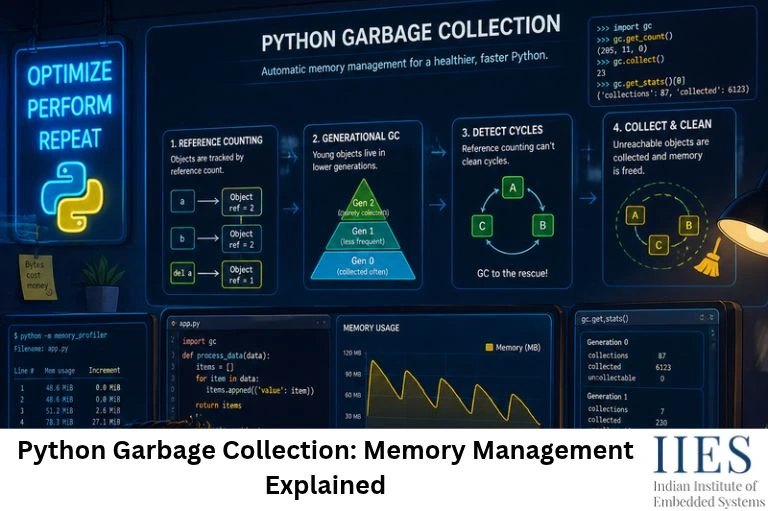
When objects are no longer accessible, Python can reclaim their memory. Reference counting handles many cases, while the garbage collector helps detect circular references.
What Is Python Garbage Collection?
Python Garbage Collection is an automatic memory management mechanism that identifies objects that are no longer accessible and helps reclaim their memory.
For example:
student = ["Rahul", "Arun", "Priya"]

student = None
Initially, the variable student references a list object.
When we assign None to student, the variable no longer references the original list. If no other references point to that list, its reference count becomes zero, allowing Python to reclaim its memory.
Why Is Garbage Collection Important?
- Prevents unnecessary memory consumption.
- Helps manage unused objects.
- Handles circular references.
- Reduces manual memory management.
- Supports long-running Python applications.
The Python garbage collector works alongside reference counting to manage objects that are no longer needed.

Understanding Reference Counting in Python
Reference Counting is one of the primary mechanisms used by Python to manage object memory.
It tracks the number of references pointing to a particular object.
Whenever a reference is created, the reference count generally increases. When a reference is removed, the count decreases.
When the reference count reaches zero, the object can usually be deallocated.
Example:
import sys

data = [10, 20, 30]

print(sys.getrefcount(data))

another_data = data

print(sys.getrefcount(data))

del another_data

print(sys.getrefcount(data))
Output:
2
3
2
The exact count can depend on the Python implementation and the way the expression is evaluated. In CPython, sys.getrefcount() temporarily creates an additional reference when passing an object as an argument.
Let’s understand the example:
- Initially,
data references the list. - Assigning
another_data = data creates another reference. - Deleting
another_data reduces the reference count.
Reference counting allows Python to reclaim many objects immediately when they are no longer referenced.
However, it cannot independently handle every memory management situation.
What Is Cyclic Garbage Collection in Python?
Reference counting works efficiently in most situations, but it has a limitation when objects reference each other.
This situation is called a circular reference.
A circular reference occurs when two or more objects reference one another, even though the program can no longer access them.
Example:
class Student:
    pass

student1 = Student()
student2 = Student()

student1.friend = student2
student2.friend = student1

del student1
del student2
Here:
student1 references student2.student2 references student1.- Both variables are deleted.
- The objects still reference each other.
Their reference counts do not become zero because they maintain references to one another.
Python’s cyclic garbage collector helps identify these unreachable object cycles and reclaim their memory.
This is why Python Garbage Collection is important beyond basic reference counting.
Python Generational Garbage Collection
Python uses generational garbage collection to make cyclic garbage collection more efficient.
The idea is based on the observation that many objects have a short lifetime, while some objects remain in memory for longer periods.
Python groups tracked objects into generations.
The traditional CPython garbage collection model has three generations:
| Generation | Description |
| Generation 0 | Contains newly tracked objects. |
| Generation 1 | Contains objects that survived earlier collection cycles. |
| Generation 2 | Contains long-lived objects that survived multiple collection cycles. |
When garbage collection runs, Python can examine younger generations more frequently than older ones.
This helps reduce the amount of work required to identify unreachable objects.
Technical note: Generational garbage collection details can vary across Python versions. Python 3.14 introduced changes to the CPython garbage collector, including removal of the traditional generation 1 collection structure.
Using the Python gc Module
Python provides a built-in module called gc that allows developers to interact with the cyclic garbage collector.
The gc module is useful for inspecting garbage collection activity, checking whether automatic collection is enabled, and manually triggering collection.
Importing the gc Module
import gc

print(gc.isenabled())
This checks whether automatic garbage collection is enabled.
Manually Triggering Garbage Collection
import gc

collected = gc.collect()

print("Objects collected:", collected)
The gc.collect() function requests a garbage collection cycle and returns the number of unreachable objects found and collected.
Disabling Automatic Garbage Collection
import gc

gc.disable()

print("Garbage collection disabled")
This disables automatic cyclic garbage collection.
Enabling Garbage Collection Again
gc.enable()

print("Garbage collection enabled")
Disabling garbage collection should be done carefully because unreachable objects may accumulate.
Checking Garbage Collection Statistics
import gc

print(gc.get_stats())
This returns collection statistics for the garbage collector’s generations, depending on the Python version.

Common Python Memory Leaks and Their Causes
A memory leak occurs when a program continues holding references to objects that are no longer needed.
Although Python provides automatic memory management, memory leaks can still happen because of incorrect reference handling.
Some common causes include:
| Cause | Explanation |
| Global variables | Unnecessary objects remain referenced throughout the program. |
| Circular references | Objects reference each other and may remain until cyclic collection occurs. |
| Unclosed resources | Files, database connections, and other resources are not properly released. |
| Large caches | Cached objects continue consuming memory. |
| Event listeners | Unused callbacks or references prevent objects from being released. |
Example: Unnecessary Object Retention
cache = []

def store_data():
    for i in range(100000):
        cache.append(i)

store_data()
The global cache list retains all the generated values.
Even after the function finishes executing, the objects remain referenced by cache.
One possible solution is to clear the cache when the stored data is no longer required:
cache.clear()
This removes the list’s references to its elements, allowing eligible objects to be reclaimed.
Python Memory Optimization Techniques
Understanding Python Memory Optimization helps developers build applications that use system resources efficiently.
Here are some practical techniques:
Use Generators Instead of Large Lists
Generators produce values one at a time instead of storing an entire sequence in memory.
numbers = (x for x in range(1000000))

for number in numbers:
    print(number)
This is useful when processing large datasets.
Delete Unnecessary References
data = [10, 20, 30, 40]

del data
Deleting the variable removes that reference. The object can be reclaimed when no other references remain.
Use Context Managers
Context managers help release resources such as files automatically.
with open("sample.txt", "r") as file:
    content = file.read()
The file is closed automatically when the with block exits.
Avoid Unnecessary Global Variables
Keeping large objects in global variables for longer than necessary can increase memory usage.
Use local variables and release references when data is no longer required.
Monitor Memory Usage
Developers can use tools such as tracemalloc to investigate memory allocation.
import tracemalloc

tracemalloc.start()

data = [i for i in range(100000)]

snapshot = tracemalloc.take_snapshot()

for stat in snapshot.statistics("lineno")[:5]:
    print(stat)
This helps identify where Python memory allocations are occurring.
Difference Between Reference Counting and Garbage Collection
Reference counting and garbage collection work together, but they have different responsibilities.
| Feature | Reference Counting | Garbage Collection |
| Purpose | Tracks object references | Detects unreachable object cycles |
| Working method | Counts references | Examines tracked objects |
| Circular references | Cannot independently resolve them | Helps identify and collect them |
| Memory management | Can reclaim objects when count reaches zero | Reclaims eligible unreachable cyclic objects |
| Python support | Core memory management mechanism | Supported through the gc module |
Both mechanisms contribute to effective Python Memory Management.
Conclusion
Python Memory Management makes application development easier by handling most memory allocation and cleanup automatically. Understanding how Python Garbage Collection, reference counting, and cyclic garbage collection work helps developers identify memory-related problems and improve application performance.
The gc module provides additional control and monitoring capabilities, while tools such as tracemalloc help investigate memory allocation.
For students and aspiring Python developers, learning these concepts provides a strong foundation for building scalable applications, working with large datasets, and developing memory-efficient software.
The key takeaway: Good Python programming is not just about writing code that works. It is also about understanding how your code uses memory and managing resources efficiently.